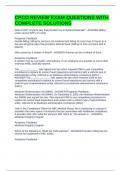
CPCO REVIEW EXAM QUESTIONS WITH
COMPLETE SOLUTIONS
What is NOT a typical way that providers try to defraud Medicaid? - ANSWER-Billing
under several NPI's at a time
Response Feedback:
Double billing, billing for services not rendered and billing for more than 24 hours in a
day are all typical ways that providers attempt fraud. (Billing for time not spent with a
patient}.
Who cannot be a violator of fraud? - ANSWER-Anyone can be a violator of fraud
Response Feedback:
A violator may be a provider, a beneficiary, or an employee of a provider or some other
business entity; basically anyone.
The ______________ was signed into law which required CMS to use competitive
procedures to replace its current fraud inspections and carriers with a uniform type of
administrative entity, referred to as Medicare administrative contractors (MAC). -
ANSWER-The ______________ was signed into law which required CMS to use
competitive procedures to replace its current fraud inspections and carriers with a
uniform type of administrative entity, referred to as Medicare administrative contractors
(MAC).
Medicare Modernization Act (MMA) - ANSWER-Response Feedback:
Medicare Modernization Act (MMA). On December 8, 2003, the Medicare Modernization
Act (MMA) was signed into law. This required CMS to use competitive procedures to
replace its current fraud inspections and carriers with a uniform type of administrative
entity, referred to as Medicare administrative contractors (MAC).
John is the Compliance Officer for ABC Medical Group. He is explaining to a group of
providers the many types of acronyms that are associated with healthcare compliance.
A provider asks John what the acronym MIP refers to. The answer is: - ANSWER-
Medicaid Integrity Program
Response Feedback:
Medicaid Integrity Program
Which of the following is TRUE per CMS website? - ANSWER-Providers billing fee-for-
service are subjected to RAC audits.
Response Feedback:
, If your practice or health care organization bills fee-for-service programs, your claims
will be subject to review by the RACs.
_________ are paid on a contingency fee basis, receiving a percentage of the improper
overpayments and underpayments they collect from providers. - ANSWER-RACs
Response Feedback:
RACs are paid on a contingency fee basis, receiving a percentage of the improper
overpayments and underpayments they collect from providers. RACs are required to
employ a staff consisting of nurses, therapists, certified coders, and a physician serving
as a certified medical director; therefore, their knowledge cannot be questioned when
performing audits.
When did the Medicare Modernization act (MMA) become a law? - ANSWER-2003
Response Feedback:
On December 8, 2003, the Medicare Modernization Act (MMA) was signed into law
Mary is the Compliance Officer for Apple Community Hospital. Mary asks the Billing
Manager to remind her of the two types of Recovery Audit Contractor (RAC) reviews.
The answer is: - ANSWER-Automated and Complex
Response Feedback:
Automated and Complex. RACs review claims on a post-payment basis by using the
same Medicare policies as carriers, fraud investigators, and MACs including NCDs,
LCDs, and CMS manuals.
There are two types of reviews:
· Automated (no medical record needed)
· Complex (medical record required)
Which statement is NOT TRUE with regard to limits of auditor record requests? -
ANSWER-Large Group (16+ individuals): 30 medical records per 45 days per NPI
Response Feedback:
A large group can have 50 medical records per 45 days per NPI requested.
What is one of the responsibilities CMS has under the Medicaid Integrity Program? -
ANSWER-To hire contractors to audit Medicaid provider claims
Response Feedback:
The MIP is the first comprehensive Federal strategy to prevent and reduce provider
fraud, waste, and abuse in the $300 billion per year Medicaid program.
RACs can look back how many years from a date of service? - ANSWER-Three
Response Feedback:
COMPLETE SOLUTIONS
What is NOT a typical way that providers try to defraud Medicaid? - ANSWER-Billing
under several NPI's at a time
Response Feedback:
Double billing, billing for services not rendered and billing for more than 24 hours in a
day are all typical ways that providers attempt fraud. (Billing for time not spent with a
patient}.
Who cannot be a violator of fraud? - ANSWER-Anyone can be a violator of fraud
Response Feedback:
A violator may be a provider, a beneficiary, or an employee of a provider or some other
business entity; basically anyone.
The ______________ was signed into law which required CMS to use competitive
procedures to replace its current fraud inspections and carriers with a uniform type of
administrative entity, referred to as Medicare administrative contractors (MAC). -
ANSWER-The ______________ was signed into law which required CMS to use
competitive procedures to replace its current fraud inspections and carriers with a
uniform type of administrative entity, referred to as Medicare administrative contractors
(MAC).
Medicare Modernization Act (MMA) - ANSWER-Response Feedback:
Medicare Modernization Act (MMA). On December 8, 2003, the Medicare Modernization
Act (MMA) was signed into law. This required CMS to use competitive procedures to
replace its current fraud inspections and carriers with a uniform type of administrative
entity, referred to as Medicare administrative contractors (MAC).
John is the Compliance Officer for ABC Medical Group. He is explaining to a group of
providers the many types of acronyms that are associated with healthcare compliance.
A provider asks John what the acronym MIP refers to. The answer is: - ANSWER-
Medicaid Integrity Program
Response Feedback:
Medicaid Integrity Program
Which of the following is TRUE per CMS website? - ANSWER-Providers billing fee-for-
service are subjected to RAC audits.
Response Feedback:
, If your practice or health care organization bills fee-for-service programs, your claims
will be subject to review by the RACs.
_________ are paid on a contingency fee basis, receiving a percentage of the improper
overpayments and underpayments they collect from providers. - ANSWER-RACs
Response Feedback:
RACs are paid on a contingency fee basis, receiving a percentage of the improper
overpayments and underpayments they collect from providers. RACs are required to
employ a staff consisting of nurses, therapists, certified coders, and a physician serving
as a certified medical director; therefore, their knowledge cannot be questioned when
performing audits.
When did the Medicare Modernization act (MMA) become a law? - ANSWER-2003
Response Feedback:
On December 8, 2003, the Medicare Modernization Act (MMA) was signed into law
Mary is the Compliance Officer for Apple Community Hospital. Mary asks the Billing
Manager to remind her of the two types of Recovery Audit Contractor (RAC) reviews.
The answer is: - ANSWER-Automated and Complex
Response Feedback:
Automated and Complex. RACs review claims on a post-payment basis by using the
same Medicare policies as carriers, fraud investigators, and MACs including NCDs,
LCDs, and CMS manuals.
There are two types of reviews:
· Automated (no medical record needed)
· Complex (medical record required)
Which statement is NOT TRUE with regard to limits of auditor record requests? -
ANSWER-Large Group (16+ individuals): 30 medical records per 45 days per NPI
Response Feedback:
A large group can have 50 medical records per 45 days per NPI requested.
What is one of the responsibilities CMS has under the Medicaid Integrity Program? -
ANSWER-To hire contractors to audit Medicaid provider claims
Response Feedback:
The MIP is the first comprehensive Federal strategy to prevent and reduce provider
fraud, waste, and abuse in the $300 billion per year Medicaid program.
RACs can look back how many years from a date of service? - ANSWER-Three
Response Feedback: