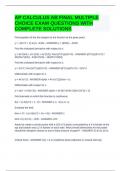
AP CALCULUS AB FINAL MULTIPLE
CHOICE EXAM QUESTIONS WITH
COMPLETE SOLUTIONS
Find equation of the line tangent to the function at the given point.
y = -3/(x^2 + 1) at (3, -3/10) - ANSWER-y = (9/50)x - 42/50
Find the indicated derivative with respect to x.
y = 5x^(5/4) + 2x^(1/3) + 4x^(1/5); Find (d^2*y)/(d*x^2) - ANSWER-(d^2*y)/(d*x^2) =
25/(16x^(3/4)) - 4/(9x^(5/3)) - 16/(25*x^(9/5))
Find the indicated derivative with respect to x.
y = 2/x^2; Find (d^2*y)/(d*x^2) - ANSWER-(d^2*y)/(d*x^2) = 12/x^4
Differentiate with respect to x.
y = 4x^(x^2) - ANSWER-dy/dx = 4x^(x^2)(2xlnx + x)
Differentiate with respect to x.
y = ln(2 + e^(3x^3)) - ANSWER-dy/dx = (e^(3x^3)*9x^2)/(e^(3x^3) + 2)
Find intervals on which the function is continuous.
f(x) = (x-2)/(x^2 + x - 6) - ANSWER-(-∞, -3)∪(-3, ∞)
Evaluate the limit.
limx->-3^- (-(x+3)/(x^2 + 5x + 6)) - ANSWER-1
limh->0 (√(2+h) - √2)/h - ANSWER-√2/4
Asked to create a movie poster with a 162 in^2 photo surrounded by a 4 in border at the
top and bottom and a 2 in border on each side. What overall dimensions for the poster
should the designer choose to use to least amount of paper? - ANSWER-13 in by 26 in.
Critical Point - ANSWER-f'(x) = 0 or undefined (and endpoints on closed interval)
, local minimum - ANSWER-f'(x) goes from - to +
local maximum - ANSWER-f'(x) goes from + to -
point of inflection - ANSWER-- concavity changes
- f''(x) goes from - to + or + to -
d/dx(xⁿ) - ANSWER-nxⁿ⁻¹
d/dx(sinx) - ANSWER-cosx
d/dx(cosx) - ANSWER--sinx
d/dx(tanx) - ANSWER-sec²x
d/dx(cotx) - ANSWER--csc²x
d/dx(secx) - ANSWER-secxtanx
d/dx(cscx) - ANSWER--cscxcotx
d/dx(lnn) - ANSWER-(1/n)(dn/dx) [w/ n acting as "u"]
d/dx(eⁿ) - ANSWER-(eⁿ)(dn/dx) [w/ n acting as "u"]
d/dx [arcsin(u/a)] - ANSWER-(1/√a²-u²)(du/dx)
d/dx[arccosx] - ANSWER--1/√1-x²
d/dx[arctan(u/a)] - ANSWER-(a/a²+u²)(du/dx)
d/dx[arccotx] - ANSWER--1/1 + x²
d/dx[arcsec(u/a)] - ANSWER-(a/|u|√u²-a²)(du/dx)
d/dx[arccscx] - ANSWER--1/|x|√x²-1
d/dx(aⁿ) - ANSWER-(aⁿ)(lna)(dn/dx) [w/ n acting as "u"]
d/dx(log₀x) - ANSWER-1/xln0 [w/ 0 acting as "a"]
Chain rule: d/dx[f(u)] - ANSWER-f'(u)(du/dx)
Product rule: d/dx(uv) - ANSWER-u'v + uv'
Quotient rule: d/dx(u/v) - ANSWER-(u'v - uv')/v²
CHOICE EXAM QUESTIONS WITH
COMPLETE SOLUTIONS
Find equation of the line tangent to the function at the given point.
y = -3/(x^2 + 1) at (3, -3/10) - ANSWER-y = (9/50)x - 42/50
Find the indicated derivative with respect to x.
y = 5x^(5/4) + 2x^(1/3) + 4x^(1/5); Find (d^2*y)/(d*x^2) - ANSWER-(d^2*y)/(d*x^2) =
25/(16x^(3/4)) - 4/(9x^(5/3)) - 16/(25*x^(9/5))
Find the indicated derivative with respect to x.
y = 2/x^2; Find (d^2*y)/(d*x^2) - ANSWER-(d^2*y)/(d*x^2) = 12/x^4
Differentiate with respect to x.
y = 4x^(x^2) - ANSWER-dy/dx = 4x^(x^2)(2xlnx + x)
Differentiate with respect to x.
y = ln(2 + e^(3x^3)) - ANSWER-dy/dx = (e^(3x^3)*9x^2)/(e^(3x^3) + 2)
Find intervals on which the function is continuous.
f(x) = (x-2)/(x^2 + x - 6) - ANSWER-(-∞, -3)∪(-3, ∞)
Evaluate the limit.
limx->-3^- (-(x+3)/(x^2 + 5x + 6)) - ANSWER-1
limh->0 (√(2+h) - √2)/h - ANSWER-√2/4
Asked to create a movie poster with a 162 in^2 photo surrounded by a 4 in border at the
top and bottom and a 2 in border on each side. What overall dimensions for the poster
should the designer choose to use to least amount of paper? - ANSWER-13 in by 26 in.
Critical Point - ANSWER-f'(x) = 0 or undefined (and endpoints on closed interval)
, local minimum - ANSWER-f'(x) goes from - to +
local maximum - ANSWER-f'(x) goes from + to -
point of inflection - ANSWER-- concavity changes
- f''(x) goes from - to + or + to -
d/dx(xⁿ) - ANSWER-nxⁿ⁻¹
d/dx(sinx) - ANSWER-cosx
d/dx(cosx) - ANSWER--sinx
d/dx(tanx) - ANSWER-sec²x
d/dx(cotx) - ANSWER--csc²x
d/dx(secx) - ANSWER-secxtanx
d/dx(cscx) - ANSWER--cscxcotx
d/dx(lnn) - ANSWER-(1/n)(dn/dx) [w/ n acting as "u"]
d/dx(eⁿ) - ANSWER-(eⁿ)(dn/dx) [w/ n acting as "u"]
d/dx [arcsin(u/a)] - ANSWER-(1/√a²-u²)(du/dx)
d/dx[arccosx] - ANSWER--1/√1-x²
d/dx[arctan(u/a)] - ANSWER-(a/a²+u²)(du/dx)
d/dx[arccotx] - ANSWER--1/1 + x²
d/dx[arcsec(u/a)] - ANSWER-(a/|u|√u²-a²)(du/dx)
d/dx[arccscx] - ANSWER--1/|x|√x²-1
d/dx(aⁿ) - ANSWER-(aⁿ)(lna)(dn/dx) [w/ n acting as "u"]
d/dx(log₀x) - ANSWER-1/xln0 [w/ 0 acting as "a"]
Chain rule: d/dx[f(u)] - ANSWER-f'(u)(du/dx)
Product rule: d/dx(uv) - ANSWER-u'v + uv'
Quotient rule: d/dx(u/v) - ANSWER-(u'v - uv')/v²