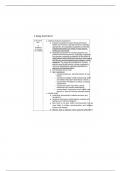
4 Study Grid Fall 22
Culture/Dive ➢ Defining Cultural competence
rsity ● Cultural competence means that professional
health care must be culturally sensitive, culturally
10
Questions appropriate, and culturally competent to meet the
ch.9 potter multifaceted health care needs of each person,
ch.4 giddens family, and community
● expected component of nursing education and
professional nursing practice. Culturally competent
care means conveying acceptance of the patient’s
health beliefs while sharing information, encouraging
self-efficacy, and strengthening the patient’s coping
resources. The scope and standards of nursing
practice specifically identify cultural competency
related to assessment, outcomes identification,
planning, and implementation.
● self-development process
● has 5 constructs:
○ cultural awareness- self-examination of own
biases
○ cultural knowledge- health professional seeks
and obtains education base about cultures
○ cultural skill- the ability to conduct a cultural
assessment
○ cultural encounter- face-face cultural
interactions (to prevent stereotyping)
○ cultural desire- motivation from a health care
person to “want to” become culturally aware.
➢ Gender roles
● masculine: achievement, material success, and
recognition
● feminine: harmonious relationships, modesty, and
taking care of others (caregiver)
● Men tend to use less verbal communication but are
more likely to initiate communication and address
issues more directly
● Women tend to disclose more personal information
, and use more active listening, answering with
responses that encourage the other person to continue
the conversation.
●
➢ Cultural influence on health
● causal beliefs about health- different explanations for
illness such as imbalance of natural, social, or
spiritual realms in addition to biomedical causes.
● illness expression- social pressure
● symptoms of illness
● taboos- not revealed to health care providers. mental
illness, suicidal thoughts, sti, social
➢ Communication -2 questions
● language barriers- use a translator blue phone
● respect model - 8 questions, respect, explanatory,
sociocultural, power, empathy, concerns and fears,
therapeutic alliance/trust
● Learn model - listen, explain, acknowledge,
recommend, negotiate
● verbal and nonverbal
➢ Culturally Competent Care
● when you provide culturally competent care- you
bridge cultural gaps to provide meaningful and
supportive care for all patients.
● effective communication is critical
➢ Cultural Congruent Care
● or transcultural care emphasizes the need to provide
care based on an individual’s cultural beliefs,
practices, and values
● culturally congruent when it fits a person’s life
patterns, values, and system of meaning. These
patterns and meanings are generated by people
themselves and not from biased, predetermined
criteria.
➢ Health Care Disparities
● as “a particular type of health difference that is
closely linked with social, economic, and/or
environmental disadvantage”
● types of disparities: poor health status, disease risk
Culture/Dive ➢ Defining Cultural competence
rsity ● Cultural competence means that professional
health care must be culturally sensitive, culturally
10
Questions appropriate, and culturally competent to meet the
ch.9 potter multifaceted health care needs of each person,
ch.4 giddens family, and community
● expected component of nursing education and
professional nursing practice. Culturally competent
care means conveying acceptance of the patient’s
health beliefs while sharing information, encouraging
self-efficacy, and strengthening the patient’s coping
resources. The scope and standards of nursing
practice specifically identify cultural competency
related to assessment, outcomes identification,
planning, and implementation.
● self-development process
● has 5 constructs:
○ cultural awareness- self-examination of own
biases
○ cultural knowledge- health professional seeks
and obtains education base about cultures
○ cultural skill- the ability to conduct a cultural
assessment
○ cultural encounter- face-face cultural
interactions (to prevent stereotyping)
○ cultural desire- motivation from a health care
person to “want to” become culturally aware.
➢ Gender roles
● masculine: achievement, material success, and
recognition
● feminine: harmonious relationships, modesty, and
taking care of others (caregiver)
● Men tend to use less verbal communication but are
more likely to initiate communication and address
issues more directly
● Women tend to disclose more personal information
, and use more active listening, answering with
responses that encourage the other person to continue
the conversation.
●
➢ Cultural influence on health
● causal beliefs about health- different explanations for
illness such as imbalance of natural, social, or
spiritual realms in addition to biomedical causes.
● illness expression- social pressure
● symptoms of illness
● taboos- not revealed to health care providers. mental
illness, suicidal thoughts, sti, social
➢ Communication -2 questions
● language barriers- use a translator blue phone
● respect model - 8 questions, respect, explanatory,
sociocultural, power, empathy, concerns and fears,
therapeutic alliance/trust
● Learn model - listen, explain, acknowledge,
recommend, negotiate
● verbal and nonverbal
➢ Culturally Competent Care
● when you provide culturally competent care- you
bridge cultural gaps to provide meaningful and
supportive care for all patients.
● effective communication is critical
➢ Cultural Congruent Care
● or transcultural care emphasizes the need to provide
care based on an individual’s cultural beliefs,
practices, and values
● culturally congruent when it fits a person’s life
patterns, values, and system of meaning. These
patterns and meanings are generated by people
themselves and not from biased, predetermined
criteria.
➢ Health Care Disparities
● as “a particular type of health difference that is
closely linked with social, economic, and/or
environmental disadvantage”
● types of disparities: poor health status, disease risk