POLARISATION
Syllabus
Transverse nature of light waves, Polarisation of electromagnetic (e.m.) waves
Plane Polarised light-production and analysis, Descriptionof linea;, circular and
elliptical polarisation.
Propagation of e.m. waves in anisotropic media, Uniaxial and biaxial Crys talk
Symmetric nature of dielectric tensor, Double refraction, Huygens' principle.
Ordinary and extraordinary refractive indices, Fresnel 's formula, Light propagation
in uniaxial crystal, Nicol prism, Procuction of circularly and elliptically polarised
light, Babinet compensator and applications, Optical rotation, Optical rotation in
liquids and its measurement through polarimeter.
4.1. Transverse Nature of Light Waves
From the phenomenon of interference and diffraction, it is
propagation oflight in a mediumis in form ofwaves. But wavesare oftwoconcluded that the
wave and transverse wave. From the phenomenon of
interference
kinds:longitudinal
and diffraction, it is not
established that whether the propagation of light is in form of
form of transverse waves because these phenomena occur for both longitudinal waves or in
transverse waves. Huygens in his wave theory assumed the light waves the longitudinal and
analogous to the sound waves. to be longitudinal
In a longitudinal wave, the medium particles
propagation of wave. If a longitudinal wave is examined execute vibrations in the direction of
through the direction of propagation of wave, the relative to the planes passing
vibrations
identical in all the planes (i.e., vibrations in all planes are of particles are seen to be
longitudinal wave is completely symmetrical about its direction identical). In other words, a
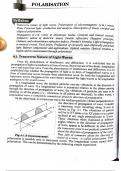
On the other hand, in a transverse wave, the of propagation.
medium particles vibrate perpendicular to
the direction of propagation of wave. Consider
X a transverse wave travelling along X-axis as
shown in Fig. 4.1. The vibrations of particle
willbe in XY plane or in XZ plane or in a plane
Inclined at any angle perpendicular to X-axis.
These vibrations when examined at different
angles relative to the direction of propagatiou
OI wave, appear to be different. n other words
Y
the transverse wave is not perfectly symmetric
about the direction of propagation ofofthe
the wave.
Fig. 4.1. A
transverse wave 1hus lack of symmetry about the direction 9J
polarisation is possible only in transverse waves.of The
travel awave, is called polarisation. 1
polarisation. This can be demonstrated by the following longitudinal waves cannot
simple experiment.
, Polarisation 215
Experinent-In Fig. 4.2, Consider two narrow rectangular slits N, and N, made in a
binsheet. A string AB passes through these slits. One end B of the string is attached with
negand by shaking the other end A along its length, longitudinal waves can be produced
hy shaking the endA in direction perpendicular to its length, transverse waves can be
produced.
N4 N2
(a) WHEN THE TWO SLITSARE PARALLEL TO EACH OTHER
B
N2
N4
(b) WHEN THE SLIT N, IS NORMAL TO THE SLIT N,
Fig. 4.2. Demonstration of polarisation of mechanical waves
Observations--Initially both the sits are kept parallel and the end Aof the string
is shaked parallel to the slit N,, we notice that the vibrations pass through the slit N,
[Fig. 4.2 (a)]. But if the end Aof the string is shaked perpendicular tothe slit Nj, we find
that these vibrations do not pass through the slit N, as shown in Fig. 4.2 (a) by the dotted
wave. If now the end A of the string is shaked parallel to the slit N, then these vibrations
pass through the slit NË and they also pass through the slit N2 when the slit N, is parallel to
theslit N as is shown in Fig. 4.2 (a). Now if the slit N, is rotated by 90° so that it becomes
normal to the slit N, we find find that the vibrations although pass through the slit N,, but
shaked in all
are stopped by the slit N, [Fig. 4.2 (b)]. Similarly, if the end A of the string is
those vibrations pass
the possible planes perpendicular to its length, we notice that only vibrations
through the slit N, and the slit N, which are parallel to them, the in all other
directions are stopped by them. shaking it along
On the other hand, if longitudinal waves are produced in the string bypositions relative
Its length, we find that the vibrations pass through the slit N2 in each ofits
to the slit N.
transverse waves
The above experiment shows that there is lack of symmetry only in
transverse waves can
and there is no lackof symmetry in longitudinal waves. Thus only the
De polarised, longitudinal wavescannot be polarised.
for transverse nature of light Waves
Bxperimental evidence
(Experimental demonstration of polarisation of light)
are transyerse. we
Experimental arrangementTo demonstrate that light waves
the above experiment. The chemical name
uSe two tourmaline crvstals in place of slits in transparent
Ortourmaline is aluminium-boron silicate. It is to light. We take two tourmaline
in its plane),
Cystals with their planes parallel to their vertical axis (i.e., axiS of eachcrystal isthrough one
Observations(1) Initially the light from a bulb S is examinedout of it which
(nearly 50%) passes
maline crystalN,, we find that only a part of lighttourmaline crystal. Now if the crysta!
SOmewhat greenish because of natural colour of the transmittedlight as shown
roated in its own plane. there is no change in the intensity of
in Fig. 4.3 (a).
Syllabus
Transverse nature of light waves, Polarisation of electromagnetic (e.m.) waves
Plane Polarised light-production and analysis, Descriptionof linea;, circular and
elliptical polarisation.
Propagation of e.m. waves in anisotropic media, Uniaxial and biaxial Crys talk
Symmetric nature of dielectric tensor, Double refraction, Huygens' principle.
Ordinary and extraordinary refractive indices, Fresnel 's formula, Light propagation
in uniaxial crystal, Nicol prism, Procuction of circularly and elliptically polarised
light, Babinet compensator and applications, Optical rotation, Optical rotation in
liquids and its measurement through polarimeter.
4.1. Transverse Nature of Light Waves
From the phenomenon of interference and diffraction, it is
propagation oflight in a mediumis in form ofwaves. But wavesare oftwoconcluded that the
wave and transverse wave. From the phenomenon of
interference
kinds:longitudinal
and diffraction, it is not
established that whether the propagation of light is in form of
form of transverse waves because these phenomena occur for both longitudinal waves or in
transverse waves. Huygens in his wave theory assumed the light waves the longitudinal and
analogous to the sound waves. to be longitudinal
In a longitudinal wave, the medium particles
propagation of wave. If a longitudinal wave is examined execute vibrations in the direction of
through the direction of propagation of wave, the relative to the planes passing
vibrations
identical in all the planes (i.e., vibrations in all planes are of particles are seen to be
longitudinal wave is completely symmetrical about its direction identical). In other words, a
On the other hand, in a transverse wave, the of propagation.
medium particles vibrate perpendicular to
the direction of propagation of wave. Consider
X a transverse wave travelling along X-axis as
shown in Fig. 4.1. The vibrations of particle
willbe in XY plane or in XZ plane or in a plane
Inclined at any angle perpendicular to X-axis.
These vibrations when examined at different
angles relative to the direction of propagatiou
OI wave, appear to be different. n other words
Y
the transverse wave is not perfectly symmetric
about the direction of propagation ofofthe
the wave.
Fig. 4.1. A
transverse wave 1hus lack of symmetry about the direction 9J
polarisation is possible only in transverse waves.of The
travel awave, is called polarisation. 1
polarisation. This can be demonstrated by the following longitudinal waves cannot
simple experiment.
, Polarisation 215
Experinent-In Fig. 4.2, Consider two narrow rectangular slits N, and N, made in a
binsheet. A string AB passes through these slits. One end B of the string is attached with
negand by shaking the other end A along its length, longitudinal waves can be produced
hy shaking the endA in direction perpendicular to its length, transverse waves can be
produced.
N4 N2
(a) WHEN THE TWO SLITSARE PARALLEL TO EACH OTHER
B
N2
N4
(b) WHEN THE SLIT N, IS NORMAL TO THE SLIT N,
Fig. 4.2. Demonstration of polarisation of mechanical waves
Observations--Initially both the sits are kept parallel and the end Aof the string
is shaked parallel to the slit N,, we notice that the vibrations pass through the slit N,
[Fig. 4.2 (a)]. But if the end Aof the string is shaked perpendicular tothe slit Nj, we find
that these vibrations do not pass through the slit N, as shown in Fig. 4.2 (a) by the dotted
wave. If now the end A of the string is shaked parallel to the slit N, then these vibrations
pass through the slit NË and they also pass through the slit N2 when the slit N, is parallel to
theslit N as is shown in Fig. 4.2 (a). Now if the slit N, is rotated by 90° so that it becomes
normal to the slit N, we find find that the vibrations although pass through the slit N,, but
shaked in all
are stopped by the slit N, [Fig. 4.2 (b)]. Similarly, if the end A of the string is
those vibrations pass
the possible planes perpendicular to its length, we notice that only vibrations
through the slit N, and the slit N, which are parallel to them, the in all other
directions are stopped by them. shaking it along
On the other hand, if longitudinal waves are produced in the string bypositions relative
Its length, we find that the vibrations pass through the slit N2 in each ofits
to the slit N.
transverse waves
The above experiment shows that there is lack of symmetry only in
transverse waves can
and there is no lackof symmetry in longitudinal waves. Thus only the
De polarised, longitudinal wavescannot be polarised.
for transverse nature of light Waves
Bxperimental evidence
(Experimental demonstration of polarisation of light)
are transyerse. we
Experimental arrangementTo demonstrate that light waves
the above experiment. The chemical name
uSe two tourmaline crvstals in place of slits in transparent
Ortourmaline is aluminium-boron silicate. It is to light. We take two tourmaline
in its plane),
Cystals with their planes parallel to their vertical axis (i.e., axiS of eachcrystal isthrough one
Observations(1) Initially the light from a bulb S is examinedout of it which
(nearly 50%) passes
maline crystalN,, we find that only a part of lighttourmaline crystal. Now if the crysta!
SOmewhat greenish because of natural colour of the transmittedlight as shown
roated in its own plane. there is no change in the intensity of
in Fig. 4.3 (a).