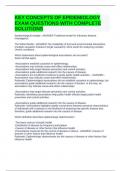
KEY CONCEPTS OF EPIDEMIOLOGY
EXAM QUESTIONS WITH COMPLETE
SOLUTIONS
Epidemiological triangle - ANSWER-Traditional model for infectious disease
investigation.
The Wheel Model - ANSWER-The multiplicity of host and environmental interactions
(multiple-causation instead of single causation). More useful for analyzing complex
chronic conditions.
Which statements about epidemiological associations are accurate?
Select all that apply.
-Associations establish causation in epidemiology.
-Associations may indicate cause-and-effect relationships.
-Associations help target disease prevention and control activities.
-Associations guide additional research into the causes of disease.
-Associations are insufficient evidence to guide public health activities. - ANSWER--
Associations may indicate cause-and-effect relationships.
Rationale: Epidemiological associations do not establish causation in epidemiology, but
associations guide additional research into the causes of disease. In this way, an
association may indicate cause-and-effect relationships.
-Associations help target disease prevention and control activities.
Rationale: Identifying associations help public health officials target public health
prevention and control activities.
-Associations guide additional research into the causes of disease.
Rationale: Associations highlight notable connections between personal characteristics
of individuals with a disease to the likelihood of acquiring that specific disease and,
therefore, guide additional research into the causes of disease.
Which definition describes epidemiologic determinants?
-The basic science of public health
-Distribution of disease by frequency and pattern
-Causes of disease or other factors that influence health
-Preventative measures for the control of disease or illness - ANSWER--Causes of
disease or other factors that influence health
Rationale: Epidemiologic determinants are the causes of disease or other factors that
influence health.
, Match the epidemiologic model of disease causation to the health event it best
represents.
1) Infectious disease outbreak in a community
2) Increase in a particular chronic condition in a community
a) Wheel model of human-environment interaction
b) Epidemiological triangle - ANSWER-1) b
2) a
What is the main purpose of epidemiologic surveillance?
-Identifies causes of disease
-Advocates for epidemiologic research
-Provides data for making public health decisions
-Builds relationships among local public health agencies - ANSWER--Provides data for
making public health decisions
Rationale: Surveillance is the purposeful and on-going acquisition, interpretation, and
synthesis of data for decision making about interventions conducted in local and
national public health programs.
Which core terms define the distribution of health events observed within a population?
Select all that apply.
-Spread
-Pattern
-Intensity
-Magnitude
-Frequency - ANSWER--Pattern
Rationale: Pattern is a defining term of epidemiologic distribution. Pattern refers to the
occurrence of health-related events by time, place, and person.
-Frequency
Rationale: Frequency is a defining term of epidemiologic distribution. It refers to the
number of health events and the relationship of that number to the size of the
population.
Match the public health functions to their branch of epidemiology.
1) Health event surveillance and monitoring
2) Investigation of causes and factors contributing to health events
a) Descriptive epidemiology
b) Analytic epidemiology - ANSWER-1) a
2) b
EXAM QUESTIONS WITH COMPLETE
SOLUTIONS
Epidemiological triangle - ANSWER-Traditional model for infectious disease
investigation.
The Wheel Model - ANSWER-The multiplicity of host and environmental interactions
(multiple-causation instead of single causation). More useful for analyzing complex
chronic conditions.
Which statements about epidemiological associations are accurate?
Select all that apply.
-Associations establish causation in epidemiology.
-Associations may indicate cause-and-effect relationships.
-Associations help target disease prevention and control activities.
-Associations guide additional research into the causes of disease.
-Associations are insufficient evidence to guide public health activities. - ANSWER--
Associations may indicate cause-and-effect relationships.
Rationale: Epidemiological associations do not establish causation in epidemiology, but
associations guide additional research into the causes of disease. In this way, an
association may indicate cause-and-effect relationships.
-Associations help target disease prevention and control activities.
Rationale: Identifying associations help public health officials target public health
prevention and control activities.
-Associations guide additional research into the causes of disease.
Rationale: Associations highlight notable connections between personal characteristics
of individuals with a disease to the likelihood of acquiring that specific disease and,
therefore, guide additional research into the causes of disease.
Which definition describes epidemiologic determinants?
-The basic science of public health
-Distribution of disease by frequency and pattern
-Causes of disease or other factors that influence health
-Preventative measures for the control of disease or illness - ANSWER--Causes of
disease or other factors that influence health
Rationale: Epidemiologic determinants are the causes of disease or other factors that
influence health.
, Match the epidemiologic model of disease causation to the health event it best
represents.
1) Infectious disease outbreak in a community
2) Increase in a particular chronic condition in a community
a) Wheel model of human-environment interaction
b) Epidemiological triangle - ANSWER-1) b
2) a
What is the main purpose of epidemiologic surveillance?
-Identifies causes of disease
-Advocates for epidemiologic research
-Provides data for making public health decisions
-Builds relationships among local public health agencies - ANSWER--Provides data for
making public health decisions
Rationale: Surveillance is the purposeful and on-going acquisition, interpretation, and
synthesis of data for decision making about interventions conducted in local and
national public health programs.
Which core terms define the distribution of health events observed within a population?
Select all that apply.
-Spread
-Pattern
-Intensity
-Magnitude
-Frequency - ANSWER--Pattern
Rationale: Pattern is a defining term of epidemiologic distribution. Pattern refers to the
occurrence of health-related events by time, place, and person.
-Frequency
Rationale: Frequency is a defining term of epidemiologic distribution. It refers to the
number of health events and the relationship of that number to the size of the
population.
Match the public health functions to their branch of epidemiology.
1) Health event surveillance and monitoring
2) Investigation of causes and factors contributing to health events
a) Descriptive epidemiology
b) Analytic epidemiology - ANSWER-1) a
2) b