EPIDEMIOLOGY FINAL EXAM
QUESTIONS AND ANSWERS
Which form of prevention takes place after the precursors of disease interact with the
host? - ANSWER-both a and B
True or False? The existence of a dose-response relationship, that is, an increase in
disease risk with an increase in the amount of exposure, does not support the view that
an association is a causal one - ANSWER-False
True or False? High firearm death rates and homicide rates are indicators of adverse
conditions within the community. - ANSWER-True
The risk of acquiring a given disease during a time period is best determined by: -
ANSWER-the incidence rate (cumulative incidence) for that disease in a given period of
time.
True or False? Calculation of the standardized mortality ratio is an example of the direct
method of age adjustment. - ANSWER-False
Successful treatment programs that would shorten the duration of a disease primarily
affect: - ANSWER-the prevalence of the disease
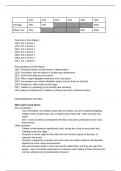
An epidemiologic survey of roller-skating injuries in Metroville, a city with a population of
100,000 (during the midpoint of the year), produced the following data for a particular
year:
The crude death rate for all causes was: - ANSWER-900/100,000 × 100,000
An epidemiologic survey of roller-skating injuries in Metroville, a city with a population of
100,000 (during the midpoint of the year), produced the following data for a particular
year:
The proportional mortality ratio (%) due to roller-skating was: - ANSWER-90/900 x 100
True or False? The crude death rate is defined as the number of deaths in a given year
divided by a reference population (during mid-point of the year) multiplied by 100,000. -
ANSWER-True
True or False? A prerequisite for using direct age adjustment is that the age-specific
death rates in the study population must be stable. - ANSWER-True
, True or False? Certain diseases can occur more than once in the same individual
during a stated period of time. Repeated cases of the disease have no effect upon
incidence rates. - ANSWER-False
True or False? The point prevalence of a disease is defined as the number of persons ill
divided by the total number in the group at a point in time. - ANSWER-True
The major disadvantage of crude rates is that: - ANSWER-they do not permit
comparison of populations that vary in composition.
True or False? The proportional mortality ratio (%) is defined as the mortality due to a
specific cause during a time period divided by the mortality due to all causes during the
same time period times 100. - ANSWER-True
True or False? One of three main purposes of descriptive epidemiology is to aid in the
creation of hypotheses. - ANSWER-True
True or False? The three categories of descriptive epidemiologic variables are person,
place, and time. - ANSWER-True
True or False? Developmental problems such as congenital birth defects occur primarily
late in life. - ANSWER-False
Which of the following reasons might account for place variation in disease? -
ANSWER-all of the above
True or False? The human biological clock phenomenon is linked to place variation in
diseases. - ANSWER-False
Cyclic variations in the occurrence of disease may reflect: - ANSWER-all of the above
True or False? WHO is a major source of information about worldwide international
variations in rates of disease. - ANSWER-True
True or False? Nativity refers to place of origin of an individual. - ANSWER-true
A null hypothesis is most similar to which of the following? - ANSWER-negative
declaration
A null hypothesis is most similar to which of the following? - ANSWER-True
Descriptive epidemiology has the following characteristics (Choose the incorrect option):
- ANSWER-allows causal inference from descriptive data
Which of Mill's four canons suggests that there is an association between frequency of
disease and the potency of a causative factor? - ANSWER-concomitant variation
QUESTIONS AND ANSWERS
Which form of prevention takes place after the precursors of disease interact with the
host? - ANSWER-both a and B
True or False? The existence of a dose-response relationship, that is, an increase in
disease risk with an increase in the amount of exposure, does not support the view that
an association is a causal one - ANSWER-False
True or False? High firearm death rates and homicide rates are indicators of adverse
conditions within the community. - ANSWER-True
The risk of acquiring a given disease during a time period is best determined by: -
ANSWER-the incidence rate (cumulative incidence) for that disease in a given period of
time.
True or False? Calculation of the standardized mortality ratio is an example of the direct
method of age adjustment. - ANSWER-False
Successful treatment programs that would shorten the duration of a disease primarily
affect: - ANSWER-the prevalence of the disease
An epidemiologic survey of roller-skating injuries in Metroville, a city with a population of
100,000 (during the midpoint of the year), produced the following data for a particular
year:
The crude death rate for all causes was: - ANSWER-900/100,000 × 100,000
An epidemiologic survey of roller-skating injuries in Metroville, a city with a population of
100,000 (during the midpoint of the year), produced the following data for a particular
year:
The proportional mortality ratio (%) due to roller-skating was: - ANSWER-90/900 x 100
True or False? The crude death rate is defined as the number of deaths in a given year
divided by a reference population (during mid-point of the year) multiplied by 100,000. -
ANSWER-True
True or False? A prerequisite for using direct age adjustment is that the age-specific
death rates in the study population must be stable. - ANSWER-True
, True or False? Certain diseases can occur more than once in the same individual
during a stated period of time. Repeated cases of the disease have no effect upon
incidence rates. - ANSWER-False
True or False? The point prevalence of a disease is defined as the number of persons ill
divided by the total number in the group at a point in time. - ANSWER-True
The major disadvantage of crude rates is that: - ANSWER-they do not permit
comparison of populations that vary in composition.
True or False? The proportional mortality ratio (%) is defined as the mortality due to a
specific cause during a time period divided by the mortality due to all causes during the
same time period times 100. - ANSWER-True
True or False? One of three main purposes of descriptive epidemiology is to aid in the
creation of hypotheses. - ANSWER-True
True or False? The three categories of descriptive epidemiologic variables are person,
place, and time. - ANSWER-True
True or False? Developmental problems such as congenital birth defects occur primarily
late in life. - ANSWER-False
Which of the following reasons might account for place variation in disease? -
ANSWER-all of the above
True or False? The human biological clock phenomenon is linked to place variation in
diseases. - ANSWER-False
Cyclic variations in the occurrence of disease may reflect: - ANSWER-all of the above
True or False? WHO is a major source of information about worldwide international
variations in rates of disease. - ANSWER-True
True or False? Nativity refers to place of origin of an individual. - ANSWER-true
A null hypothesis is most similar to which of the following? - ANSWER-negative
declaration
A null hypothesis is most similar to which of the following? - ANSWER-True
Descriptive epidemiology has the following characteristics (Choose the incorrect option):
- ANSWER-allows causal inference from descriptive data
Which of Mill's four canons suggests that there is an association between frequency of
disease and the potency of a causative factor? - ANSWER-concomitant variation