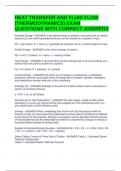
HEAT TRANSFER AND FLUID FLOW
(THERMODYNAMICS) EXAM
QUESTIONS WITH CORRECT ANSWERS
Potential Energy - ANSWER-is the stored energy of position, and exists due to vertical
distance (z) over which gravitational forces can be exerted on a system's mass.
PE = mgz where: m = mass, g = gravitational constant, and z = vertical height of mass.
Kinetic Energy - ANSWER-is the mass's energy of motion.
KE = mv^ where: m = mass, v = velocity of fluid
Flow Energy - ANSWER-is the work done by the working fluid on its surroundings as it
moves from one point to another in a system.
FE = PV where: P = pressure, V = volume
Internal Energy - ANSWER-(U) is the sum of energy in a substance. A substance
possesses several microscopic forms of energy due to rotation, vibration, translation,
and interactions among molecules of the substance.
Enthalpy (H) - ANSWER-Enthalpy is the amount of heat content used or released in a
system at constant pressure.
h = (PV + U) / m (BTU/lbm)
Second Law of Thermodynamics - ANSWER-No heat engine, actual or ideal, when
operating in a cycle can convert all the heat supplied to it into mechanical work. (i.e.,
you cannot have a 100% efficient cycle).
Entropy - ANSWER-When considering how much work can be produced with an
amount of heat, we must know the temperature at which heat is transferred in addition
to the amount of heat transfer. Entropy is a property used to describe both the amount
of heat transferred and the temperature at which it is transferred. Change in entropy is
normally defined instead of entropy itself.
Explain the General Energy Equation - ANSWER-(KE + PE + FE + U + Q)in =(KE + PE
+ FE + U + W)out + (KE + PE + FE + U)stored
Steam Tables Consist of Three Sets of Tables - ANSWER-Table 1 - Saturated Steam
Table By Temperature
Table 2 - Saturated Steam Table By Pressure
, Table 3 - Superheated Steam Table
Mollier Diagram - ANSWER-graph of enthalpy versus entropy and is a graphic
representation of the information presented in the steam tables. It is used when quality if
above 50% and for superheated steam.
Saturation Temperature - ANSWER-the temperature at which the water first begins to
evaporate into steam, while under a given pressure. Saturation is achieved when
additional heat is supplied to the water and the water evaporates into steam instead of
getting hotter.
Subcooled Liquid - ANSWER-liquid existing to the left of the saturated liquid line.
Wet Vapor - ANSWER-If a saturated liquid is heated, the liquid gradually evaporates,
forming a mixture of liquid and vapor. As long as some liquid is present, any heat added
will be used to vaporize the remaining liquid, and the temperature will not rise.
The vapor-gas mixture will move across the vapor dome from left to right. The vapor is
defined as saturated, or dry, at the point when the last of the liquid has boiled off and
become vapor.
Quality - ANSWER-Vapor Quality is the amount of vapor present in the mixture. When
the mixture is steam, it is usually refereed to as steam quality. Quality is often given as
a percentage, with a quality of 100% corresponding to saturated, or dry, steam.
Moisture Content (M) - ANSWER-M = mass of liquid / (mass of liquid + mass of vapor)
Quality (x) is defined as: x = 1-M
Superheated Vapor - ANSWER-defined as vapor heated beyond the saturated vapor
state.
Thermodynamic Cycle - ANSWER-When the working fluid of a system goes through
different changes of state, or processes, and then returns to its initial state. Thus, a
thermodynamic cycle is a recurring series so thermodynamic processes used for the
transformation of energy to produce a useful effect.
Elements of Thermodynamic Cycle - ANSWER-1. Working Fluid
2. Device to move the working fluid (pump)
3. Heat source or high temperature reservoir
4. An engine for conversion of heat energy to work (turbine)
5. A heat sink or low temp reservoir (condenser)
Adiabatic Process - ANSWER-No loss or gain of heat
Isobaric Process - ANSWER-Constant Pressure
(THERMODYNAMICS) EXAM
QUESTIONS WITH CORRECT ANSWERS
Potential Energy - ANSWER-is the stored energy of position, and exists due to vertical
distance (z) over which gravitational forces can be exerted on a system's mass.
PE = mgz where: m = mass, g = gravitational constant, and z = vertical height of mass.
Kinetic Energy - ANSWER-is the mass's energy of motion.
KE = mv^ where: m = mass, v = velocity of fluid
Flow Energy - ANSWER-is the work done by the working fluid on its surroundings as it
moves from one point to another in a system.
FE = PV where: P = pressure, V = volume
Internal Energy - ANSWER-(U) is the sum of energy in a substance. A substance
possesses several microscopic forms of energy due to rotation, vibration, translation,
and interactions among molecules of the substance.
Enthalpy (H) - ANSWER-Enthalpy is the amount of heat content used or released in a
system at constant pressure.
h = (PV + U) / m (BTU/lbm)
Second Law of Thermodynamics - ANSWER-No heat engine, actual or ideal, when
operating in a cycle can convert all the heat supplied to it into mechanical work. (i.e.,
you cannot have a 100% efficient cycle).
Entropy - ANSWER-When considering how much work can be produced with an
amount of heat, we must know the temperature at which heat is transferred in addition
to the amount of heat transfer. Entropy is a property used to describe both the amount
of heat transferred and the temperature at which it is transferred. Change in entropy is
normally defined instead of entropy itself.
Explain the General Energy Equation - ANSWER-(KE + PE + FE + U + Q)in =(KE + PE
+ FE + U + W)out + (KE + PE + FE + U)stored
Steam Tables Consist of Three Sets of Tables - ANSWER-Table 1 - Saturated Steam
Table By Temperature
Table 2 - Saturated Steam Table By Pressure
, Table 3 - Superheated Steam Table
Mollier Diagram - ANSWER-graph of enthalpy versus entropy and is a graphic
representation of the information presented in the steam tables. It is used when quality if
above 50% and for superheated steam.
Saturation Temperature - ANSWER-the temperature at which the water first begins to
evaporate into steam, while under a given pressure. Saturation is achieved when
additional heat is supplied to the water and the water evaporates into steam instead of
getting hotter.
Subcooled Liquid - ANSWER-liquid existing to the left of the saturated liquid line.
Wet Vapor - ANSWER-If a saturated liquid is heated, the liquid gradually evaporates,
forming a mixture of liquid and vapor. As long as some liquid is present, any heat added
will be used to vaporize the remaining liquid, and the temperature will not rise.
The vapor-gas mixture will move across the vapor dome from left to right. The vapor is
defined as saturated, or dry, at the point when the last of the liquid has boiled off and
become vapor.
Quality - ANSWER-Vapor Quality is the amount of vapor present in the mixture. When
the mixture is steam, it is usually refereed to as steam quality. Quality is often given as
a percentage, with a quality of 100% corresponding to saturated, or dry, steam.
Moisture Content (M) - ANSWER-M = mass of liquid / (mass of liquid + mass of vapor)
Quality (x) is defined as: x = 1-M
Superheated Vapor - ANSWER-defined as vapor heated beyond the saturated vapor
state.
Thermodynamic Cycle - ANSWER-When the working fluid of a system goes through
different changes of state, or processes, and then returns to its initial state. Thus, a
thermodynamic cycle is a recurring series so thermodynamic processes used for the
transformation of energy to produce a useful effect.
Elements of Thermodynamic Cycle - ANSWER-1. Working Fluid
2. Device to move the working fluid (pump)
3. Heat source or high temperature reservoir
4. An engine for conversion of heat energy to work (turbine)
5. A heat sink or low temp reservoir (condenser)
Adiabatic Process - ANSWER-No loss or gain of heat
Isobaric Process - ANSWER-Constant Pressure