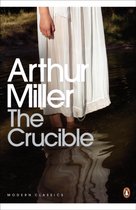
Literature Essay – The Crucible
Kate Jones
Topic:
In an article in The Observer newspaper in 2000, Arthur Miller wrote that, “more than a
political metaphor, more than a moral tale, The Crucible, as it developed over more than
a year, became a wholesome evidence of the power of human imagination inflamed, the
poetry of suggestion, and the tragedy of heroic resistance to society possessed to the
point of ruin”.
Discuss Miller’s vision of The Crucible by relating the concepts he mentions in the above
quotation, to the play as a whole.
Miller’s statement on The Crucible and its central issues is most apt. While the play does
relate to modern political issues, drawing a parallel with McCarthyism, and raise questions
on the meaning of integrity and the fine line between goodness and evil, these are not
the main concepts of The Crucible. The play focuses rather on the potency of imagination
and speculation, as well as on the ‘power of suggestion’ and assumption, and on the
courageous struggle against the court and the witch trials by members of the Salem
society. There are several reasons for Salem citizens’ beliefs in the supernatural, and
these unfounded assumptions have numerous effects. Proctor and Hale illustrate the
tragedy of their defiance against the witch trials.
The belief in witchcraft and the power of imagination lead to the loss of many innocent
lives, as well as the downfall of Salem’s theocracy. The witch trials began when Abigail,
after watching Hale forgive Tituba, confesses to “danc[ing] for the Devil” and tells him that
she “saw Sarah Good with the Devil.” As she continues to name names, Betty becomes
caught up in the excitement and accuses even more people of witchcraft. Imaginations in
Salem begin to soar. Even before Abigail started her accusations, suspicions were
aroused when the girls were discovered in the forests, and rumours formed. Many people
Kate Jones
Topic:
In an article in The Observer newspaper in 2000, Arthur Miller wrote that, “more than a
political metaphor, more than a moral tale, The Crucible, as it developed over more than
a year, became a wholesome evidence of the power of human imagination inflamed, the
poetry of suggestion, and the tragedy of heroic resistance to society possessed to the
point of ruin”.
Discuss Miller’s vision of The Crucible by relating the concepts he mentions in the above
quotation, to the play as a whole.
Miller’s statement on The Crucible and its central issues is most apt. While the play does
relate to modern political issues, drawing a parallel with McCarthyism, and raise questions
on the meaning of integrity and the fine line between goodness and evil, these are not
the main concepts of The Crucible. The play focuses rather on the potency of imagination
and speculation, as well as on the ‘power of suggestion’ and assumption, and on the
courageous struggle against the court and the witch trials by members of the Salem
society. There are several reasons for Salem citizens’ beliefs in the supernatural, and
these unfounded assumptions have numerous effects. Proctor and Hale illustrate the
tragedy of their defiance against the witch trials.
The belief in witchcraft and the power of imagination lead to the loss of many innocent
lives, as well as the downfall of Salem’s theocracy. The witch trials began when Abigail,
after watching Hale forgive Tituba, confesses to “danc[ing] for the Devil” and tells him that
she “saw Sarah Good with the Devil.” As she continues to name names, Betty becomes
caught up in the excitement and accuses even more people of witchcraft. Imaginations in
Salem begin to soar. Even before Abigail started her accusations, suspicions were
aroused when the girls were discovered in the forests, and rumours formed. Many people