

Chapter 10: Motivation and Emotion
- Motivation: A need or desire that energizes and directs behavior
o Instinct Theory
Instinct (Darwin and others)
Fixed, unlearned pattern throughout species
Genes predispose some species-typical behavior
Drive-Reduction Theory
Assumptions
o We have psychological needs
o Unmet needs create a drive
o That drive pushes the person to reduce the need
o Ex.
Need (food, water) => Drive (hunger, thirst) => Drive-reducing behaviors (eating,
drinking)
Homeostasis- maintaining the same state, wanting to keep a constant/balance
Incentive- reinforcement (positive/negative) that pulls towards a particular behavior; can
be used to maintain homeostasis
Arousal Theory
High arousal levels motivate engagement in behaviors that will lower these levels
Low arousal levels motivate activities that can increase arousal – often through curiosity
Difficult tasks with low arousal have high performance levels; easy tasks with high
arousal have high performance levels (Yerkes-Dodson law)
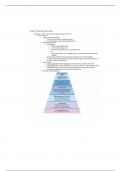
Hierarchy of Needs (Maslow)
- Motivation: A need or desire that energizes and directs behavior
o Instinct Theory
Instinct (Darwin and others)
Fixed, unlearned pattern throughout species
Genes predispose some species-typical behavior
Drive-Reduction Theory
Assumptions
o We have psychological needs
o Unmet needs create a drive
o That drive pushes the person to reduce the need
o Ex.
Need (food, water) => Drive (hunger, thirst) => Drive-reducing behaviors (eating,
drinking)
Homeostasis- maintaining the same state, wanting to keep a constant/balance
Incentive- reinforcement (positive/negative) that pulls towards a particular behavior; can
be used to maintain homeostasis
Arousal Theory
High arousal levels motivate engagement in behaviors that will lower these levels
Low arousal levels motivate activities that can increase arousal – often through curiosity
Difficult tasks with low arousal have high performance levels; easy tasks with high
arousal have high performance levels (Yerkes-Dodson law)
Hierarchy of Needs (Maslow)


