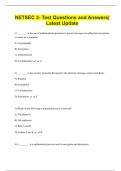
NETSEC 3- Test Questions and Answers|
Latest Update
1) ________ is the use of mathematical operations to protect messages travelling between parties
or stored on a computer.
A) Cryptography
B) Encryption
C) Authentication
D) Confidentiality A
2) ________ is the security guarantee that people who intercept messages cannot read them.
A) Integrity
B) Availability
C) Confidentiality
D) Encryption C
3) Which of the following is transmitted across a network?
A) The plaintext
B) The ciphertext
C) Both A and B
D) Neither A nor B B
4) A ________ is a mathematical process used in encryption and decryption.
,A) key
B) cipher
C) plaintext
D) coding method B
5) A ________ is a random string of 40 to 4,000 bits (ones and zeros) used to encrypt messages.
A) key
B) cipher
C) plaintext
D) code A
6) Someone who breaks encryption is called a ________.
A) cracker
B) coder
C) hacker
D) cryptanalyst D
7) ________ ciphers move letters around within a message but characters are not substituted.
A) Transposition
B) Substitution
C) Both A and B
D) Neither A nor B A
, 8) ________ ciphers leave letters in their original positions.
A) Transposition
B) Substitution
C) Both A and B
D) Neither A nor B B
9) In codes, code symbols may represent ________.
A) complete words
B) complete phrases
C) individual letters
D) All of the above D
10) When two parties communicate with each other using symmetric key encryption, how many
keys are used in total to encrypt and decrypt?
A) 1
B) 2
C) 4
D) 8 A
11) Nearly all encryption for confidentiality uses ________ encryption ciphers.
A) public key
B) symmetric key
Latest Update
1) ________ is the use of mathematical operations to protect messages travelling between parties
or stored on a computer.
A) Cryptography
B) Encryption
C) Authentication
D) Confidentiality A
2) ________ is the security guarantee that people who intercept messages cannot read them.
A) Integrity
B) Availability
C) Confidentiality
D) Encryption C
3) Which of the following is transmitted across a network?
A) The plaintext
B) The ciphertext
C) Both A and B
D) Neither A nor B B
4) A ________ is a mathematical process used in encryption and decryption.
,A) key
B) cipher
C) plaintext
D) coding method B
5) A ________ is a random string of 40 to 4,000 bits (ones and zeros) used to encrypt messages.
A) key
B) cipher
C) plaintext
D) code A
6) Someone who breaks encryption is called a ________.
A) cracker
B) coder
C) hacker
D) cryptanalyst D
7) ________ ciphers move letters around within a message but characters are not substituted.
A) Transposition
B) Substitution
C) Both A and B
D) Neither A nor B A
, 8) ________ ciphers leave letters in their original positions.
A) Transposition
B) Substitution
C) Both A and B
D) Neither A nor B B
9) In codes, code symbols may represent ________.
A) complete words
B) complete phrases
C) individual letters
D) All of the above D
10) When two parties communicate with each other using symmetric key encryption, how many
keys are used in total to encrypt and decrypt?
A) 1
B) 2
C) 4
D) 8 A
11) Nearly all encryption for confidentiality uses ________ encryption ciphers.
A) public key
B) symmetric key