NETSEC 1- Test Questions and Answers|
Latest Update
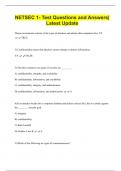
Threat environment consists of the types of attackers and attacks that companies face. T/F
TRUE
2) Confidentiality means that attackers cannot change or destroy information.
T/F FALSE
3) The three common core goals of security are ________.
A) confidentiality, integrity, and availability
B) confidentiality, information, and availability
C) confidentiality, integrity, and authentication
D) confidentiality, information, and authorization A
4) If an attacker breaks into a corporate database and deletes critical files, this is a attack against
the ________ security goal.
A) integrity
B) confidentiality
C) Both A and B
D) Neither A nor B A
5) Which of the following are types of countermeasures?
,A) Preventative
B) Detective
C) Corrective
D) All of the above D
6) When a threat succeeds in causing harm to a business, this is called a ________.
A) breach
B) compromise
C) incident
D) All of the above D
7) When a threat succeeds in causing harm to a business, this is a(n) ________.
A) breach
B) countermeasure
C) Both A and B
D) Neither A nor B A
8) Another name for safeguard is ________.
A) countermeasure
B) compromise
C) Both A and B
D) Neither A nor B A
, 9) Which of the following is a type of countermeasure?
A) Detective
B) Corrective
C) Both A and B
D) Neither A nor B C
10) Preventative countermeasures identify when a threat is attacking and especially when it is
succeeding.
T/F FALSE
11) Detective countermeasures identify when a threat is attacking and especially when it is
succeeding. TRUE
12) Detective countermeasures keep attacks from succeeding. FALSE
13) Preventative countermeasures keep attacks from succeeding. TRUE
14) Most countermeasure controls are preventative controls. TRUE
15) Most countermeasure controls are detective controls. FALSE
Latest Update
Threat environment consists of the types of attackers and attacks that companies face. T/F
TRUE
2) Confidentiality means that attackers cannot change or destroy information.
T/F FALSE
3) The three common core goals of security are ________.
A) confidentiality, integrity, and availability
B) confidentiality, information, and availability
C) confidentiality, integrity, and authentication
D) confidentiality, information, and authorization A
4) If an attacker breaks into a corporate database and deletes critical files, this is a attack against
the ________ security goal.
A) integrity
B) confidentiality
C) Both A and B
D) Neither A nor B A
5) Which of the following are types of countermeasures?
,A) Preventative
B) Detective
C) Corrective
D) All of the above D
6) When a threat succeeds in causing harm to a business, this is called a ________.
A) breach
B) compromise
C) incident
D) All of the above D
7) When a threat succeeds in causing harm to a business, this is a(n) ________.
A) breach
B) countermeasure
C) Both A and B
D) Neither A nor B A
8) Another name for safeguard is ________.
A) countermeasure
B) compromise
C) Both A and B
D) Neither A nor B A
, 9) Which of the following is a type of countermeasure?
A) Detective
B) Corrective
C) Both A and B
D) Neither A nor B C
10) Preventative countermeasures identify when a threat is attacking and especially when it is
succeeding.
T/F FALSE
11) Detective countermeasures identify when a threat is attacking and especially when it is
succeeding. TRUE
12) Detective countermeasures keep attacks from succeeding. FALSE
13) Preventative countermeasures keep attacks from succeeding. TRUE
14) Most countermeasure controls are preventative controls. TRUE
15) Most countermeasure controls are detective controls. FALSE