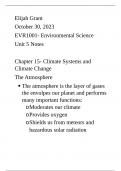
Elijah Grant
October 30, 2023
EVR1001- Environmental Science
Unit 5 Notes
Chapter 15- Climate Systems and
Climate Change
The Atmosphere
The atmosphere is the layer of gases
the envolpes our planet and performs
many important functions:
oModerates our climate
oProvides oxygen
oShields us from meteors and
hazardous solar radiation
, oTransports and recycles water and
nutrients
The atmosphere is layered
The atmosphere consists of four
layers that differ in temperature,
density, and composition.
Starting from the bottom, these layers
are the:
oTroposphere
oStratosphere
oMesosphere
oThermosphere
The troposphere is the bottom layer
containing the air we breathe and our
weather.
, oThe air gets colder with altitude,
stabilizing around –52°C at the
tropopause.
The stratosphere is much drier and
less dense than the troposphere, with
very little vertical mixing.
oThe stratosphere warms with
altitude due to absorption of
sunlight by the ozone layer.
The ozone layer protects living
organisms from UV damage from the
sun.
The mesosphere extends upward to a
height of about 85 km (53 miles)
above our planet.
Most meteors burn up in the
mesosphere.
, temperatures once again grow colder
as you rise up through the
mesosphere. The coldest temperatures
in Earth's atmosphere, about -90° C (-
130° F), are found near the top of this
layer.
The air in the mesosphere is far too
thin to breathe; air pressure at the
bottom of the layer is well below 1%
of the pressure at sea level, and
continues dropping as you go higher.
The thermosphere
oHigh-energy X-rays and UV
radiation from the Sun are
absorbed in the thermosphere,
raising its temperature to hundreds
or at times thousands of degrees.
October 30, 2023
EVR1001- Environmental Science
Unit 5 Notes
Chapter 15- Climate Systems and
Climate Change
The Atmosphere
The atmosphere is the layer of gases
the envolpes our planet and performs
many important functions:
oModerates our climate
oProvides oxygen
oShields us from meteors and
hazardous solar radiation
, oTransports and recycles water and
nutrients
The atmosphere is layered
The atmosphere consists of four
layers that differ in temperature,
density, and composition.
Starting from the bottom, these layers
are the:
oTroposphere
oStratosphere
oMesosphere
oThermosphere
The troposphere is the bottom layer
containing the air we breathe and our
weather.
, oThe air gets colder with altitude,
stabilizing around –52°C at the
tropopause.
The stratosphere is much drier and
less dense than the troposphere, with
very little vertical mixing.
oThe stratosphere warms with
altitude due to absorption of
sunlight by the ozone layer.
The ozone layer protects living
organisms from UV damage from the
sun.
The mesosphere extends upward to a
height of about 85 km (53 miles)
above our planet.
Most meteors burn up in the
mesosphere.
, temperatures once again grow colder
as you rise up through the
mesosphere. The coldest temperatures
in Earth's atmosphere, about -90° C (-
130° F), are found near the top of this
layer.
The air in the mesosphere is far too
thin to breathe; air pressure at the
bottom of the layer is well below 1%
of the pressure at sea level, and
continues dropping as you go higher.
The thermosphere
oHigh-energy X-rays and UV
radiation from the Sun are
absorbed in the thermosphere,
raising its temperature to hundreds
or at times thousands of degrees.