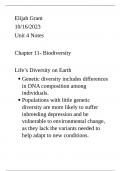
Elijah Grant
10/16/2023
Unit 4 Notes
Chapter 11- Biodiversity
Life’s Diversity on Earth
Genetic diversity includes differences
in DNA composition among
individuals.
Populations with little genetic
diversity are more likely to suffer
inbreeding depression and be
vulnerable to environmental change,
as they lack the variants needed to
help adapt to new conditions.
, Species diversity describes the
number or variety of species found in
a region.
Species richness describes the number
of species.
Evenness or relative abundance
describes how much the species differ
from each other in numbers of
individuals.
Ecosystem diversity (aka habitat
diversity) refers to the number and
variety of ecosystems, communities,
or habitats.
Biodiversity is unevenly distributed
Some groups of organisms include
more species than others.
Insects, for example, are the most
diverse group of organisms.
, Species diversity tends to decrease
with latitude and/or altitude (similar
to biomes)
Species diversity also tends to
increase in areas with more diverse
habitats, such as ecotones.
Structurally diverse habitats, like
forests, also tend to be more
biodiverse.
How many species are there?
Currently 1.7 million species
identified
Estimates range between 3 to 50
million
Recent data support an estimate of 4
to 6 million insect species alone.
, Invertebrates make up 65% of all
known species, and probably most of
yet to be discovered species.
Tropical rainforests and coral reefs
are biodiversity hotspots.
34 hotspots (1.4% of world’s land
area) contain 75% of the world’s most
threatened mammals, birds and
amphibians.
Biodiversity provides ecosystem services
Biodiversity provides the following
categories of ecosystem services
Provisioning Services
Regulating Services
Cultural Services
Supporting Services
Extinction is irreversible
10/16/2023
Unit 4 Notes
Chapter 11- Biodiversity
Life’s Diversity on Earth
Genetic diversity includes differences
in DNA composition among
individuals.
Populations with little genetic
diversity are more likely to suffer
inbreeding depression and be
vulnerable to environmental change,
as they lack the variants needed to
help adapt to new conditions.
, Species diversity describes the
number or variety of species found in
a region.
Species richness describes the number
of species.
Evenness or relative abundance
describes how much the species differ
from each other in numbers of
individuals.
Ecosystem diversity (aka habitat
diversity) refers to the number and
variety of ecosystems, communities,
or habitats.
Biodiversity is unevenly distributed
Some groups of organisms include
more species than others.
Insects, for example, are the most
diverse group of organisms.
, Species diversity tends to decrease
with latitude and/or altitude (similar
to biomes)
Species diversity also tends to
increase in areas with more diverse
habitats, such as ecotones.
Structurally diverse habitats, like
forests, also tend to be more
biodiverse.
How many species are there?
Currently 1.7 million species
identified
Estimates range between 3 to 50
million
Recent data support an estimate of 4
to 6 million insect species alone.
, Invertebrates make up 65% of all
known species, and probably most of
yet to be discovered species.
Tropical rainforests and coral reefs
are biodiversity hotspots.
34 hotspots (1.4% of world’s land
area) contain 75% of the world’s most
threatened mammals, birds and
amphibians.
Biodiversity provides ecosystem services
Biodiversity provides the following
categories of ecosystem services
Provisioning Services
Regulating Services
Cultural Services
Supporting Services
Extinction is irreversible