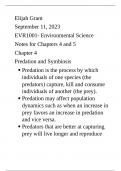
Elijah Grant
September 11, 2023
EVR1001- Environmental Science
Notes for Chapters 4 and 5
Chapter 4
Predation and Symbiosis
Predation is the process by which
individuals of one species (the
predators) capture, kill and consume
individuals of another (the prey).
Predation may affect population
dynamics such as when an increase in
prey favors an increase in predation
and vice versa.
Predators that are better at capturing
prey will live longer and reproduce
, more. Natural selection will favor
adaptions that enhance hunting.
Prey have the risk of death as a
selective pressure, causing the
evolution of many types of defenses.
Herbivores exploit plants
In herbivory, animals feed on the
tissues of plants.
oInsects are the most common
type of herbivore.
Plants have also evolved
defenses, such as toxic
chemicals, thorns, spines,
or irritating hairs.
Coevolution
Intense selection pressures between
each predator and prey populations.
, Symbiosis- interactions between two
different organisms living near each
other.
Mutualists help one another
Mutualism is a relationship where
two or more species benefit each
other.
Many mutualistic relationships
occur as part of symbiosis – a close
physical association between
species.
Others, such as in pollination, only
require free-living organisms to
encounter each other once.
oBirds or insects transfer pollen
from
flower to flower, causing
fertilization.
September 11, 2023
EVR1001- Environmental Science
Notes for Chapters 4 and 5
Chapter 4
Predation and Symbiosis
Predation is the process by which
individuals of one species (the
predators) capture, kill and consume
individuals of another (the prey).
Predation may affect population
dynamics such as when an increase in
prey favors an increase in predation
and vice versa.
Predators that are better at capturing
prey will live longer and reproduce
, more. Natural selection will favor
adaptions that enhance hunting.
Prey have the risk of death as a
selective pressure, causing the
evolution of many types of defenses.
Herbivores exploit plants
In herbivory, animals feed on the
tissues of plants.
oInsects are the most common
type of herbivore.
Plants have also evolved
defenses, such as toxic
chemicals, thorns, spines,
or irritating hairs.
Coevolution
Intense selection pressures between
each predator and prey populations.
, Symbiosis- interactions between two
different organisms living near each
other.
Mutualists help one another
Mutualism is a relationship where
two or more species benefit each
other.
Many mutualistic relationships
occur as part of symbiosis – a close
physical association between
species.
Others, such as in pollination, only
require free-living organisms to
encounter each other once.
oBirds or insects transfer pollen
from
flower to flower, causing
fertilization.