
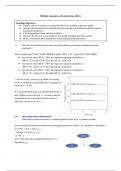
Multiple regression with interaction effects
Learning Objectives:
● Explain when you would use interaction effects in a multiple regression model.
● Interpret the parameters in a multiple regression model with interaction effects between
quantitative predictors.
● Test an hypothesis about interaction effects.
● Interpret the effect of a focal predictor in a model including interaction terms.
● Draw a conclusion about hypotheses concerning statistical interaction.
Eg Does the association between class size and academic performance depend on teacher
experience?
When explaining AP with CS and CRED this yields: ^
AP=1.75 −0.26∗CS+1.05∗CRED
● For schools with CRED = 30%, the regression equation simplifies to:
^
AP=1.75 −0.26∗CS+1.05∗30=33.25−0.26∗CS
● For schools with CRED = 50%, the regression equation simplifies to:
^
AP=1.75 −0.26∗CS+1.05∗50=54.25−0.26∗CS
● For schools with CRED = 80%, the regression equation simplifies to:
^
AP=1.75 −0.26∗CS+1.05∗80=85.75−0.26∗CS
→ In this model, intercepts (a) differ for varying
levels of CRED, but partial effect of CS remains the
same (at b = -0.26)
If we hypothesise that the association (b) between x 1
and y differs across levels of x 2, we need to add an
interaction term to our model to allow slopes to
differ for various levels of x 2
(1) Interaction effects/Moderation
When the association between 2 variables depends on the level of another variable
We can model this interaction effect by including the product of x 1and x 2 as a predictor to the model:
^y =a+b1 x 1+ b2 x 2 +b3 x 1 x 2❑
¿( a+b 2 x 2)+(b1 + b3 x2❑) x 1
¿ a '+ b ' x1
Note: both intercept and regression slope of x 1❑
depends on x 2
Learning Objectives:
● Explain when you would use interaction effects in a multiple regression model.
● Interpret the parameters in a multiple regression model with interaction effects between
quantitative predictors.
● Test an hypothesis about interaction effects.
● Interpret the effect of a focal predictor in a model including interaction terms.
● Draw a conclusion about hypotheses concerning statistical interaction.
Eg Does the association between class size and academic performance depend on teacher
experience?
When explaining AP with CS and CRED this yields: ^
AP=1.75 −0.26∗CS+1.05∗CRED
● For schools with CRED = 30%, the regression equation simplifies to:
^
AP=1.75 −0.26∗CS+1.05∗30=33.25−0.26∗CS
● For schools with CRED = 50%, the regression equation simplifies to:
^
AP=1.75 −0.26∗CS+1.05∗50=54.25−0.26∗CS
● For schools with CRED = 80%, the regression equation simplifies to:
^
AP=1.75 −0.26∗CS+1.05∗80=85.75−0.26∗CS
→ In this model, intercepts (a) differ for varying
levels of CRED, but partial effect of CS remains the
same (at b = -0.26)
If we hypothesise that the association (b) between x 1
and y differs across levels of x 2, we need to add an
interaction term to our model to allow slopes to
differ for various levels of x 2
(1) Interaction effects/Moderation
When the association between 2 variables depends on the level of another variable
We can model this interaction effect by including the product of x 1and x 2 as a predictor to the model:
^y =a+b1 x 1+ b2 x 2 +b3 x 1 x 2❑
¿( a+b 2 x 2)+(b1 + b3 x2❑) x 1
¿ a '+ b ' x1
Note: both intercept and regression slope of x 1❑
depends on x 2

