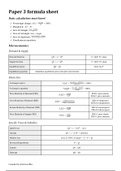
Paper 3 formula sheet
Basic calculations must-know!
X2−X1
✓ Percentage change: Δ% = X1 × 100%
✓ Marginal X: X 2 − X 1
base × height
✓ Area of triangle: 2
✓ Area of rectangle: base × height
(top+bottom) × height
✓ Area of trapezium: 2
✓ Simultaneous equations
Microeconomics
Demand & Supply
Demand function Qd = a + bP "a": shift "b": slope
Supply function Qs = c + dP "c": shift "d": slope
Equilibrium price Qd = Qs Solve for P
Equilibrium quantity Substitute equilibrium price into Qd or Qs function -
Elasticities
new price − old price
% change in price %ΔP = old price × 100%
new Qd − old Qd
% change in quantity %ΔQd = old Qd × 100%
Price Elasticity of Demand (PED) %ΔQd PED>1 price elastic
P ED = %ΔP PED<1 price inelastic
Cross Elasticity of Demand (XED) %ΔQd of good X XED>0 substitutes
X ED = %Δprice of good Y XED<0 complements
Income Elasticity of Demand (YED) %ΔQd YED>0 normal good
Y ED = %ΔY YED<0 inferior good
Price Elasticity of Supply (PES) %ΔQs PES>1 price elastic
P ES = %ΔP PES<1 price inelastic
Specific Taxes & Subsidies
Specific tax Qs = c + d (P − tax)
Subsidy Qs = c + d (P + subsidy)
1
Welfare loss area of DW L triangle = 2 ×P ×Q
Revenue/Expenditure P ×Q
Surplus Qs − Qd
Shortage Qd − Qs
Compiled by @oatsnwaffles
Basic calculations must-know!
X2−X1
✓ Percentage change: Δ% = X1 × 100%
✓ Marginal X: X 2 − X 1
base × height
✓ Area of triangle: 2
✓ Area of rectangle: base × height
(top+bottom) × height
✓ Area of trapezium: 2
✓ Simultaneous equations
Microeconomics
Demand & Supply
Demand function Qd = a + bP "a": shift "b": slope
Supply function Qs = c + dP "c": shift "d": slope
Equilibrium price Qd = Qs Solve for P
Equilibrium quantity Substitute equilibrium price into Qd or Qs function -
Elasticities
new price − old price
% change in price %ΔP = old price × 100%
new Qd − old Qd
% change in quantity %ΔQd = old Qd × 100%
Price Elasticity of Demand (PED) %ΔQd PED>1 price elastic
P ED = %ΔP PED<1 price inelastic
Cross Elasticity of Demand (XED) %ΔQd of good X XED>0 substitutes
X ED = %Δprice of good Y XED<0 complements
Income Elasticity of Demand (YED) %ΔQd YED>0 normal good
Y ED = %ΔY YED<0 inferior good
Price Elasticity of Supply (PES) %ΔQs PES>1 price elastic
P ES = %ΔP PES<1 price inelastic
Specific Taxes & Subsidies
Specific tax Qs = c + d (P − tax)
Subsidy Qs = c + d (P + subsidy)
1
Welfare loss area of DW L triangle = 2 ×P ×Q
Revenue/Expenditure P ×Q
Surplus Qs − Qd
Shortage Qd − Qs
Compiled by @oatsnwaffles