AQA A LEVEL BIOLOGY Paper 1 2025
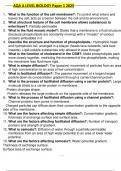
1. What is the function of the cell membrane?: To control what enters and
leaves the cell, acts as a barrier between the cell and its environment.
2. What structural feature of the cell membrane allows substances to
enter/leave?: Partially permeable
3. What is the fluid mosaic model?: States that a membrane is a fluid structure
(because phospholipids are constantly moving) with a "mosaic" of various
proteins embedded in it
4. Describe the structure and function of phospholipids.: Hydrophilic head
and hydrophobic tail, arranged in a bilayer (heads face outwards, tails face
inwards). Lipid-soluble substances only allowed to pass through.
5. What is the function of cholesterol in the CSM?: Make phospholipids pack
more closely together, restricting the movement of the phospholipids, making
the membrane less fluid/more rigid.
6. What is simple diffusion?: The (passive) movement of particles from an area
of high concentration to an area of low concentration.
7. What is facilitated diffusion?: The passive movement of a large/charged
particle down its concentration gradient through a carrier/channel protein.
8. What is the process of facilitated diffusion using a carrier protein?: Large
molecule binds to a carrier protein in membrane.
Protein changes shape.
Protein releases the large molecule on the opposite side of the membrane.
9. What is the process of facilitated diffusion using a channel protein?:
Channel proteins form pores in membrane.
Charged particles can diffuse down their concentration gradients to the opposite
side of the membrane.
10. What are the factors affecting simple diffusion?: Concentration gradient,
thickness of exchange surface and surface area.
11. What are the factors affecting facilitated diffusion?: Number of transport
proteins and strength of gradient.
12. What is osmosis?: Diffusion of water through a partially permeable
membrane from an area of high water potential to an area of lower water
potential.
13. What are the factors affecting osmosis?: Water potential gradient.
Thickness of exchange surface.
Surface area of exchange surface.
, 14. Outline a method for RP3 (investigation of osmosis using potato chips).:
Produce a series of dilutions from 1M sucrose solution (of a variety of different
concentrations, 0M, 0.2M, 0.4M, 0.6M, 0.8M, 1M).
Use a cork borer to cut potatoes into identically-sized chips.
Blot them dry with a paper towel and measure the mass of each using a mass
balance.
Place one chip into each of the sucrose solutions.
Put the test tubes into a water bath at 30°C for 20 minutes.
Take them out and reweigh the mass of the chips.
Calculate the %change in mass for each chip.
15. What is active transport?: The active process of moving molecules from an
area of low concentration to an area of high concentration using ATP.
16. Name one type of carrier protein and describe how it works.: Co-
transporters.
Bind two molecules at once.
The concentration gradient of one of the molecules is used to move the other
molecule against its own concentration gradient.
17. Give an example of co-transport in mammals.: Glucose/Na+ co-transport.
Na+ actively transported out of the ileum epithelial cells into the blood by the Na+/K+
pump. This creates a concentration gradient, higher concentration of Na+ in lumen
than inside cell.
Na+ Defuses into the epithelial cells from the lumen Na+/glucose co-transporter
proteins.
Co-transporter carries glucose into the cell with the sodium so glucose
concentration inside the cell increases.
Glucose diffuses out of the cell, down its concentration gradient, through a protein
channel, into the blood, by facilitated diffusion.
18. What are the factors affecting active transport?: Speed of individual carrier
proteins.
Number of carrier proteins present.
Rate of respiration/availability of ATP.
19. 3.2.1 Cell Structure:
20. Eukaryotic cells: Complex, include all animal and plant cells (& algal/fungal
cells).
1. What is the function of the cell membrane?: To control what enters and
leaves the cell, acts as a barrier between the cell and its environment.
2. What structural feature of the cell membrane allows substances to
enter/leave?: Partially permeable
3. What is the fluid mosaic model?: States that a membrane is a fluid structure
(because phospholipids are constantly moving) with a "mosaic" of various
proteins embedded in it
4. Describe the structure and function of phospholipids.: Hydrophilic head
and hydrophobic tail, arranged in a bilayer (heads face outwards, tails face
inwards). Lipid-soluble substances only allowed to pass through.
5. What is the function of cholesterol in the CSM?: Make phospholipids pack
more closely together, restricting the movement of the phospholipids, making
the membrane less fluid/more rigid.
6. What is simple diffusion?: The (passive) movement of particles from an area
of high concentration to an area of low concentration.
7. What is facilitated diffusion?: The passive movement of a large/charged
particle down its concentration gradient through a carrier/channel protein.
8. What is the process of facilitated diffusion using a carrier protein?: Large
molecule binds to a carrier protein in membrane.
Protein changes shape.
Protein releases the large molecule on the opposite side of the membrane.
9. What is the process of facilitated diffusion using a channel protein?:
Channel proteins form pores in membrane.
Charged particles can diffuse down their concentration gradients to the opposite
side of the membrane.
10. What are the factors affecting simple diffusion?: Concentration gradient,
thickness of exchange surface and surface area.
11. What are the factors affecting facilitated diffusion?: Number of transport
proteins and strength of gradient.
12. What is osmosis?: Diffusion of water through a partially permeable
membrane from an area of high water potential to an area of lower water
potential.
13. What are the factors affecting osmosis?: Water potential gradient.
Thickness of exchange surface.
Surface area of exchange surface.
, 14. Outline a method for RP3 (investigation of osmosis using potato chips).:
Produce a series of dilutions from 1M sucrose solution (of a variety of different
concentrations, 0M, 0.2M, 0.4M, 0.6M, 0.8M, 1M).
Use a cork borer to cut potatoes into identically-sized chips.
Blot them dry with a paper towel and measure the mass of each using a mass
balance.
Place one chip into each of the sucrose solutions.
Put the test tubes into a water bath at 30°C for 20 minutes.
Take them out and reweigh the mass of the chips.
Calculate the %change in mass for each chip.
15. What is active transport?: The active process of moving molecules from an
area of low concentration to an area of high concentration using ATP.
16. Name one type of carrier protein and describe how it works.: Co-
transporters.
Bind two molecules at once.
The concentration gradient of one of the molecules is used to move the other
molecule against its own concentration gradient.
17. Give an example of co-transport in mammals.: Glucose/Na+ co-transport.
Na+ actively transported out of the ileum epithelial cells into the blood by the Na+/K+
pump. This creates a concentration gradient, higher concentration of Na+ in lumen
than inside cell.
Na+ Defuses into the epithelial cells from the lumen Na+/glucose co-transporter
proteins.
Co-transporter carries glucose into the cell with the sodium so glucose
concentration inside the cell increases.
Glucose diffuses out of the cell, down its concentration gradient, through a protein
channel, into the blood, by facilitated diffusion.
18. What are the factors affecting active transport?: Speed of individual carrier
proteins.
Number of carrier proteins present.
Rate of respiration/availability of ATP.
19. 3.2.1 Cell Structure:
20. Eukaryotic cells: Complex, include all animal and plant cells (& algal/fungal
cells).