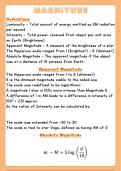
Magnitude
Definitions
Luminosity - Total amount of energy emitted as EM radiation
per second
Intensity - Total power received from obejct per unit area
on Earth (Brightness)
Apparent Magnitude - A measure of the brightness of a star
The Hipparcos scale ranged from 1 (brightest) - 6 (dimmest)
Absolute Magnitude - The apparent magnitude if the object
was at a distance of 10 parsecs from Earth
Apparent Magnitude
The Hipparcos scale ranged from 1 to 6 (dimmest)
6 is the dimmest magnitude visible to the naked eye
The scale was redefined to be logarithmic:
A magnitude 1 star is 100x more intense than Magnitude 6
A difference
1
of 1 in AM leads to a difference in intensity of
100 5 = 2.51 approx.
So the ration of Intensity can be calculated by:
The scale was extended from -30 to 30
The scale is tied to star Vega, defined as having AM of 0
Absolute Magnitude
, STARS AS BlaCK BODIES
Black Bodies
Object that emits and absorbs all wavelengths of EM
radiation
All objects emit some radiation
At room temp, this is in the infrared spectrum
As objects get hotter, they emit visible light
Wavelength is related to temperature
Stars are considered to be perfect black bodies
Black Body Curve
A graph can be plotted as they emit a continuous spectrum
They can be used to estimate a star’s temperature
Wien’s Displacement Law
As all spectra have a peak wavelength, , this can be used
to estimate the Surface temperature:
The number is Wien’s Constant
Definitions
Luminosity - Total amount of energy emitted as EM radiation
per second
Intensity - Total power received from obejct per unit area
on Earth (Brightness)
Apparent Magnitude - A measure of the brightness of a star
The Hipparcos scale ranged from 1 (brightest) - 6 (dimmest)
Absolute Magnitude - The apparent magnitude if the object
was at a distance of 10 parsecs from Earth
Apparent Magnitude
The Hipparcos scale ranged from 1 to 6 (dimmest)
6 is the dimmest magnitude visible to the naked eye
The scale was redefined to be logarithmic:
A magnitude 1 star is 100x more intense than Magnitude 6
A difference
1
of 1 in AM leads to a difference in intensity of
100 5 = 2.51 approx.
So the ration of Intensity can be calculated by:
The scale was extended from -30 to 30
The scale is tied to star Vega, defined as having AM of 0
Absolute Magnitude
, STARS AS BlaCK BODIES
Black Bodies
Object that emits and absorbs all wavelengths of EM
radiation
All objects emit some radiation
At room temp, this is in the infrared spectrum
As objects get hotter, they emit visible light
Wavelength is related to temperature
Stars are considered to be perfect black bodies
Black Body Curve
A graph can be plotted as they emit a continuous spectrum
They can be used to estimate a star’s temperature
Wien’s Displacement Law
As all spectra have a peak wavelength, , this can be used
to estimate the Surface temperature:
The number is Wien’s Constant