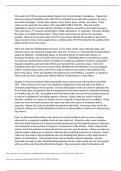
This week in HIT 205 we learned about Chapters 20, 21 and Section IV guidelines. Chapter 20,
External Causes of Morbidity codes V00-Y99 are intended to provide data necessary for injury
prevention strategies. These codes capture cause, intent, place, activity, and status. These
codes can be used with any codes in the range A00.0-T88.9, Z00-Z99. They are mostly
applicable to injuries, but also valid for infections or diseases caused by some external source.
They also have a 7th character classification ( initial, subsequent, or sequelae). They also identify
the injury or condition being treated. These codes must always be used in the secondary
position. Place of Occurrence codes Y92-Y92.9 are used to identify the location of where the
injury occurred and are only assigned once. Activity codes Y93-Y93.9 describe the activity of the
patient at the time of the injury.
There are codes for Multiple External Cause. If 2 or more events cause separate injury, and
external cause code should be assigned for each one. There is a 1st listed priority list that should
always be followed. 1) Child/Adult Abuse, 2) Terrorism Events, 3) Cataclysmic Events, 4)
Transport Accidents, and 5) all other external causes. Child/Adult Abuse is classified as assault.
For Unknown/Undetermined Intent it should be recorded as accidental if intent is unspecified.
Sequelae should be used when late effects are reported from a previous injury. Terrorism
Guidelines state that a terrorism event must be identified by the FBI before it can be assigned
(Y38.9). External Cause Status (Y99.9) are used to code the work status of the patient at the
time of the injury. These also identify if the patient was in the Military, a student, or volunteer.
These codes are N/A to poisoning, adverse effects, misadventures, or late effects.
Chapter 21 discussed Factors Influencing Health Status and Contact with Health Service (Z00-
Z99). These codes can be used in any healthcare setting and can be principle, first listed, or
secondary depending on the encounter. Contact and Exposure codes are used for patients who
do not show signs or symptoms, but are suspected to have been exposed to a particular disease
or condition (eg, an STD). Inoculations and Vaccination codes are used when a patient comes in
to receive a prophylactic inoculation against a disease. Status codes are used to indicate
whether a patient is a carrier of a disease or has a residual of a past disease or condition. These
codes are very informative because the status may affect the course of treatment and its
outcome. History (of) codes are divided into personal and family. Screening codes are for the
testing of a disease on a well individual to check for an abnormality or evidence of a disease (eg,
Pap smear).
Next, we discussed Observation codes which are used in situations when a person is being
observed for a suspected condition that has been ruled out. Aftercare codes cover situations
when the initial treatment of a disease has been performed and the patient requires continuous
care during the recovery phase or long-term consequence of the disease. These codes should
not be used if the treatment is being directed on an acute, current disease. Follow-up codes are
used to explain continuous survaelence following the completed treatment of a disease. Donor
codes are only used on living individuals who are donating their blood or other body tissue to
others, not themselves. They should not be used to identify cadaveric donation. We also
discussed Counseling codes, Obstetrical/Reproductive Service codes, which are not to be coded
with any other code from the Obstetrical chapter. There are also Z codes for Newborn and
This study source was downloaded by 100000896168064 from CourseHero.com on 02-06-2025 03:26:49 GMT -06:00
https://www.coursehero.com/file/42688295/HIT-205-WK-7-DISCUSSIONdocx/
External Causes of Morbidity codes V00-Y99 are intended to provide data necessary for injury
prevention strategies. These codes capture cause, intent, place, activity, and status. These
codes can be used with any codes in the range A00.0-T88.9, Z00-Z99. They are mostly
applicable to injuries, but also valid for infections or diseases caused by some external source.
They also have a 7th character classification ( initial, subsequent, or sequelae). They also identify
the injury or condition being treated. These codes must always be used in the secondary
position. Place of Occurrence codes Y92-Y92.9 are used to identify the location of where the
injury occurred and are only assigned once. Activity codes Y93-Y93.9 describe the activity of the
patient at the time of the injury.
There are codes for Multiple External Cause. If 2 or more events cause separate injury, and
external cause code should be assigned for each one. There is a 1st listed priority list that should
always be followed. 1) Child/Adult Abuse, 2) Terrorism Events, 3) Cataclysmic Events, 4)
Transport Accidents, and 5) all other external causes. Child/Adult Abuse is classified as assault.
For Unknown/Undetermined Intent it should be recorded as accidental if intent is unspecified.
Sequelae should be used when late effects are reported from a previous injury. Terrorism
Guidelines state that a terrorism event must be identified by the FBI before it can be assigned
(Y38.9). External Cause Status (Y99.9) are used to code the work status of the patient at the
time of the injury. These also identify if the patient was in the Military, a student, or volunteer.
These codes are N/A to poisoning, adverse effects, misadventures, or late effects.
Chapter 21 discussed Factors Influencing Health Status and Contact with Health Service (Z00-
Z99). These codes can be used in any healthcare setting and can be principle, first listed, or
secondary depending on the encounter. Contact and Exposure codes are used for patients who
do not show signs or symptoms, but are suspected to have been exposed to a particular disease
or condition (eg, an STD). Inoculations and Vaccination codes are used when a patient comes in
to receive a prophylactic inoculation against a disease. Status codes are used to indicate
whether a patient is a carrier of a disease or has a residual of a past disease or condition. These
codes are very informative because the status may affect the course of treatment and its
outcome. History (of) codes are divided into personal and family. Screening codes are for the
testing of a disease on a well individual to check for an abnormality or evidence of a disease (eg,
Pap smear).
Next, we discussed Observation codes which are used in situations when a person is being
observed for a suspected condition that has been ruled out. Aftercare codes cover situations
when the initial treatment of a disease has been performed and the patient requires continuous
care during the recovery phase or long-term consequence of the disease. These codes should
not be used if the treatment is being directed on an acute, current disease. Follow-up codes are
used to explain continuous survaelence following the completed treatment of a disease. Donor
codes are only used on living individuals who are donating their blood or other body tissue to
others, not themselves. They should not be used to identify cadaveric donation. We also
discussed Counseling codes, Obstetrical/Reproductive Service codes, which are not to be coded
with any other code from the Obstetrical chapter. There are also Z codes for Newborn and
This study source was downloaded by 100000896168064 from CourseHero.com on 02-06-2025 03:26:49 GMT -06:00
https://www.coursehero.com/file/42688295/HIT-205-WK-7-DISCUSSIONdocx/