Lecture 1: introduction (Chapter 1 and 3 of the book)
1) supply chains in the 21st century
Why integration creates value
Customers have three perspectives of value:
Economic value (traditional value): builds on economy of scale in operations as the source of efficiency.
à Quality at a low price
Market value: presenting an attractive assortment of products at the right time and place to realize
effectiveness. à convenient product/service assortment and choice.
Relevance value: involves customization of value adding services, over and above basic product characteristics
and physical location, that make a real difference to customers.
Economy value Market value Relevance value
- Lowest total cost - Attractive assortment - Customization
- Economy-of-scale efficiency - Economy-of-scope effectiveness - Segmental diversity
- Product/service creation - Product/service presentation - Product/service positioning
procurement/manufacturing market/distribution strategy Supply chain strategy
strategy
Integrated supply chain framework
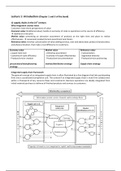
The general concept of an integrated supply chain is often illustrated by a line diagram that links participating
firms into a coordinated competitive unit. The context if an integrated supply chain is multi firm collaboration
within a framework of key resource flows and constraints. Business operations are ideally integrated from
initial material purchase to delivery of finished products and services to customers.
,Integrated supply chain frame work à Drivers and enablers:
Collaboration: Different departments need to come together in order to
work together.
- It is best for the efficiency, so specific process steps are not done
twice (like quality checks).
- A decrease of costs at one department can cause an increase of
costs at another value. The overall change for the organization will
be similar to zero!!
Within most companies the departments are not working together.
à Companies mostly don’t see the advantages of working together.
Enterprise extension: The central thrust of enterprise extensions is to
expand managerial influence and control beyond the ownership boundaries of a single enterprise to facilitate
joint planning and operations with customers and suppliers. Two basic paradigms:
- Information sharing: the widespan belief that achieving a high degree of cooperative behavior
requires that supply chain participants voluntarily share operating information and jointly plan
strategies.
- Process specialization: the commitment to focusing collaborative arrangements on planning joint
operations with a goal of eliminating nonproductive of non-value-adding redundancy by firms in a
supply chain.
Integrated (logistics) service providers:
The two traditional logistics service providers are transportation and warehousing specialties:
- Thousands of carriers who specialize in product movement between geographical locations. Over the years
a comprehensive carrier network has emerged, providing shippers a broad assortment of services, utilizing
all available forms, called modes, of transportation and related technology.
- Traditionally called public warehouses, these forms provide product storage supplemented with other
specialized services. Two significant benefits when shippers use public services:
o Elimination of capital investment in warehouse buildings
o Ability to consolidate small shipments for combined delivery with products of other firms that use
the same public warehouse.
3PL = third-party service providers: asset based firms which own and operate transportation equipment and
warehouse buildings
4PL = fourth-party service providers: non asset service firms which specialize in providing comprehensive
information services that facilitate supply chain arrangements.
,Responsive vs anticipatory business models
Anticipatory Business model
Push models à Trying to forecast the demand
Forecasting’s are always wrong!! Sometimes they are close to the actual demand,
but always wrong!
Forecast à purchase materials à manufacture à warehouse à sell à deliver
Responsive business model
Pull models à Produce as a demand is made certain
Seeks to reduce or eliminate forecast reliance by joint planning and rapid exchange of information between
supply chain participants.
Sell à Buy components/materials à manufacture à deliver
A hybrid model is a combination of both
Postponement strategies
Geographic postponement:
- Produce products and then stock them at a strategic location, you keep them in stock regardless how
expensive it is.
- For different reasons, it makes sense to have products on stock at strategic locations until something
triggers it to be used.
Example: spare parts of an airplane, they are stocked at airports and are only used in emergency’s. The costs
of an airplane at the ground are higher as having spare parts on stock
Manufacturing postponement:
- Move the CODP (customer order decoupling point) in order to lower cost. Products are less customer
specific.
- Mass-Customization…
o Is the production of personalized or
customer-tailed goods in order to
meet the diverse and ever-changing
customer preferences at almost mass
production costs?
o The postponement of logistics
functions such as distribution,
assembly, production until the latest
possible point in the supply network
Mass customization: is the best of both worlds.
, 2) Integrated logistics Management
Physical Distribution and logistics management
- Physical distribution management can be defined as that part of the supply chain process that is
concerned with the planning, control and operational activities pertaining to the flow of finished goods
into the market.
- We see physical distribution as part of the broader area of logistics management, which, in turn, is
concerned with the flows of goods, information and money among companies pursuing supply chain
management.
Logistical value proposition
Availability: the probability of having inventory to consistently meet
customer material or product requirements.
à Is the product available?
Operational Performance: deals with the time required to deliver a
customer’s order, involves speed, consistency, flexibility, malfunction
and recovery time.
à How are you managing the processes, speed, profitability’s?
Service Reliability: involves the quality attributes of logistics. The key
to quality is accurate measurement of availability and operational
performance.
Main areas of logistics work
1) Order processing:
2) Inventory: logistics systems should be designed to achieve
customer service goals while maintaining the lowest possible
financial investment in inventory, the goal is to achieve
maximum inventory turnover. A sound inventory strategy
considers five aspects of selective deployment:
- Core customer segmentation: Not all customers are equally,
prioritize and support core customers.
- Product profitability: most firms experience a substantial
variance in the volume and profitability across product lines.
(80/20 rule and Pareto principle). Product line profitability
analysis is essential in developing an effective inventory stocking strategy.
- Transportation integration: most transportation rates benefit from economy of scale: the larger the
shipment, the lower the effective transportation rate per unit. The cost savings achieved in transportation
may be more than offset the incremental inventory carrying costs.
- Time-based performance (also known as transportation lead time): A firm’s degree of commitment to
deliver products rapidly to meet customers’ requirement is a major competitive factor. An alternative for
safety stock is to receive exact and timely inventory replenishment.
- Competitor performance: when evaluating competitive pressure, a firm may choose the position
inventory in specify locations or use an expedited transportation service to gain a competitive advantage
even if such commitments increase total costs.
Each type of inventory and the level of commitment must be viewed form a total cost perspective.
à What kind of stock do you hold in your inventory? How many of each do you keep for each type? And where
do you hold them?
1) supply chains in the 21st century
Why integration creates value
Customers have three perspectives of value:
Economic value (traditional value): builds on economy of scale in operations as the source of efficiency.
à Quality at a low price
Market value: presenting an attractive assortment of products at the right time and place to realize
effectiveness. à convenient product/service assortment and choice.
Relevance value: involves customization of value adding services, over and above basic product characteristics
and physical location, that make a real difference to customers.
Economy value Market value Relevance value
- Lowest total cost - Attractive assortment - Customization
- Economy-of-scale efficiency - Economy-of-scope effectiveness - Segmental diversity
- Product/service creation - Product/service presentation - Product/service positioning
procurement/manufacturing market/distribution strategy Supply chain strategy
strategy
Integrated supply chain framework
The general concept of an integrated supply chain is often illustrated by a line diagram that links participating
firms into a coordinated competitive unit. The context if an integrated supply chain is multi firm collaboration
within a framework of key resource flows and constraints. Business operations are ideally integrated from
initial material purchase to delivery of finished products and services to customers.
,Integrated supply chain frame work à Drivers and enablers:
Collaboration: Different departments need to come together in order to
work together.
- It is best for the efficiency, so specific process steps are not done
twice (like quality checks).
- A decrease of costs at one department can cause an increase of
costs at another value. The overall change for the organization will
be similar to zero!!
Within most companies the departments are not working together.
à Companies mostly don’t see the advantages of working together.
Enterprise extension: The central thrust of enterprise extensions is to
expand managerial influence and control beyond the ownership boundaries of a single enterprise to facilitate
joint planning and operations with customers and suppliers. Two basic paradigms:
- Information sharing: the widespan belief that achieving a high degree of cooperative behavior
requires that supply chain participants voluntarily share operating information and jointly plan
strategies.
- Process specialization: the commitment to focusing collaborative arrangements on planning joint
operations with a goal of eliminating nonproductive of non-value-adding redundancy by firms in a
supply chain.
Integrated (logistics) service providers:
The two traditional logistics service providers are transportation and warehousing specialties:
- Thousands of carriers who specialize in product movement between geographical locations. Over the years
a comprehensive carrier network has emerged, providing shippers a broad assortment of services, utilizing
all available forms, called modes, of transportation and related technology.
- Traditionally called public warehouses, these forms provide product storage supplemented with other
specialized services. Two significant benefits when shippers use public services:
o Elimination of capital investment in warehouse buildings
o Ability to consolidate small shipments for combined delivery with products of other firms that use
the same public warehouse.
3PL = third-party service providers: asset based firms which own and operate transportation equipment and
warehouse buildings
4PL = fourth-party service providers: non asset service firms which specialize in providing comprehensive
information services that facilitate supply chain arrangements.
,Responsive vs anticipatory business models
Anticipatory Business model
Push models à Trying to forecast the demand
Forecasting’s are always wrong!! Sometimes they are close to the actual demand,
but always wrong!
Forecast à purchase materials à manufacture à warehouse à sell à deliver
Responsive business model
Pull models à Produce as a demand is made certain
Seeks to reduce or eliminate forecast reliance by joint planning and rapid exchange of information between
supply chain participants.
Sell à Buy components/materials à manufacture à deliver
A hybrid model is a combination of both
Postponement strategies
Geographic postponement:
- Produce products and then stock them at a strategic location, you keep them in stock regardless how
expensive it is.
- For different reasons, it makes sense to have products on stock at strategic locations until something
triggers it to be used.
Example: spare parts of an airplane, they are stocked at airports and are only used in emergency’s. The costs
of an airplane at the ground are higher as having spare parts on stock
Manufacturing postponement:
- Move the CODP (customer order decoupling point) in order to lower cost. Products are less customer
specific.
- Mass-Customization…
o Is the production of personalized or
customer-tailed goods in order to
meet the diverse and ever-changing
customer preferences at almost mass
production costs?
o The postponement of logistics
functions such as distribution,
assembly, production until the latest
possible point in the supply network
Mass customization: is the best of both worlds.
, 2) Integrated logistics Management
Physical Distribution and logistics management
- Physical distribution management can be defined as that part of the supply chain process that is
concerned with the planning, control and operational activities pertaining to the flow of finished goods
into the market.
- We see physical distribution as part of the broader area of logistics management, which, in turn, is
concerned with the flows of goods, information and money among companies pursuing supply chain
management.
Logistical value proposition
Availability: the probability of having inventory to consistently meet
customer material or product requirements.
à Is the product available?
Operational Performance: deals with the time required to deliver a
customer’s order, involves speed, consistency, flexibility, malfunction
and recovery time.
à How are you managing the processes, speed, profitability’s?
Service Reliability: involves the quality attributes of logistics. The key
to quality is accurate measurement of availability and operational
performance.
Main areas of logistics work
1) Order processing:
2) Inventory: logistics systems should be designed to achieve
customer service goals while maintaining the lowest possible
financial investment in inventory, the goal is to achieve
maximum inventory turnover. A sound inventory strategy
considers five aspects of selective deployment:
- Core customer segmentation: Not all customers are equally,
prioritize and support core customers.
- Product profitability: most firms experience a substantial
variance in the volume and profitability across product lines.
(80/20 rule and Pareto principle). Product line profitability
analysis is essential in developing an effective inventory stocking strategy.
- Transportation integration: most transportation rates benefit from economy of scale: the larger the
shipment, the lower the effective transportation rate per unit. The cost savings achieved in transportation
may be more than offset the incremental inventory carrying costs.
- Time-based performance (also known as transportation lead time): A firm’s degree of commitment to
deliver products rapidly to meet customers’ requirement is a major competitive factor. An alternative for
safety stock is to receive exact and timely inventory replenishment.
- Competitor performance: when evaluating competitive pressure, a firm may choose the position
inventory in specify locations or use an expedited transportation service to gain a competitive advantage
even if such commitments increase total costs.
Each type of inventory and the level of commitment must be viewed form a total cost perspective.
à What kind of stock do you hold in your inventory? How many of each do you keep for each type? And where
do you hold them?