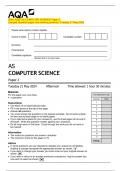
2024_AQA: AS COMPUTER SCIENCE Paper 2
(merged Question paper and marking scheme): Tuesday 21 May 2024
Please write clearly in block capitals.
Centre number Candidate number
Surname
Forename(s)
Candidate signature
I declare this is my own work.
AS
COMPUTER SCIENCE
Paper 2
Tuesday 21 May 2024 Afternoon Time allowed: 1 hour 30 minutes
Materials
For this paper you must have: For Examiner’s Use
a calculator.
Question Mark
Instructions 1
Use black ink or black ball-point pen. 2
Fill in the boxes at the top of this page. 3
Answer all questions.
4
You must answer the questions in the spaces provided. Do not write outside
the box around each page or on blank pages. 5
If you need extra space for your answer(s), use the lined pages at the end of 6
this book. Write the question number against your answer(s).
7
Do all rough work in this book. Cross through any work you do not want to
be marked. 8
9
Information 10
The marks for questions are shown in brackets.
11
The maximum mark for this paper is 75.
TOTAL
Advice
In some questions you are required to indicate your answer by completely
shading a lozenge alongside the appropriate answer as shown.
If you want to change your answer you must cross out your original answer as
shown.
If you wish to return to an answer previously crossed out, ring the answer you
now wish to select as shown.
, AS Computer Science Paper 2 - Key Areas to Revise
Paper 2 focuses on practical problem-solving, algorithmic thinking, and understanding the theoretical concepts
behind computer systems, programming, and data structures. It assesses your ability to apply theoretical
knowledge to solve complex problems using algorithms and programming techniques. Key areas to revise
include:
1. Advanced Programming Concepts:
Data Structures: Review important data structures like arrays, linked lists, stacks, queues, and trees.
Be prepared to implement and manipulate these structures in code.
Algorithms: Focus on more complex algorithms beyond basic sorting and searching. You should be
comfortable with:
o Sorting Algorithms: Quick sort, merge sort, insertion sort, and their time complexities (Big O
notation).
o Searching Algorithms: Binary search (for sorted data) and linear search.
Recursion: Algorithm Efficiency:
2. Data Representation and Structures:
Binary and Hexadecimal Representation: Be comfortable with converting between binary,
hexadecimal, and decimal systems. Understand how binary numbers are used to represent data (e.g.,
integers, floating point numbers).
Data Structures Implementation: Understand how to implement and work with more advanced data
structures, including:
o Stacks and Queues: Implementing and using stacks (LIFO) and queues (FIFO).
o Trees: Study binary trees, binary search trees, and tree traversal algorithms (in-order, pre-order,
post-order).
File Handling:
3. Problem Solving and Algorithm Design:
Developing Algorithms: Focus on developing algorithms for solving problems. Be prepared to break
down a problem into smaller steps and design a solution using appropriate algorithms.
Pseudocode and Flowcharts: Practice writing pseudocode and flowcharts to represent algorithms
Optimization
4. Software Development and Testing:
Testing and Debugging: Understand how to write and apply test cases to verify the correctness of a
program. Review common debugging techniques to locate and fix errors in code.
Error Handling & Version Control:
5. Computer Systems and Networks:
6. Databases and SQL:
7. Ethical, Legal, and Social Issues in Computing:
By focusing on these areas, you will be well-prepared for AS Computer Science Paper 2, which will test your
ability to solve complex problems, write efficient algorithms, and understand the theoretical aspects of computer
systems, programming, and data structures.
IB/G/Jun24/G4001/E11 7516/2
, 2
Do not write
outside the
Answer all questions in the spaces provided. box
0 1 . 1 Describe the set of real numbers.
[1 mark]
15
0 1 . 2 The number 5 can be written as
3
Shade two lozenges to indicate which of the following statements are true.
[2 marks]
A 15 and 3 are not integers
B 15 and 3 are irrational numbers
C 5 is an irrational number
D 5 is a natural number
E 5 is a rational number
0 1 . 3 Shade one lozenge to indicate which of the symbols below represents the set of
rational numbers.
[1 mark]
A ℂ
B ℕ
C ℚ
D ℝ
E ℤ 4
IB/G/Jun24/7516/2
, 3
Do not write
outside the
0 2 . 1 Convert the bit pattern 10001010 to hexadecimal. box
[1 mark]
0 2 . 2 Represent the decimal number 139 as an 8-bit unsigned binary integer.
[1 mark]
0 2 . 3 Show how the unsigned binary number 00100011 can be added to the unsigned
binary number 00101011 without converting the numbers into decimal.
You must show all your working in binary.
[2 marks]
0 0 1 0 0 0 1 1
+ 0 0 1 0 1 0 1 1
Question 2 continues on the next page
Turn over ►
IB/G/Jun24/7516/2
, 4
Do not write
outside the
0 2 . 4 Show how the 8-bit two’s complement binary integer 00011100 can be box
subtracted from the 8-bit two’s complement binary integer 00111011 without
converting the numbers to decimal.
You must show all your working in binary.
[2 marks]
0 2 . 5 The bit pattern in Figure 1 represents a 10-bit unsigned fixed point binary number
with four bits before and six bits after the binary point.
Figure 1
0 1 1 1 0 1 0 1 1 0
Convert the bit pattern in Figure 1 to decimal.
[2 marks]
8
IB/G/Jun24/7516/2
, 5
Do not write
outside the
0 3 . 1 State the name of the component on a sound card that transforms the continuous box
signal received from a microphone to a form that can be stored by a computer.
[1 mark]
0 3 . 2 A bitmap image is 52 pixels in height and 26 pixels in width. The bitmap
representation of the image requires 845 bytes.
Calculate the maximum number of colours that could be used in the bitmap image.
You should show all your working.
[2 marks]
0 3 . 3 When a bitmap image is stored in a file, additional information is stored as well as the
colours of the pixels. For example, the bitmap file might contain information on the
date of creation, image width and height.
State the name given to this additional information when storing a bitmap image.
[1 mark]
Question 3 continues on the next page
Turn over ►
IB/G/Jun24/7516/2
, 6
Do not write
outside the
0 3 . 4 A sound is recorded with a sample rate of 96 000 Hz and a sample resolution of box
24 bits. The file size of the recording is 12 096 kilobytes.
A sample rate of 1 Hz means that one sample has been taken every second.
Calculate the duration of the sound recording.
You should show all your working.
[3 marks]
0 3 . 5 A sample resolution of 16 bits is commonly used in audio recordings.
Explain why increasing the sample resolution from 16 bits to 24 bits can improve the
quality of an audio recording.
[1 mark]
IB/G/Jun24/7516/2
, 7
Do not write
outside the
0 3 . 6 MIDI does not use sampling to represent music. box
Describe how music is represented using MIDI.
[2 marks]
0 3 . 7 Explain one advantage of using MIDI instead of sampled sound to represent music.
[1 mark]
11
Turn over for the next question
Turn over ►
IB/G/Jun24/7516/2
, 8
Do not write
outside the
0 4 . 1 A message is encrypted using a Caesar cipher that operates with a shift value of four. box
For example, the letter A in plaintext would be represented by E in ciphertext.
The ciphertext for the message is WSSDI.
What is the plaintext for the message?
[1 mark]
0 4 . 2 Explain two reasons why Caesar ciphers are vulnerable to being cracked.
[2 marks]
3
IB/G/Jun24/7516/2
, 9
Do not write
outside the
0 5 . 1 Shade one lozenge to indicate which of the following is an example of box
system software.
[1 mark]
A Computer game
B Image editor
C Programming language translator
D Video conferencing software
E Word processor
0 5 . 2 An operating system manages hardware resources, for example the I/O devices
associated with a computer system.
State two other examples of hardware resources that an operating system is
responsible for managing.
[2 marks]
3
Turn over for the next question
Turn over ►
IB/G/Jun24/7516/2
(merged Question paper and marking scheme): Tuesday 21 May 2024
Please write clearly in block capitals.
Centre number Candidate number
Surname
Forename(s)
Candidate signature
I declare this is my own work.
AS
COMPUTER SCIENCE
Paper 2
Tuesday 21 May 2024 Afternoon Time allowed: 1 hour 30 minutes
Materials
For this paper you must have: For Examiner’s Use
a calculator.
Question Mark
Instructions 1
Use black ink or black ball-point pen. 2
Fill in the boxes at the top of this page. 3
Answer all questions.
4
You must answer the questions in the spaces provided. Do not write outside
the box around each page or on blank pages. 5
If you need extra space for your answer(s), use the lined pages at the end of 6
this book. Write the question number against your answer(s).
7
Do all rough work in this book. Cross through any work you do not want to
be marked. 8
9
Information 10
The marks for questions are shown in brackets.
11
The maximum mark for this paper is 75.
TOTAL
Advice
In some questions you are required to indicate your answer by completely
shading a lozenge alongside the appropriate answer as shown.
If you want to change your answer you must cross out your original answer as
shown.
If you wish to return to an answer previously crossed out, ring the answer you
now wish to select as shown.
, AS Computer Science Paper 2 - Key Areas to Revise
Paper 2 focuses on practical problem-solving, algorithmic thinking, and understanding the theoretical concepts
behind computer systems, programming, and data structures. It assesses your ability to apply theoretical
knowledge to solve complex problems using algorithms and programming techniques. Key areas to revise
include:
1. Advanced Programming Concepts:
Data Structures: Review important data structures like arrays, linked lists, stacks, queues, and trees.
Be prepared to implement and manipulate these structures in code.
Algorithms: Focus on more complex algorithms beyond basic sorting and searching. You should be
comfortable with:
o Sorting Algorithms: Quick sort, merge sort, insertion sort, and their time complexities (Big O
notation).
o Searching Algorithms: Binary search (for sorted data) and linear search.
Recursion: Algorithm Efficiency:
2. Data Representation and Structures:
Binary and Hexadecimal Representation: Be comfortable with converting between binary,
hexadecimal, and decimal systems. Understand how binary numbers are used to represent data (e.g.,
integers, floating point numbers).
Data Structures Implementation: Understand how to implement and work with more advanced data
structures, including:
o Stacks and Queues: Implementing and using stacks (LIFO) and queues (FIFO).
o Trees: Study binary trees, binary search trees, and tree traversal algorithms (in-order, pre-order,
post-order).
File Handling:
3. Problem Solving and Algorithm Design:
Developing Algorithms: Focus on developing algorithms for solving problems. Be prepared to break
down a problem into smaller steps and design a solution using appropriate algorithms.
Pseudocode and Flowcharts: Practice writing pseudocode and flowcharts to represent algorithms
Optimization
4. Software Development and Testing:
Testing and Debugging: Understand how to write and apply test cases to verify the correctness of a
program. Review common debugging techniques to locate and fix errors in code.
Error Handling & Version Control:
5. Computer Systems and Networks:
6. Databases and SQL:
7. Ethical, Legal, and Social Issues in Computing:
By focusing on these areas, you will be well-prepared for AS Computer Science Paper 2, which will test your
ability to solve complex problems, write efficient algorithms, and understand the theoretical aspects of computer
systems, programming, and data structures.
IB/G/Jun24/G4001/E11 7516/2
, 2
Do not write
outside the
Answer all questions in the spaces provided. box
0 1 . 1 Describe the set of real numbers.
[1 mark]
15
0 1 . 2 The number 5 can be written as
3
Shade two lozenges to indicate which of the following statements are true.
[2 marks]
A 15 and 3 are not integers
B 15 and 3 are irrational numbers
C 5 is an irrational number
D 5 is a natural number
E 5 is a rational number
0 1 . 3 Shade one lozenge to indicate which of the symbols below represents the set of
rational numbers.
[1 mark]
A ℂ
B ℕ
C ℚ
D ℝ
E ℤ 4
IB/G/Jun24/7516/2
, 3
Do not write
outside the
0 2 . 1 Convert the bit pattern 10001010 to hexadecimal. box
[1 mark]
0 2 . 2 Represent the decimal number 139 as an 8-bit unsigned binary integer.
[1 mark]
0 2 . 3 Show how the unsigned binary number 00100011 can be added to the unsigned
binary number 00101011 without converting the numbers into decimal.
You must show all your working in binary.
[2 marks]
0 0 1 0 0 0 1 1
+ 0 0 1 0 1 0 1 1
Question 2 continues on the next page
Turn over ►
IB/G/Jun24/7516/2
, 4
Do not write
outside the
0 2 . 4 Show how the 8-bit two’s complement binary integer 00011100 can be box
subtracted from the 8-bit two’s complement binary integer 00111011 without
converting the numbers to decimal.
You must show all your working in binary.
[2 marks]
0 2 . 5 The bit pattern in Figure 1 represents a 10-bit unsigned fixed point binary number
with four bits before and six bits after the binary point.
Figure 1
0 1 1 1 0 1 0 1 1 0
Convert the bit pattern in Figure 1 to decimal.
[2 marks]
8
IB/G/Jun24/7516/2
, 5
Do not write
outside the
0 3 . 1 State the name of the component on a sound card that transforms the continuous box
signal received from a microphone to a form that can be stored by a computer.
[1 mark]
0 3 . 2 A bitmap image is 52 pixels in height and 26 pixels in width. The bitmap
representation of the image requires 845 bytes.
Calculate the maximum number of colours that could be used in the bitmap image.
You should show all your working.
[2 marks]
0 3 . 3 When a bitmap image is stored in a file, additional information is stored as well as the
colours of the pixels. For example, the bitmap file might contain information on the
date of creation, image width and height.
State the name given to this additional information when storing a bitmap image.
[1 mark]
Question 3 continues on the next page
Turn over ►
IB/G/Jun24/7516/2
, 6
Do not write
outside the
0 3 . 4 A sound is recorded with a sample rate of 96 000 Hz and a sample resolution of box
24 bits. The file size of the recording is 12 096 kilobytes.
A sample rate of 1 Hz means that one sample has been taken every second.
Calculate the duration of the sound recording.
You should show all your working.
[3 marks]
0 3 . 5 A sample resolution of 16 bits is commonly used in audio recordings.
Explain why increasing the sample resolution from 16 bits to 24 bits can improve the
quality of an audio recording.
[1 mark]
IB/G/Jun24/7516/2
, 7
Do not write
outside the
0 3 . 6 MIDI does not use sampling to represent music. box
Describe how music is represented using MIDI.
[2 marks]
0 3 . 7 Explain one advantage of using MIDI instead of sampled sound to represent music.
[1 mark]
11
Turn over for the next question
Turn over ►
IB/G/Jun24/7516/2
, 8
Do not write
outside the
0 4 . 1 A message is encrypted using a Caesar cipher that operates with a shift value of four. box
For example, the letter A in plaintext would be represented by E in ciphertext.
The ciphertext for the message is WSSDI.
What is the plaintext for the message?
[1 mark]
0 4 . 2 Explain two reasons why Caesar ciphers are vulnerable to being cracked.
[2 marks]
3
IB/G/Jun24/7516/2
, 9
Do not write
outside the
0 5 . 1 Shade one lozenge to indicate which of the following is an example of box
system software.
[1 mark]
A Computer game
B Image editor
C Programming language translator
D Video conferencing software
E Word processor
0 5 . 2 An operating system manages hardware resources, for example the I/O devices
associated with a computer system.
State two other examples of hardware resources that an operating system is
responsible for managing.
[2 marks]
3
Turn over for the next question
Turn over ►
IB/G/Jun24/7516/2