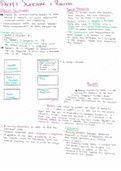
Supervised Learning
Supervised learning is one of the most fundamental and widely used types of
machine learning. In this type of learning, an algorithm is trained on labeled data,
meaning that the input data is paired with the correct output. The model learns
from these input-output pairs to make predictions on new, unseen data.
Supervised learning is particularly useful when the goal is to map input data to
specific, known outputs.
What is Supervised Learning?
Supervised learning involves training a machine learning model on a dataset
where the desired output is already known. The algorithm uses this labeled data
to learn the relationship between the input features and the target variable. Once
the model has been trained, it can predict the output for new, unseen input data.
Labeled Data: Labeled data refers to the dataset that contains both input
features (independent variables) and corresponding outputs (dependent
variables). For example, in a dataset of housing prices, the features could
include the number of rooms, square footage, and location, while the label
would be the actual price of the house.
Training Process: The training process involves feeding the algorithm the
input-output pairs and allowing it to learn the mapping between inputs and
outputs. The model is trained to minimize the error between its predicted
outputs and the actual outputs.
Types of Supervised Learning Tasks
Supervised learning can be broadly categorized into two main types of tasks:
1. Classification Classification is the task of predicting a discrete label or
category. The goal is to assign a given input to one of several predefined
categories based on its features.
, o Example: A common example of classification is spam detection in
email. The model is trained to classify emails as either "spam" or "not
spam" based on various features such as the subject line, the
sender's address, and the content of the email.
o Applications: Classification is used in various domains, including
medical diagnostics (e.g., predicting whether a patient has a certain
disease), image recognition (e.g., identifying objects in an image),
and fraud detection in finance.
2. Regression Regression involves predicting a continuous value rather than a
discrete category. The model's goal is to estimate the output based on
input features.
o Example: In predicting house prices, the model would use features
like square footage, number of bedrooms, and neighborhood to
predict the continuous value of the house's price.
o Applications: Regression is commonly used in fields like economics
(predicting stock prices), healthcare (predicting patient outcomes),
and weather forecasting (predicting temperatures or rainfall).
The Supervised Learning Process
The process of supervised learning can be broken down into several key steps:
1. Data Collection: The first step is to gather a dataset that contains input-
output pairs. This dataset should be representative of the problem you are
trying to solve.
2. Data Preprocessing: Before training the model, the data must be cleaned
and prepared. This involves handling missing values, normalizing the data
(scaling features to a consistent range), encoding categorical variables, and
splitting the dataset into training and test sets.
3. Model Selection: Once the data is ready, the next step is to choose a
suitable machine learning algorithm. Common algorithms for supervised
learning include linear regression, logistic regression, decision trees,
support vector machines (SVM), and k-nearest neighbors (KNN).
4. Model Training: The chosen algorithm is then trained on the labeled
training data. During this step, the model learns the relationships between
the input features and the corresponding outputs.
Supervised learning is one of the most fundamental and widely used types of
machine learning. In this type of learning, an algorithm is trained on labeled data,
meaning that the input data is paired with the correct output. The model learns
from these input-output pairs to make predictions on new, unseen data.
Supervised learning is particularly useful when the goal is to map input data to
specific, known outputs.
What is Supervised Learning?
Supervised learning involves training a machine learning model on a dataset
where the desired output is already known. The algorithm uses this labeled data
to learn the relationship between the input features and the target variable. Once
the model has been trained, it can predict the output for new, unseen input data.
Labeled Data: Labeled data refers to the dataset that contains both input
features (independent variables) and corresponding outputs (dependent
variables). For example, in a dataset of housing prices, the features could
include the number of rooms, square footage, and location, while the label
would be the actual price of the house.
Training Process: The training process involves feeding the algorithm the
input-output pairs and allowing it to learn the mapping between inputs and
outputs. The model is trained to minimize the error between its predicted
outputs and the actual outputs.
Types of Supervised Learning Tasks
Supervised learning can be broadly categorized into two main types of tasks:
1. Classification Classification is the task of predicting a discrete label or
category. The goal is to assign a given input to one of several predefined
categories based on its features.
, o Example: A common example of classification is spam detection in
email. The model is trained to classify emails as either "spam" or "not
spam" based on various features such as the subject line, the
sender's address, and the content of the email.
o Applications: Classification is used in various domains, including
medical diagnostics (e.g., predicting whether a patient has a certain
disease), image recognition (e.g., identifying objects in an image),
and fraud detection in finance.
2. Regression Regression involves predicting a continuous value rather than a
discrete category. The model's goal is to estimate the output based on
input features.
o Example: In predicting house prices, the model would use features
like square footage, number of bedrooms, and neighborhood to
predict the continuous value of the house's price.
o Applications: Regression is commonly used in fields like economics
(predicting stock prices), healthcare (predicting patient outcomes),
and weather forecasting (predicting temperatures or rainfall).
The Supervised Learning Process
The process of supervised learning can be broken down into several key steps:
1. Data Collection: The first step is to gather a dataset that contains input-
output pairs. This dataset should be representative of the problem you are
trying to solve.
2. Data Preprocessing: Before training the model, the data must be cleaned
and prepared. This involves handling missing values, normalizing the data
(scaling features to a consistent range), encoding categorical variables, and
splitting the dataset into training and test sets.
3. Model Selection: Once the data is ready, the next step is to choose a
suitable machine learning algorithm. Common algorithms for supervised
learning include linear regression, logistic regression, decision trees,
support vector machines (SVM), and k-nearest neighbors (KNN).
4. Model Training: The chosen algorithm is then trained on the labeled
training data. During this step, the model learns the relationships between
the input features and the corresponding outputs.