1
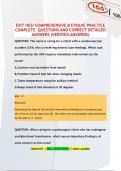
EXIT HESI COMPREHENSIVE B EVOLVE PRACTICE
COMPLETE QUESTIONS AND CORRECT DETAILED
ANSWERS (VERIFIED ANSWERS)
QUESTION: The nurse is caring for a client with a cerebrovascular
accident (CVA) who is receiving enteral tube feedings. Which task
performed by the UAP requires immediate intervention by the
nurse?
A.Suctions oral secretions from mouth
B.Positions head of bed flat when changing sheets
C.Takes temperature using the axillary method
D.Keeps head of bed elevated at 30 degrees
Ans: B
Rationale:
Positioning the head of the bed flat when enteral feedings are in progress puts
the client at risk for aspiration (B). The others are all acceptable tasks performed
by the UAP (A, C, and D).
QUESTION: When caring for a postsurgical client who has undergone
multiple blood transfusions, which serum laboratory finding is of
most concern to the nurse?
Master01 | Dec, 2024/2025 | Latest update
, 2
A.Sodium level, 137 mEq/L
B.Potassium level, 5.5 mEq/L
C.Blood urea nitrogen (BUN) level, 18 mg/dL
D.Calcium level, 10 mEq/L
Ans: B
Rationale:
Multiple blood transfusions are a risk factor for hyperkalemia. A serum potassium
level higher than 5.0 mEq/L indicates hyperkalemia (B). The others are normal
findings (A, C, and D).
QUESTION: Which vaccination should the nurse administer to a
newborn?
A.Hepatitis B
B.Human papilloma virus (HPV)
C.Varicella
D.Meningococcal vaccine
Ans: A
Rationale:
The hepatitis B vaccination should be given to all newborns before hospital
discharge (A). HPV is not recommended until adolescence (B). Varicella
Master01 | Dec, 2024/2025 | Latest update
, 3
immunization begins at 12 months (C). Meningococcal vaccine is administered
beginning at 2 years (D).
QUESTION: The nurse is caring for a client on the medical unit.
Which task can be delegated to unlicensed assistive personnel
(UAP)?
A.Assess the need to change a central line dressing.
B.Obtain a fingerstick blood glucose level.
C.Answer a family member's questions about the client's plan of
care.
D.Teach the client side effects to report related to the current
medication regimen.
Ans: B
Rationale:
Obtaining a fingerstick blood glucose level is a simple treatment and is an
appropriate skill for UAP to perform (B). (A, C, and D) are skills that cannot be
delegated to UAP.
QUESTION: The nurse is caring for a client with an ischemic stroke
who has a prescription for tissue plasminogen activator (t-PA) IV.
Master01 | Dec, 2024/2025 | Latest update
, 4
Which action(s) should the nurse expect to implement? (Select all
that apply.)
A.Administer aspirin with tissue plasminogen activator (t-PA).
B.Complete the National Institute of Health Stroke Scale (NIHSS).
C.Assess the client for signs of bleeding during and after the
infusion.
D.Start t-PA within 6 hours after the onset of stroke symptoms.
E.Initiate multidisciplinary consult for potential rehabilitation.
Ans: B,C,E
Rationale:
Neurologic assessment, including the NIHSS, is indicated for the client receiving t-
PA. This includes close monitoring for bleeding during and after the infusion; if
bleeding or other signs of neurologic impairment occur, the infusion should be
stopped (B, C, and E). Aspirin is contraindicated with t-PA because it increases the
risk for bleeding (A). The administration of t-PA within 6 hours of symptoms is
concurrent with a diagnosis of a myocardial infarction and within 4.5 hours of
symptoms is concurrent for a stroke (D).
QUESTION: When caring for a client in labor, which finding is most
important to report to the primary health care provider?
A.Maternal heart rate, 90 beats/min.
Master01 | Dec, 2024/2025 | Latest update
EXIT HESI COMPREHENSIVE B EVOLVE PRACTICE
COMPLETE QUESTIONS AND CORRECT DETAILED
ANSWERS (VERIFIED ANSWERS)
QUESTION: The nurse is caring for a client with a cerebrovascular
accident (CVA) who is receiving enteral tube feedings. Which task
performed by the UAP requires immediate intervention by the
nurse?
A.Suctions oral secretions from mouth
B.Positions head of bed flat when changing sheets
C.Takes temperature using the axillary method
D.Keeps head of bed elevated at 30 degrees
Ans: B
Rationale:
Positioning the head of the bed flat when enteral feedings are in progress puts
the client at risk for aspiration (B). The others are all acceptable tasks performed
by the UAP (A, C, and D).
QUESTION: When caring for a postsurgical client who has undergone
multiple blood transfusions, which serum laboratory finding is of
most concern to the nurse?
Master01 | Dec, 2024/2025 | Latest update
, 2
A.Sodium level, 137 mEq/L
B.Potassium level, 5.5 mEq/L
C.Blood urea nitrogen (BUN) level, 18 mg/dL
D.Calcium level, 10 mEq/L
Ans: B
Rationale:
Multiple blood transfusions are a risk factor for hyperkalemia. A serum potassium
level higher than 5.0 mEq/L indicates hyperkalemia (B). The others are normal
findings (A, C, and D).
QUESTION: Which vaccination should the nurse administer to a
newborn?
A.Hepatitis B
B.Human papilloma virus (HPV)
C.Varicella
D.Meningococcal vaccine
Ans: A
Rationale:
The hepatitis B vaccination should be given to all newborns before hospital
discharge (A). HPV is not recommended until adolescence (B). Varicella
Master01 | Dec, 2024/2025 | Latest update
, 3
immunization begins at 12 months (C). Meningococcal vaccine is administered
beginning at 2 years (D).
QUESTION: The nurse is caring for a client on the medical unit.
Which task can be delegated to unlicensed assistive personnel
(UAP)?
A.Assess the need to change a central line dressing.
B.Obtain a fingerstick blood glucose level.
C.Answer a family member's questions about the client's plan of
care.
D.Teach the client side effects to report related to the current
medication regimen.
Ans: B
Rationale:
Obtaining a fingerstick blood glucose level is a simple treatment and is an
appropriate skill for UAP to perform (B). (A, C, and D) are skills that cannot be
delegated to UAP.
QUESTION: The nurse is caring for a client with an ischemic stroke
who has a prescription for tissue plasminogen activator (t-PA) IV.
Master01 | Dec, 2024/2025 | Latest update
, 4
Which action(s) should the nurse expect to implement? (Select all
that apply.)
A.Administer aspirin with tissue plasminogen activator (t-PA).
B.Complete the National Institute of Health Stroke Scale (NIHSS).
C.Assess the client for signs of bleeding during and after the
infusion.
D.Start t-PA within 6 hours after the onset of stroke symptoms.
E.Initiate multidisciplinary consult for potential rehabilitation.
Ans: B,C,E
Rationale:
Neurologic assessment, including the NIHSS, is indicated for the client receiving t-
PA. This includes close monitoring for bleeding during and after the infusion; if
bleeding or other signs of neurologic impairment occur, the infusion should be
stopped (B, C, and E). Aspirin is contraindicated with t-PA because it increases the
risk for bleeding (A). The administration of t-PA within 6 hours of symptoms is
concurrent with a diagnosis of a myocardial infarction and within 4.5 hours of
symptoms is concurrent for a stroke (D).
QUESTION: When caring for a client in labor, which finding is most
important to report to the primary health care provider?
A.Maternal heart rate, 90 beats/min.
Master01 | Dec, 2024/2025 | Latest update