ISBN.13:97819751161002
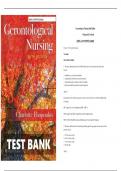
Gerontological Nursing 10th Edition
EliopoulosTest Bank
ISBN.13:9781975161002
Chapter 1 The Aging Population
Test Bank
MULTIPLE CHOICE
1. The nurse explains that in the late 1960s, health care focus was aimed at the older adult
because:
a. disability was viewed as unavoidable.
b. complications from disease increased mortality.
c. older adults needs are similar to those of all adults.
d. preventive health care practices increased longevity.
ANS: D
Increased preventive health care practices, disease control, and focus on wellness helped people
live longer.
DIF: Cognitive Level: Comprehension REF: 2 OBJ: 2
TOP: Aging Trends KEY: Nursing Process Step: Implementation
MSC: NCLEX: Health Promotion and Maintenance: Growth and Development
2. The nurse clarifies that in the terminology defining specific age groups, the term aged refers to
persons who are:
a. 55 to 64 years of age.
b. 65 to 74 years of age.
c. 75 to 84 years of age.
d. 85 and older.
ANS: C
,The term aged refers to persons who are 75 to 84 years of age. DIF: Cognitive Level: Application REF: 16 OBJ: 6
DIF: Cognitive Level: Comprehension REF: 2, Table 1-1 OBJ: 1 TOP: Legislation KEY: Nursing Process Step: Implementation
TOP: Age Categories KEY: Nursing Process Step: Implementation MSC: NCLEX: N/A
MSC: NCLEX: Health Promotion and Maintenance: Growth and Development 5. The nurse clarifies that a housing option for the older adult that offers the privacy of an
apartment with restaurant-style meals and some medical and personal care services is the:
3. The nurse cautions that ageism is a mindset that influences persons to:
a. government-subsidized housing.
a. discriminate against persons solely on the basis of age. b. long-term care facility.
b. fear aging. c. assisted-living center.
c. be culturally sensitive to concerns of aging. d. group housing plan.
d. focus on resources for the older adult.
ANS: C
ANS: A
Assisted-living arrangements offer the privacy of an apartment or condominium with meals
Ageism is a negative belief pattern that influences persons to discriminate against persons solely prepared and served, limited medical care, and a variety of personal services.
on the basis of age and can lead to destructive behaviors toward the older adult.
DIF: Cognitive Level: Application REF: 14 OBJ: 9
DIF: Cognitive Level: Comprehension REF: 5 OBJ: 3
TOP: Housing Options KEY: Nursing Process Step: Implementation
TOP: Ageism KEY: Nursing Process Step: Implementation
MSC: NCLEX: Physiological Integrity: Physiological Adaptation
MSC: NCLEX: Psychosocial Integrity: Psychosocial Adaptation
6. The 75-year-old man who has been hospitalized following a severe case of pneumonia is
4. The nurse points out that the most beneficial legislation that has influenced health care for the concerned about his mounting hospital bill and asks if his Medicare coverage will pay for his
older adult is: care. The nurses most helpful response is Yes. Medicare:
a. Medicare and Medicaid. a. pays 100% of all medical costs for persons older than 65.
b. elimination of the mandatory retirement age. b. Part B pays hospital costs and physician fees.
c. the Americans with Disabilities Act. c. Part A pays for inpatient hospital costs.
d. the Drug Benefit Program. d. Part D pays 80% of the charges made by physicians.
ANS: A ANS: C
The broadest sweeping legislation beneficial to the older adult is Medicare and Medicaid. Medicare Part A pays inpatient hospital costs, Part B pays 80% of physicians charges, and Part D
helps defray prescription drug costs.
,DIF: Cognitive Level: Application REF: 16 OBJ: 6 Loss of independence and control is a significant issue for the older adult. Some residents will
exercise whatever control they may retain.
TOP: Medicare Provisions KEY: Nursing Process Step: Implementation
DIF: Cognitive Level: Application REF: 21 OBJ: 11
MSC: NCLEX: Psychosocial Integrity: Coping and Adaptation
TOP: Loss of Independence KEY: Nursing Process Step: Implementation
7. The daughter of a patient who has been diagnosed with terminal cancer asks which documents
are required to allow her to make health care decisions for her parent. The nurses most MSC: NCLEX: Psychosocial Integrity: Coping and Adaptation
informative response is:
9. The nurse clarifies that the conditions of a living will go into effect when:
a. Advance directives indicate the degree of intervention desired by the patient.
b. A Do Not Resuscitate document signed by the patient transfers authority to the next a. the patient declares that desire in writing.
of kin. b. a family member indicates the desire for curative therapy to cease.
c. A durable power of attorney for health care transfers decision-making authority for c. two physicians agree in writing that the criteria in the living will have been met.
health care to a designated person. d. the physician and a family member agree that the criteria in the living will have
d. A living will transfers authority to the physician. been met.
ANS: C ANS: C
A durable power of attorney for health care transfers the authority for decision making to a Two physicians must agree in writing that the criteria of the living will have been met before the
designated person. document can go into effect.
DIF: Cognitive Level: Application REF: 19 OBJ: 11 DIF: Cognitive Level: Application REF: 19 OBJ: 11
TOP: Advance Directives KEY: Nursing Process Step: Implementation TOP: Living Wills KEY: Nursing Process Step: Implementation
MSC: NCLEX: Psychosocial Integrity: Coping and Adaptation MSC: NCLEX: Safe, Effective Care Environment: Coordinated Care
8. The daughter of a resident in a long-term care facility is frustrated with her 80-year-old 10. In the 1980s, Medicare initiated a program of diagnosis-related groups (DRGs) to reduce
mothers refusal to eat. The nurse explains that the refusal to eat is a behavior that is an: hospital costs by:
a. effort to maintain a portion of independence and self direction. a. classifying various diagnoses as ineligible for hospitalization.
b. indication of approaching Alzheimer disease. b. allotting a set amount of hospital days and prospective payment on the basis of the
c. effort to gain attention. admitting diagnosis.
d. indication of the dislike of the institutional food. c. specifying particular physicians to treat specified diagnoses.
d. using frequency of a particular diagnosis to set a payment schedule.
ANS: A
ANS: B
, DRGs set up a system of preset hospitalization time and payment on the basis of the admitting Medicare will cover extended-care costs for 100 days while skilled care is being applied to the
diagnosis. resident. After 100 days, the resident must revert to private pay or ancillary long-term care
insurance.
DIF: Cognitive Level: Comprehension REF: 16 OBJ: 6
DIF: Cognitive Level: Application REF: 16 OBJ: 8
TOP: DRGs KEY: Nursing Process Step: N/A MSC: NCLEX: N/A
TOP: Extended Care KEY: Nursing Process Step: Implementation
11. When discussing extended care with a patient who has had a hip replacement and needs
physical therapy, the nurse would recommend a(n): MSC: NCLEX: Safe, Effective Care Environment: Coordinated Care
a. basic care facility. 13. The senior citizen political action group that uses volunteers and lobbyists to advance the
b. skilled care facility.
interests of older adults is the:
c. subacute care facility.
d. assisted-living residence. a. American Association of Retired Persons (AARP).
b. National Council of Senior Citizens (NCSC).
ANS: B c. National Alliance of Senior Citizens (NASC).
d. Gray Panthers.
Skilled care facilities offer not only basic care but also services from trained licensed
professionals such as nurses, physical therapists, speech therapists, and occupational therapists. ANS: A
DIF: Cognitive Level: Application REF: 16 OBJ: 9 The AARP uses volunteers and lobbyists to advance the interests and welfare of older adults.
TOP: Extended-Care Facilities KEY: Nursing Process Step: Implementation DIF: Cognitive Level: Knowledge REF: 12 OBJ: 7
MSC: NCLEX: Safe, Effective Care Environment: Coordinated Care TOP: Political Action Groups KEY: Nursing Process Step: N/A
12. The 80-year-old woman who is recovering from a stroke is being sent to an extended-care MSC: NCLEX: N/A
facility. She is concerned about the expense. The nurse can allay anxiety by explaining that
Medicare will cover extended-care facility costs: 14. The nurse gives an example of the caregiver who is guilty of elder abuse as the:
a. for a period of 30 days. a. daughter who uses her mothers Social Security money to purchase her mothers
medication.
b. for a period of 45 days for physical therapy.
b. son who puts an alarm on the front door to prevent his mother from wandering out
c. for a period of 100 days for needed skilled care. of the house.
d. until she is able to be discharged home. c. wife who allows her mentally competent husband to refuse to take a bath for a
week.
ANS: C d. frail spouse who is unable to bathe or change the clothes of her physically
dependent husband.
Gerontological Nursing 10th Edition
EliopoulosTest Bank
ISBN.13:9781975161002
Chapter 1 The Aging Population
Test Bank
MULTIPLE CHOICE
1. The nurse explains that in the late 1960s, health care focus was aimed at the older adult
because:
a. disability was viewed as unavoidable.
b. complications from disease increased mortality.
c. older adults needs are similar to those of all adults.
d. preventive health care practices increased longevity.
ANS: D
Increased preventive health care practices, disease control, and focus on wellness helped people
live longer.
DIF: Cognitive Level: Comprehension REF: 2 OBJ: 2
TOP: Aging Trends KEY: Nursing Process Step: Implementation
MSC: NCLEX: Health Promotion and Maintenance: Growth and Development
2. The nurse clarifies that in the terminology defining specific age groups, the term aged refers to
persons who are:
a. 55 to 64 years of age.
b. 65 to 74 years of age.
c. 75 to 84 years of age.
d. 85 and older.
ANS: C
,The term aged refers to persons who are 75 to 84 years of age. DIF: Cognitive Level: Application REF: 16 OBJ: 6
DIF: Cognitive Level: Comprehension REF: 2, Table 1-1 OBJ: 1 TOP: Legislation KEY: Nursing Process Step: Implementation
TOP: Age Categories KEY: Nursing Process Step: Implementation MSC: NCLEX: N/A
MSC: NCLEX: Health Promotion and Maintenance: Growth and Development 5. The nurse clarifies that a housing option for the older adult that offers the privacy of an
apartment with restaurant-style meals and some medical and personal care services is the:
3. The nurse cautions that ageism is a mindset that influences persons to:
a. government-subsidized housing.
a. discriminate against persons solely on the basis of age. b. long-term care facility.
b. fear aging. c. assisted-living center.
c. be culturally sensitive to concerns of aging. d. group housing plan.
d. focus on resources for the older adult.
ANS: C
ANS: A
Assisted-living arrangements offer the privacy of an apartment or condominium with meals
Ageism is a negative belief pattern that influences persons to discriminate against persons solely prepared and served, limited medical care, and a variety of personal services.
on the basis of age and can lead to destructive behaviors toward the older adult.
DIF: Cognitive Level: Application REF: 14 OBJ: 9
DIF: Cognitive Level: Comprehension REF: 5 OBJ: 3
TOP: Housing Options KEY: Nursing Process Step: Implementation
TOP: Ageism KEY: Nursing Process Step: Implementation
MSC: NCLEX: Physiological Integrity: Physiological Adaptation
MSC: NCLEX: Psychosocial Integrity: Psychosocial Adaptation
6. The 75-year-old man who has been hospitalized following a severe case of pneumonia is
4. The nurse points out that the most beneficial legislation that has influenced health care for the concerned about his mounting hospital bill and asks if his Medicare coverage will pay for his
older adult is: care. The nurses most helpful response is Yes. Medicare:
a. Medicare and Medicaid. a. pays 100% of all medical costs for persons older than 65.
b. elimination of the mandatory retirement age. b. Part B pays hospital costs and physician fees.
c. the Americans with Disabilities Act. c. Part A pays for inpatient hospital costs.
d. the Drug Benefit Program. d. Part D pays 80% of the charges made by physicians.
ANS: A ANS: C
The broadest sweeping legislation beneficial to the older adult is Medicare and Medicaid. Medicare Part A pays inpatient hospital costs, Part B pays 80% of physicians charges, and Part D
helps defray prescription drug costs.
,DIF: Cognitive Level: Application REF: 16 OBJ: 6 Loss of independence and control is a significant issue for the older adult. Some residents will
exercise whatever control they may retain.
TOP: Medicare Provisions KEY: Nursing Process Step: Implementation
DIF: Cognitive Level: Application REF: 21 OBJ: 11
MSC: NCLEX: Psychosocial Integrity: Coping and Adaptation
TOP: Loss of Independence KEY: Nursing Process Step: Implementation
7. The daughter of a patient who has been diagnosed with terminal cancer asks which documents
are required to allow her to make health care decisions for her parent. The nurses most MSC: NCLEX: Psychosocial Integrity: Coping and Adaptation
informative response is:
9. The nurse clarifies that the conditions of a living will go into effect when:
a. Advance directives indicate the degree of intervention desired by the patient.
b. A Do Not Resuscitate document signed by the patient transfers authority to the next a. the patient declares that desire in writing.
of kin. b. a family member indicates the desire for curative therapy to cease.
c. A durable power of attorney for health care transfers decision-making authority for c. two physicians agree in writing that the criteria in the living will have been met.
health care to a designated person. d. the physician and a family member agree that the criteria in the living will have
d. A living will transfers authority to the physician. been met.
ANS: C ANS: C
A durable power of attorney for health care transfers the authority for decision making to a Two physicians must agree in writing that the criteria of the living will have been met before the
designated person. document can go into effect.
DIF: Cognitive Level: Application REF: 19 OBJ: 11 DIF: Cognitive Level: Application REF: 19 OBJ: 11
TOP: Advance Directives KEY: Nursing Process Step: Implementation TOP: Living Wills KEY: Nursing Process Step: Implementation
MSC: NCLEX: Psychosocial Integrity: Coping and Adaptation MSC: NCLEX: Safe, Effective Care Environment: Coordinated Care
8. The daughter of a resident in a long-term care facility is frustrated with her 80-year-old 10. In the 1980s, Medicare initiated a program of diagnosis-related groups (DRGs) to reduce
mothers refusal to eat. The nurse explains that the refusal to eat is a behavior that is an: hospital costs by:
a. effort to maintain a portion of independence and self direction. a. classifying various diagnoses as ineligible for hospitalization.
b. indication of approaching Alzheimer disease. b. allotting a set amount of hospital days and prospective payment on the basis of the
c. effort to gain attention. admitting diagnosis.
d. indication of the dislike of the institutional food. c. specifying particular physicians to treat specified diagnoses.
d. using frequency of a particular diagnosis to set a payment schedule.
ANS: A
ANS: B
, DRGs set up a system of preset hospitalization time and payment on the basis of the admitting Medicare will cover extended-care costs for 100 days while skilled care is being applied to the
diagnosis. resident. After 100 days, the resident must revert to private pay or ancillary long-term care
insurance.
DIF: Cognitive Level: Comprehension REF: 16 OBJ: 6
DIF: Cognitive Level: Application REF: 16 OBJ: 8
TOP: DRGs KEY: Nursing Process Step: N/A MSC: NCLEX: N/A
TOP: Extended Care KEY: Nursing Process Step: Implementation
11. When discussing extended care with a patient who has had a hip replacement and needs
physical therapy, the nurse would recommend a(n): MSC: NCLEX: Safe, Effective Care Environment: Coordinated Care
a. basic care facility. 13. The senior citizen political action group that uses volunteers and lobbyists to advance the
b. skilled care facility.
interests of older adults is the:
c. subacute care facility.
d. assisted-living residence. a. American Association of Retired Persons (AARP).
b. National Council of Senior Citizens (NCSC).
ANS: B c. National Alliance of Senior Citizens (NASC).
d. Gray Panthers.
Skilled care facilities offer not only basic care but also services from trained licensed
professionals such as nurses, physical therapists, speech therapists, and occupational therapists. ANS: A
DIF: Cognitive Level: Application REF: 16 OBJ: 9 The AARP uses volunteers and lobbyists to advance the interests and welfare of older adults.
TOP: Extended-Care Facilities KEY: Nursing Process Step: Implementation DIF: Cognitive Level: Knowledge REF: 12 OBJ: 7
MSC: NCLEX: Safe, Effective Care Environment: Coordinated Care TOP: Political Action Groups KEY: Nursing Process Step: N/A
12. The 80-year-old woman who is recovering from a stroke is being sent to an extended-care MSC: NCLEX: N/A
facility. She is concerned about the expense. The nurse can allay anxiety by explaining that
Medicare will cover extended-care facility costs: 14. The nurse gives an example of the caregiver who is guilty of elder abuse as the:
a. for a period of 30 days. a. daughter who uses her mothers Social Security money to purchase her mothers
medication.
b. for a period of 45 days for physical therapy.
b. son who puts an alarm on the front door to prevent his mother from wandering out
c. for a period of 100 days for needed skilled care. of the house.
d. until she is able to be discharged home. c. wife who allows her mentally competent husband to refuse to take a bath for a
week.
ANS: C d. frail spouse who is unable to bathe or change the clothes of her physically
dependent husband.