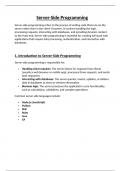
Server-Side Programming
Server-side programming refers to the process of writing code that runs on the
server rather than in the client’s browser. It involves handling the logic,
processing requests, interacting with databases, and providing dynamic content
to the front-end. Server-side programming is essential for creating full-stack web
applications that require data processing, authentication, and interaction with
databases.
1. Introduction to Server-Side Programming
Server-side programming is responsible for:
Handling client requests: The server listens for requests from clients
(usually a web browser or mobile app), processes those requests, and sends
back responses.
Interacting with databases: The server queries, inserts, updates, or deletes
data in databases to store or retrieve information.
Business logic: The server processes the application’s core functionality,
such as calculations, validations, and complex operations.
Common server-side languages include:
Node.js (JavaScript)
Python
PHP
Ruby
Java
C#
, 2. Server-Side Scripting Languages
Server-side scripting languages are used to create dynamic web pages that
interact with databases, process input from users, and generate content on the
fly.
1. Node.js (JavaScript)
Overview: Node.js is a runtime environment that allows you to run
JavaScript on the server side.
Why use Node.js?:
o Non-blocking, event-driven architecture makes it suitable for real-
time applications.
o It uses JavaScript, which is popular for both front-end and back-end
development.
Popular Frameworks:
o Express.js: Minimal and flexible Node.js web application framework.
o NestJS: A framework for building scalable server-side applications.
Example:
const express = require('express');
const app = express();
app.get('/', (req, res) => {
res.send('Hello World!');
});
app.listen(3000, () => console.log('Server running on port 3000'));
2. Python
Overview: Python is a versatile language that can be used for back-end
development, especially for building scalable, secure web applications.
Popular Frameworks:
o Django: A high-level Python web framework that emphasizes rapid
development and clean, pragmatic design.
o Flask: A micro-framework that is lightweight and easy to use for
small to medium applications.
Server-side programming refers to the process of writing code that runs on the
server rather than in the client’s browser. It involves handling the logic,
processing requests, interacting with databases, and providing dynamic content
to the front-end. Server-side programming is essential for creating full-stack web
applications that require data processing, authentication, and interaction with
databases.
1. Introduction to Server-Side Programming
Server-side programming is responsible for:
Handling client requests: The server listens for requests from clients
(usually a web browser or mobile app), processes those requests, and sends
back responses.
Interacting with databases: The server queries, inserts, updates, or deletes
data in databases to store or retrieve information.
Business logic: The server processes the application’s core functionality,
such as calculations, validations, and complex operations.
Common server-side languages include:
Node.js (JavaScript)
Python
PHP
Ruby
Java
C#
, 2. Server-Side Scripting Languages
Server-side scripting languages are used to create dynamic web pages that
interact with databases, process input from users, and generate content on the
fly.
1. Node.js (JavaScript)
Overview: Node.js is a runtime environment that allows you to run
JavaScript on the server side.
Why use Node.js?:
o Non-blocking, event-driven architecture makes it suitable for real-
time applications.
o It uses JavaScript, which is popular for both front-end and back-end
development.
Popular Frameworks:
o Express.js: Minimal and flexible Node.js web application framework.
o NestJS: A framework for building scalable server-side applications.
Example:
const express = require('express');
const app = express();
app.get('/', (req, res) => {
res.send('Hello World!');
});
app.listen(3000, () => console.log('Server running on port 3000'));
2. Python
Overview: Python is a versatile language that can be used for back-end
development, especially for building scalable, secure web applications.
Popular Frameworks:
o Django: A high-level Python web framework that emphasizes rapid
development and clean, pragmatic design.
o Flask: A micro-framework that is lightweight and easy to use for
small to medium applications.