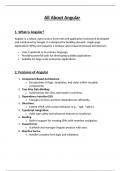
All About Angular
1. What is Angular?
Angular is a robust, open-source front-end web application framework developed
and maintained by Google. It is designed for building dynamic, single-page
applications (SPAs) and supports a modular and component-based architecture.
Uses TypeScript as its primary language.
Provides powerful tools for developing scalable applications.
Suitable for large-scale enterprise applications.
2. Features of Angular
1. Component-Based Architecture:
o Encapsulates UI logic, templates, and styles within reusable
components.
2. Two-Way Data Binding:
o Synchronizes the view and model in real-time.
3. Dependency Injection (DI):
o Manages services and their dependencies efficiently.
4. Directives:
o Extend HTML with custom behavior (e.g., *ngIf, *ngFor).
5. TypeScript Integration:
o Adds type safety and advanced features to JavaScript.
6. Routing:
o Built-in support for creating SPAs with seamless navigation.
7. Powerful CLI:
o Scaffolds and manages Angular projects with ease.
8. Reactive Forms:
o Handles complex form logic and validation.
, 3. Setting Up an Angular Project
1. Install Angular CLI:
o The Angular CLI simplifies the setup and management of projects.
npm install -g @angular/cli
2. Create a New Angular Project:
ng new my-app
cd my-app
ng serve
3. Serve the Application:
o Open http://localhost:4200 to view the app.
4. Core Concepts of Angular
1. Modules:
o Angular applications are modular and consist of multiple NgModules.
o The root module is AppModule.
@NgModule({
declarations: [AppComponent],
imports: [BrowserModule],
bootstrap: [AppComponent]
})
export class AppModule {}
2. Components:
o Building blocks of Angular applications.
o Consist of a template, style, and logic.
@Component({
selector: 'app-root',
template: `<h1>{{ title }}</h1>`,
styles: [`h1 { color: blue; }`]
1. What is Angular?
Angular is a robust, open-source front-end web application framework developed
and maintained by Google. It is designed for building dynamic, single-page
applications (SPAs) and supports a modular and component-based architecture.
Uses TypeScript as its primary language.
Provides powerful tools for developing scalable applications.
Suitable for large-scale enterprise applications.
2. Features of Angular
1. Component-Based Architecture:
o Encapsulates UI logic, templates, and styles within reusable
components.
2. Two-Way Data Binding:
o Synchronizes the view and model in real-time.
3. Dependency Injection (DI):
o Manages services and their dependencies efficiently.
4. Directives:
o Extend HTML with custom behavior (e.g., *ngIf, *ngFor).
5. TypeScript Integration:
o Adds type safety and advanced features to JavaScript.
6. Routing:
o Built-in support for creating SPAs with seamless navigation.
7. Powerful CLI:
o Scaffolds and manages Angular projects with ease.
8. Reactive Forms:
o Handles complex form logic and validation.
, 3. Setting Up an Angular Project
1. Install Angular CLI:
o The Angular CLI simplifies the setup and management of projects.
npm install -g @angular/cli
2. Create a New Angular Project:
ng new my-app
cd my-app
ng serve
3. Serve the Application:
o Open http://localhost:4200 to view the app.
4. Core Concepts of Angular
1. Modules:
o Angular applications are modular and consist of multiple NgModules.
o The root module is AppModule.
@NgModule({
declarations: [AppComponent],
imports: [BrowserModule],
bootstrap: [AppComponent]
})
export class AppModule {}
2. Components:
o Building blocks of Angular applications.
o Consist of a template, style, and logic.
@Component({
selector: 'app-root',
template: `<h1>{{ title }}</h1>`,
styles: [`h1 { color: blue; }`]