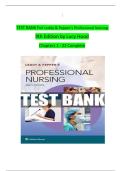
Test Bank - Lewis's Medical Surgical Nursing (11th Edition by Harding) 1
Table of Contents
Table of Contents 1
Chapter 01: Professional Nursing 3
Chapter 02: Health Equity and Culturally Competent Care 13
Chapter 03: Health History and Physical Examination 21
Chapter 04: Patient and Caregiver Teaching 28
Chapter 05: Chronic Illness and Older Adults 38
Chapter 06: Stress Management 48
Chapter 07: Sleep and Sleep Disorders 54
Chapter 08: Pain 59
Chapter 09: Palliative and End of Life Care 71
Chapter 10: Substance Use Disorders 79
Chapter 11: Inflammation and Healing 91
Chapter 12: Genetics 101
Chapter 13: Immune Responses and Transplantation 105
Chapter 14: Infection 117
Chapter 15: Cancer 129
Chapter 16: Fluid, Electrolyte, and Acid-Base Imbalances 148
Chapter 17: Preoperative Care 165
Chapter 18: Intraoperative Care 175
Chapter 19: Postoperative Care 184
Chapter 20: Assessment and Management: Visual Problems 196
Chapter 21: Assessment and Management: Auditory Problems 216
Chapter 22: Assessment: Integumentary System 227
Chapter 23: Integumentary Problems 233
Chapter 24: Burns 245
Chapter 25: Assessment: Respiratory System 259
Chapter 26: Upper Respiratory Problems 270
Chapter 27: Lower Respiratory Problems 282
Chapter 28: Obstructive Pulmonary Diseases 305
Chapter 29: Assessment: Hematologic System 325
Chapter 30: Hematologic Problems 332
Chapter 31: Assessment: Cardiovascular System 353
Chapter 32: Hypertension 364
Chapter 33: Coronary Artery Disease and Acute Coronary Syndrome 375
Chapter 34: Heart Failure 394
Chapter 35: Dysrhythmias 406
Chapter 36: Inflammatory and Structural Heart Disorders 420
Chapter 37: Vascular Disorders 435
Chapter 38: Assessment: Gastrointestinal System 450
Chapter 39: Nutritional Problems 458
Chapter 40: Obesity 469
Chapter 41: Upper Gastrointestinal Problems 478
Chapter 42: Lower Gastrointestinal Problems 499
Chapter 43: Liver, Biliary Tract, and Pancreas Problems 523
Chapter 44: Assessment: Urinary System 543
Chapter 45: Renal and Urologic Problems 553
Chapter 46: Acute Kidney Injury and Chronic Kidney Disease 573
Chapter 47: Assessment: Endocrine System 590
Chapter 48: Diabetes Mellitus 600
Chapter 49: Endocrine Problems 622
Chapter 50: Assessment: Reproductive System 642
,Test Bank - Lewis's Medical Surgical Nursing (11th Edition by Harding) 2 Test Bank - Lewis's Medical Surgical Nursing (11th Edition by Harding) 3
Chapter 51: Breast Disorders 650 Chapter 01: Professional Nursing
Chapter 52: Sexually Transmitted Infections 662
Chapter 53: Female Reproductive Problems 671 Test Bank: Lewis’s Medical Surgical Nursing, 11th Edition by Harding
Chapter 54: Male Reproductive Problems 693
Chapter 55: Assessment: Nervous System 708
Chapter 56: Acute Intracranial Problems 717 MULTIPLE CHOICE
Chapter 57: Stroke 734
1. The nurse teaches a student nurse about how to apply the nursing process when
Chapter 58: Chronic Neurologic Problems 747
providing patient care.Which statement, if made by the student nurse, indicates that
Chapter 59: Dementia and Delirium 763
teaching was successful?
Chapter 60: Spinal Cord and Peripheral Nerve Problems 772
Chapter 61: Assessment: Musculoskeletal System 787
Chapter 62: Musculoskeletal Trauma and Orthopedic Surgery 794 a. The nursing process is a scientific-based method of diagnosing the patients health care
Chapter 63: Musculoskeletal Problems 814 problems.
Chapter 64: Arthritis and Connective Tissue Diseases 825
Chapter 65: Critical Care 845
Chapter 66: Shock, Sepsis, and Multiple Organ Dysfunction Syndrome 864 b. The nursing process is a problem-solving tool used to identify and treat patient’s health
Chapter 67: Acute Respiratory Failure and Acute Respiratory Distress Syndrome 877 care needs.
Chapter 68: Emergency and Disaster Nursing 889
c. The nursing process is based on nursing theory that incorporates the
biopsychosocial nature ofhumans.
d. The nursing process is used primarily to explain nursing interventions to
other health careprofessionals.
ANS: B
The nursing process is a problem-solving approach to the identification and treatment of
patient’s problems. Diagnosis is only one phase of the nursing process. The primary use of the
nursing process is in patient care,not to establish nursing theory or explain nursing
interventions to other health care professionals.
DIF: Cognitive Level: Understand (comprehension)
TOP: Nursing Process: Implementation MSC: NCLEX: Safe and Effective Care Environment
2. The nurse describes to a student nurse how to use evidence-based practice guidelines
when caring forpatients. Which statement, if made by the nurse, would be the most
accurate?
a. Inferences from clinical research studies are used as a guide.
b. Patient care is based on clinical judgment, experience, and traditions.
c. Data are evaluated to show that the patient outcomes are consistently met.
d. Recommendations are based on research, clinical expertise, and patient preferences.
ANS: D
Evidence-based practice (EBP) is the use of the best research-based evidence combined with
,Test Bank - Lewis's Medical Surgical Nursing (11th Edition by Harding) 4 Test Bank - Lewis's Medical Surgical Nursing (11th Edition by Harding) 5
clinician expertise. Clinical judgment based on the nurses clinical experience is part of EBP, The patients major problem is the impaired skin integrity as demonstrated by the presence of a
but clinical decision making should also incorporate current research and research-based pressure ulcer.The nurse is able to treat the cause of altered circulation and pressure by
guidelines. Evaluation of patient outcomesis important, but interventions should be based on frequently repositioning the patient. Although left-sided weakness is a problem for the
research from randomized control studies with a large number of subjects. patient, the nurse cannot treat the weakness. The risk fordiagnosis is not appropriate for this
patient, who already has impaired tissue integrity. The patient does have ineffective tissue
DIF: Cognitive Level: Remember (knowledge) perfusion, but the impaired skin integrity diagnosis indicates more clearly what the health
problem is.
TOP: Nursing Process: Planning MSC: NCLEX: Safe and Effective Care Environment
3. The nurse completes an admission database and explains that the plan of care and DIF: Cognitive Level: Apply (application)
discharge goals will be developed with the patients input. The patient states, How is this
different from what the doctor does? Whichresponse would be most appropriate for the TOP: Nursing Process: Diagnosis MSC: NCLEX: Physiological Integrity
nurse to make?
5. A patient has been admitted to the hospital for surgery and tells the nurse, I do not feel
comfortable leavingmy children with my parents. Which action should the nurse take next?
a. The role of the nurse is to administer medications and other treatments prescribed by
your doctor. a. Reassure the patient that these feelings are common for parents.
b. The nurses job is to help the doctor by collecting information and communicating b. Have the patient call the children to ensure that they are doing well.
any problemsthat occur.
c. Gather more data about the patients feelings about the child-care arrangements.
c. Nurses perform many of the same procedures as the doctor, but nurses are with
the patients for alonger time than the doctor.
d. Call the patients parents to determine whether adequate child care is being provided.
d. In addition to caring for you while you are sick, the nurses will assist you
to develop anindividualized plan to maintain your health. ANS: C
Since a complete assessment is necessary in order to identify a problem and choose an
ANS: D appropriate intervention, the nurses first action should be to obtain more information. The
other actions may beappropriate, but more assessment is needed before the best intervention
This response is consistent with the American Nurses Association (ANA) definition of can be chosen.
nursing, which describes the role of nurses in promoting health. The other responses describe
some of the dependent and collaborative functions of the nursing role but do not accurately DIF: Cognitive Level: Apply (application)
describe the nurses role in the health caresystem.
OBJ: Special Questions: Prioritization TOP: Nursing Process:
DIF: Cognitive Level: Understand (comprehension)
AssessmentMSC: NCLEX: Psychosocial Integrity
TOP: Nursing Process: Implementation MSC: NCLEX: Safe and Effective Care Environment
6. A patient with a bacterial infection has a nursing diagnosis of deficient fluid volume
4. A patient who is paralyzed on the left side of the body after a stroke develops a pressure related to excessivediaphoresis. Which outcome would the nurse recognize as most
ulcer on the left hipWhich nursing diagnosis is most appropriate? appropriate for this patient?
a. Impaired physical mobility related to left-sided paralysis a. Patient has a balanced intake and output.
b. Risk for impaired tissue integrity related to left-sided weakness b. Patients bedding is changed when it becomes damp.
c. Impaired skin integrity related to altered circulation and pressure c. Patient understands the need for increased fluid intake.
d. Ineffective tissue perfusion related to inability to move d. Patients skin remains cool and dry throughout hospitalization.
independentlyANS: C ANS: A
, Test Bank - Lewis's Medical Surgical Nursing (11th Edition by Harding) 6 Test Bank - Lewis's Medical Surgical Nursing (11th Edition by Harding) 7
This statement gives measurable data showing resolution of the problem of deficient fluid
volume that wasidentified in the nursing diagnosis statement. The other statements would not
a. Altered tissue perfusion related to heart failure
indicate that the problem of deficient fluid volume was resolved.
DIF: Cognitive Level: Apply (application) b. Risk for impaired tissue integrity related to sacral redness
TOP: Nursing Process: Planning MSC: NCLEX: Physiological Integrity
c. Ineffective coping related to response to biopsy test results
7. A nurse asks the patient if pain was relieved after receiving medication. What is the
purpose of theevaluation phase of the nursing process?
d. Altered urinary elimination related to urinary tract
a. To determine if interventions have been effective in meeting patient outcomes
infectionANS: C
b. To document the nursing care plan in the progress notes of the medical record This diagnosis statement includes a NANDA nursing diagnosis and an etiology that
describes a patients response to a health problem that can be treated by nursing. The use of a
medical diagnosis as an etiology (asin the responses beginning Altered tissue perfusion and
c. To decide whether the patients health problems have been completely resolved Altered urinary elimination) is not appropriate. The response beginning Risk for impaired
d. To establish if the patient agrees that the nursing care provided was satisfactory tissue integrity uses the defining characteristic as the etiology.
DIF: Cognitive Level: Understand (comprehension)
ANS: A
TOP: Nursing Process: Diagnosis MSC: NCLEX: Safe and Effective Care Environment
Evaluation consists of determining whether the desired patient outcomes have been met and 10. The nurse admits a patient to the hospital and develops a plan of care. What components
whether thenursing interventions were appropriate. The other responses do not describe the should the nurseinclude in the nursing diagnosis statement?
evaluation phase.
DIF: Cognitive Level: Understand (comprehension) a. The problem and the suggested patient goals or outcomes
TOP: Nursing Process: Evaluation MSC: NCLEX: Safe and Effective Care Environment
b. The problem with possible causes and the planned interventions
8. The nurse interviews a patient while completing the health history and physical
examination. What is thepurpose of the assessment phase of the nursing process? c. The problem, its cause, and objective data that support the problem
a. To teach interventions that relieve health problems d. The problem with an etiology and the signs and symptoms of
b. To use patient data to evaluate patient care outcomes the problemANS: D
When writing nursing diagnoses, this format should be used: problem, etiology, and signs and
c. To obtain data with which to diagnose patient problems symptoms. Thesubjective, as well as objective, data should be included in the defining
characteristics. Interventions and outcomes are not included in the nursing diagnosis
d. To help the patient identify realistic outcomes for health statement.
DIF: Cognitive Level: Remember (knowledge)
problemsANS: C
TOP: Nursing Process: Diagnosis MSC: NCLEX: Safe and Effective Care Environment
During the assessment phase, the nurse gathers information about the patient to diagnose patient
problems. Theother responses are examples of the planning, intervention, and evaluation phases 11. A nurse is caring for a patient with heart failure. Which task is appropriate for the nurse
of the nursing process. to delegate toexperienced unlicensed assistive personnel (UAP)?
DIF: Cognitive Level: Understand (comprehension)
a. Monitor for shortness of breath or fatigue after ambulation.
TOP: Nursing Process: Assessment MSC: NCLEX: Safe and Effective Care Environment
9. Which nursing diagnosis statement is written correctly? b. Instruct the patient about the need to alternate activity and rest.
Table of Contents
Table of Contents 1
Chapter 01: Professional Nursing 3
Chapter 02: Health Equity and Culturally Competent Care 13
Chapter 03: Health History and Physical Examination 21
Chapter 04: Patient and Caregiver Teaching 28
Chapter 05: Chronic Illness and Older Adults 38
Chapter 06: Stress Management 48
Chapter 07: Sleep and Sleep Disorders 54
Chapter 08: Pain 59
Chapter 09: Palliative and End of Life Care 71
Chapter 10: Substance Use Disorders 79
Chapter 11: Inflammation and Healing 91
Chapter 12: Genetics 101
Chapter 13: Immune Responses and Transplantation 105
Chapter 14: Infection 117
Chapter 15: Cancer 129
Chapter 16: Fluid, Electrolyte, and Acid-Base Imbalances 148
Chapter 17: Preoperative Care 165
Chapter 18: Intraoperative Care 175
Chapter 19: Postoperative Care 184
Chapter 20: Assessment and Management: Visual Problems 196
Chapter 21: Assessment and Management: Auditory Problems 216
Chapter 22: Assessment: Integumentary System 227
Chapter 23: Integumentary Problems 233
Chapter 24: Burns 245
Chapter 25: Assessment: Respiratory System 259
Chapter 26: Upper Respiratory Problems 270
Chapter 27: Lower Respiratory Problems 282
Chapter 28: Obstructive Pulmonary Diseases 305
Chapter 29: Assessment: Hematologic System 325
Chapter 30: Hematologic Problems 332
Chapter 31: Assessment: Cardiovascular System 353
Chapter 32: Hypertension 364
Chapter 33: Coronary Artery Disease and Acute Coronary Syndrome 375
Chapter 34: Heart Failure 394
Chapter 35: Dysrhythmias 406
Chapter 36: Inflammatory and Structural Heart Disorders 420
Chapter 37: Vascular Disorders 435
Chapter 38: Assessment: Gastrointestinal System 450
Chapter 39: Nutritional Problems 458
Chapter 40: Obesity 469
Chapter 41: Upper Gastrointestinal Problems 478
Chapter 42: Lower Gastrointestinal Problems 499
Chapter 43: Liver, Biliary Tract, and Pancreas Problems 523
Chapter 44: Assessment: Urinary System 543
Chapter 45: Renal and Urologic Problems 553
Chapter 46: Acute Kidney Injury and Chronic Kidney Disease 573
Chapter 47: Assessment: Endocrine System 590
Chapter 48: Diabetes Mellitus 600
Chapter 49: Endocrine Problems 622
Chapter 50: Assessment: Reproductive System 642
,Test Bank - Lewis's Medical Surgical Nursing (11th Edition by Harding) 2 Test Bank - Lewis's Medical Surgical Nursing (11th Edition by Harding) 3
Chapter 51: Breast Disorders 650 Chapter 01: Professional Nursing
Chapter 52: Sexually Transmitted Infections 662
Chapter 53: Female Reproductive Problems 671 Test Bank: Lewis’s Medical Surgical Nursing, 11th Edition by Harding
Chapter 54: Male Reproductive Problems 693
Chapter 55: Assessment: Nervous System 708
Chapter 56: Acute Intracranial Problems 717 MULTIPLE CHOICE
Chapter 57: Stroke 734
1. The nurse teaches a student nurse about how to apply the nursing process when
Chapter 58: Chronic Neurologic Problems 747
providing patient care.Which statement, if made by the student nurse, indicates that
Chapter 59: Dementia and Delirium 763
teaching was successful?
Chapter 60: Spinal Cord and Peripheral Nerve Problems 772
Chapter 61: Assessment: Musculoskeletal System 787
Chapter 62: Musculoskeletal Trauma and Orthopedic Surgery 794 a. The nursing process is a scientific-based method of diagnosing the patients health care
Chapter 63: Musculoskeletal Problems 814 problems.
Chapter 64: Arthritis and Connective Tissue Diseases 825
Chapter 65: Critical Care 845
Chapter 66: Shock, Sepsis, and Multiple Organ Dysfunction Syndrome 864 b. The nursing process is a problem-solving tool used to identify and treat patient’s health
Chapter 67: Acute Respiratory Failure and Acute Respiratory Distress Syndrome 877 care needs.
Chapter 68: Emergency and Disaster Nursing 889
c. The nursing process is based on nursing theory that incorporates the
biopsychosocial nature ofhumans.
d. The nursing process is used primarily to explain nursing interventions to
other health careprofessionals.
ANS: B
The nursing process is a problem-solving approach to the identification and treatment of
patient’s problems. Diagnosis is only one phase of the nursing process. The primary use of the
nursing process is in patient care,not to establish nursing theory or explain nursing
interventions to other health care professionals.
DIF: Cognitive Level: Understand (comprehension)
TOP: Nursing Process: Implementation MSC: NCLEX: Safe and Effective Care Environment
2. The nurse describes to a student nurse how to use evidence-based practice guidelines
when caring forpatients. Which statement, if made by the nurse, would be the most
accurate?
a. Inferences from clinical research studies are used as a guide.
b. Patient care is based on clinical judgment, experience, and traditions.
c. Data are evaluated to show that the patient outcomes are consistently met.
d. Recommendations are based on research, clinical expertise, and patient preferences.
ANS: D
Evidence-based practice (EBP) is the use of the best research-based evidence combined with
,Test Bank - Lewis's Medical Surgical Nursing (11th Edition by Harding) 4 Test Bank - Lewis's Medical Surgical Nursing (11th Edition by Harding) 5
clinician expertise. Clinical judgment based on the nurses clinical experience is part of EBP, The patients major problem is the impaired skin integrity as demonstrated by the presence of a
but clinical decision making should also incorporate current research and research-based pressure ulcer.The nurse is able to treat the cause of altered circulation and pressure by
guidelines. Evaluation of patient outcomesis important, but interventions should be based on frequently repositioning the patient. Although left-sided weakness is a problem for the
research from randomized control studies with a large number of subjects. patient, the nurse cannot treat the weakness. The risk fordiagnosis is not appropriate for this
patient, who already has impaired tissue integrity. The patient does have ineffective tissue
DIF: Cognitive Level: Remember (knowledge) perfusion, but the impaired skin integrity diagnosis indicates more clearly what the health
problem is.
TOP: Nursing Process: Planning MSC: NCLEX: Safe and Effective Care Environment
3. The nurse completes an admission database and explains that the plan of care and DIF: Cognitive Level: Apply (application)
discharge goals will be developed with the patients input. The patient states, How is this
different from what the doctor does? Whichresponse would be most appropriate for the TOP: Nursing Process: Diagnosis MSC: NCLEX: Physiological Integrity
nurse to make?
5. A patient has been admitted to the hospital for surgery and tells the nurse, I do not feel
comfortable leavingmy children with my parents. Which action should the nurse take next?
a. The role of the nurse is to administer medications and other treatments prescribed by
your doctor. a. Reassure the patient that these feelings are common for parents.
b. The nurses job is to help the doctor by collecting information and communicating b. Have the patient call the children to ensure that they are doing well.
any problemsthat occur.
c. Gather more data about the patients feelings about the child-care arrangements.
c. Nurses perform many of the same procedures as the doctor, but nurses are with
the patients for alonger time than the doctor.
d. Call the patients parents to determine whether adequate child care is being provided.
d. In addition to caring for you while you are sick, the nurses will assist you
to develop anindividualized plan to maintain your health. ANS: C
Since a complete assessment is necessary in order to identify a problem and choose an
ANS: D appropriate intervention, the nurses first action should be to obtain more information. The
other actions may beappropriate, but more assessment is needed before the best intervention
This response is consistent with the American Nurses Association (ANA) definition of can be chosen.
nursing, which describes the role of nurses in promoting health. The other responses describe
some of the dependent and collaborative functions of the nursing role but do not accurately DIF: Cognitive Level: Apply (application)
describe the nurses role in the health caresystem.
OBJ: Special Questions: Prioritization TOP: Nursing Process:
DIF: Cognitive Level: Understand (comprehension)
AssessmentMSC: NCLEX: Psychosocial Integrity
TOP: Nursing Process: Implementation MSC: NCLEX: Safe and Effective Care Environment
6. A patient with a bacterial infection has a nursing diagnosis of deficient fluid volume
4. A patient who is paralyzed on the left side of the body after a stroke develops a pressure related to excessivediaphoresis. Which outcome would the nurse recognize as most
ulcer on the left hipWhich nursing diagnosis is most appropriate? appropriate for this patient?
a. Impaired physical mobility related to left-sided paralysis a. Patient has a balanced intake and output.
b. Risk for impaired tissue integrity related to left-sided weakness b. Patients bedding is changed when it becomes damp.
c. Impaired skin integrity related to altered circulation and pressure c. Patient understands the need for increased fluid intake.
d. Ineffective tissue perfusion related to inability to move d. Patients skin remains cool and dry throughout hospitalization.
independentlyANS: C ANS: A
, Test Bank - Lewis's Medical Surgical Nursing (11th Edition by Harding) 6 Test Bank - Lewis's Medical Surgical Nursing (11th Edition by Harding) 7
This statement gives measurable data showing resolution of the problem of deficient fluid
volume that wasidentified in the nursing diagnosis statement. The other statements would not
a. Altered tissue perfusion related to heart failure
indicate that the problem of deficient fluid volume was resolved.
DIF: Cognitive Level: Apply (application) b. Risk for impaired tissue integrity related to sacral redness
TOP: Nursing Process: Planning MSC: NCLEX: Physiological Integrity
c. Ineffective coping related to response to biopsy test results
7. A nurse asks the patient if pain was relieved after receiving medication. What is the
purpose of theevaluation phase of the nursing process?
d. Altered urinary elimination related to urinary tract
a. To determine if interventions have been effective in meeting patient outcomes
infectionANS: C
b. To document the nursing care plan in the progress notes of the medical record This diagnosis statement includes a NANDA nursing diagnosis and an etiology that
describes a patients response to a health problem that can be treated by nursing. The use of a
medical diagnosis as an etiology (asin the responses beginning Altered tissue perfusion and
c. To decide whether the patients health problems have been completely resolved Altered urinary elimination) is not appropriate. The response beginning Risk for impaired
d. To establish if the patient agrees that the nursing care provided was satisfactory tissue integrity uses the defining characteristic as the etiology.
DIF: Cognitive Level: Understand (comprehension)
ANS: A
TOP: Nursing Process: Diagnosis MSC: NCLEX: Safe and Effective Care Environment
Evaluation consists of determining whether the desired patient outcomes have been met and 10. The nurse admits a patient to the hospital and develops a plan of care. What components
whether thenursing interventions were appropriate. The other responses do not describe the should the nurseinclude in the nursing diagnosis statement?
evaluation phase.
DIF: Cognitive Level: Understand (comprehension) a. The problem and the suggested patient goals or outcomes
TOP: Nursing Process: Evaluation MSC: NCLEX: Safe and Effective Care Environment
b. The problem with possible causes and the planned interventions
8. The nurse interviews a patient while completing the health history and physical
examination. What is thepurpose of the assessment phase of the nursing process? c. The problem, its cause, and objective data that support the problem
a. To teach interventions that relieve health problems d. The problem with an etiology and the signs and symptoms of
b. To use patient data to evaluate patient care outcomes the problemANS: D
When writing nursing diagnoses, this format should be used: problem, etiology, and signs and
c. To obtain data with which to diagnose patient problems symptoms. Thesubjective, as well as objective, data should be included in the defining
characteristics. Interventions and outcomes are not included in the nursing diagnosis
d. To help the patient identify realistic outcomes for health statement.
DIF: Cognitive Level: Remember (knowledge)
problemsANS: C
TOP: Nursing Process: Diagnosis MSC: NCLEX: Safe and Effective Care Environment
During the assessment phase, the nurse gathers information about the patient to diagnose patient
problems. Theother responses are examples of the planning, intervention, and evaluation phases 11. A nurse is caring for a patient with heart failure. Which task is appropriate for the nurse
of the nursing process. to delegate toexperienced unlicensed assistive personnel (UAP)?
DIF: Cognitive Level: Understand (comprehension)
a. Monitor for shortness of breath or fatigue after ambulation.
TOP: Nursing Process: Assessment MSC: NCLEX: Safe and Effective Care Environment
9. Which nursing diagnosis statement is written correctly? b. Instruct the patient about the need to alternate activity and rest.