🔄
A: Rock Cycle
Interlude A: Introducing Rocks
A.2 What Is Rock?
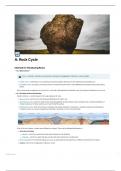
🪨 Rock = a coherent, naturally occurring solid, consisting of an aggregate of minerals or a mass of glass.
Clastic rocks = sedimentary rock consisting of cemented-together detritus from the weathering of preexisting rock
Crystalline rocks =an igneous rock that consists of minerals that grew when a melt solidified and eventually interlock like puzzles
pieces.
Rock can be found as fragments or as bedrock (= rock that is still attached to the Earth’s crust). An exposure of bedrock is an outcrop.
A.3 The Basis of Rock Classification
Genetic scheme = a scheme based on the origin (genesis) of rocks
Igneous rocks: which form by the freezing (solidification) of molten rock.
Sedimentary rocks: which form either by the cementing together of grains broken off pre-existing rocks or by the precipitation of
mineral crystals out of water solutions at or near the Earth’s surface.
Metamorphic rocks: which form when pre-existing rocks change character in response to change in pressure and temperature
conditions, and/or as a result of squashing, stretching or shearing. It occurs in the solid state.
Each of the rock classes, contains many different rock types. These can be distinguished based on:
Grain size and shape.
Equant = a term for a grain that has the same dimensions in all directions.
Inequant = a term for a grain that does not have the same dimensions in all directions.
Rock composition: the chemical makeup of a rock, as represented by the proportions of different minerals that it contains.
Texture: refers to the configuration of grains in a rock.
A: Rock Cycle 1
, Layering: some rocks contain distinct layers (eg. bedding or foliation).
Interlude B: A Surface Veneer: Sediments and Soils
B.1 Introduction
Sediment = an accumulation of loose mineral grains, such as boulders, pebbles, sand, silt or mud that are not cemented together.
Regolith = any kind of unconsolidated debris that covers bedrock.
B.2 Weathering: Forming Sediment
Weathering = the processes that break up and corrode solid rock, eventually transforming in into loose debris (= detritus).
✊🏼 Physical or mechanical weathering = the process in which intact rock breaks
into smaller grains or chunks. Many phenomena can contribute:
Clast
Boulders
Diameter of grain
More than 256 mm
Cobbles 65 mm - 265 mm
Pebbles 3 mm - 64 mm
Jointing: when natural cracks are formed in bedrock due to the removal of overburden
Sand 1/16 mm - 2 mm
or to cooling, both caused by exhumation (= the process (involving uplift and erosion)
Silt 1/256 mm - 1/16 mm
that returns deeply buried rocks to the surface).
Mud Less than 1/256 mm
Frost wedging: when trapped water in a joint freezes, forces the joint open and may
cause it to grow or break off.
Salt wedging: in dry climates, when dissolved salt crystallises, grows in open pore
spaces in rocks and pushes apart the surrounding grains. In coastal areas where the
salt dries, the resulting weathering may resemble a honeycomb.
Root wedging: when the roots of a tree grow in a joint and make it wider.
Thermal expansion: heat of the sun or a fire caused the rocks to expand, when it
cools, it grows back to its original size. The friction may cause a fracture.
Animal attack: animals and humans can cause weathering as well.
🧪 Chemical weathering = the process in which chemical reactions alter or destroy minerals when rock comes in contact with water
solutions or air. Common reactions include:
Dissolution: a process during which materials dissolve in water. More acid water (with
more H⁺ atoms) often causes materials to dissolve more rapidly. It affects mainly salts and
carbonates.
Hydrolysis: when water reacts chemically with minerals and breaks them down to form
other minerals, it affects mainly felsic minerals. The Greek lysis = loosen.
Oxidation: when an element loses electrons during a chemical reaction, it mainly affects
iron-bearing, mafic minerals.
Hydration: when water is absorbed into the crystal structure of a mineral. It may causes
certain types of clay to expand and thus weaken.
The pace at which chemical weathering occurs depends on:
1. The strength of the crystal structure: minerals with fewer links between silicon-oxygen
tetrahedra tend to have weaker structures.
2. The chemical composition: minerals containing iron, magnesium, sodium, potassium and
aluminium tend to weather faster.
The minerals that form early in Bowen’s reaction series are among the least stable minerals,
minerals that are the products of weathering reactions are among the most stable minerals.
Chemical weathering speeds up physical weathering by dissolving grains or cements that hold a rock together.
Physical weathering speeds up chemical weathering by increasing the surface area of a rock.
A: Rock Cycle 2
A: Rock Cycle
Interlude A: Introducing Rocks
A.2 What Is Rock?
🪨 Rock = a coherent, naturally occurring solid, consisting of an aggregate of minerals or a mass of glass.
Clastic rocks = sedimentary rock consisting of cemented-together detritus from the weathering of preexisting rock
Crystalline rocks =an igneous rock that consists of minerals that grew when a melt solidified and eventually interlock like puzzles
pieces.
Rock can be found as fragments or as bedrock (= rock that is still attached to the Earth’s crust). An exposure of bedrock is an outcrop.
A.3 The Basis of Rock Classification
Genetic scheme = a scheme based on the origin (genesis) of rocks
Igneous rocks: which form by the freezing (solidification) of molten rock.
Sedimentary rocks: which form either by the cementing together of grains broken off pre-existing rocks or by the precipitation of
mineral crystals out of water solutions at or near the Earth’s surface.
Metamorphic rocks: which form when pre-existing rocks change character in response to change in pressure and temperature
conditions, and/or as a result of squashing, stretching or shearing. It occurs in the solid state.
Each of the rock classes, contains many different rock types. These can be distinguished based on:
Grain size and shape.
Equant = a term for a grain that has the same dimensions in all directions.
Inequant = a term for a grain that does not have the same dimensions in all directions.
Rock composition: the chemical makeup of a rock, as represented by the proportions of different minerals that it contains.
Texture: refers to the configuration of grains in a rock.
A: Rock Cycle 1
, Layering: some rocks contain distinct layers (eg. bedding or foliation).
Interlude B: A Surface Veneer: Sediments and Soils
B.1 Introduction
Sediment = an accumulation of loose mineral grains, such as boulders, pebbles, sand, silt or mud that are not cemented together.
Regolith = any kind of unconsolidated debris that covers bedrock.
B.2 Weathering: Forming Sediment
Weathering = the processes that break up and corrode solid rock, eventually transforming in into loose debris (= detritus).
✊🏼 Physical or mechanical weathering = the process in which intact rock breaks
into smaller grains or chunks. Many phenomena can contribute:
Clast
Boulders
Diameter of grain
More than 256 mm
Cobbles 65 mm - 265 mm
Pebbles 3 mm - 64 mm
Jointing: when natural cracks are formed in bedrock due to the removal of overburden
Sand 1/16 mm - 2 mm
or to cooling, both caused by exhumation (= the process (involving uplift and erosion)
Silt 1/256 mm - 1/16 mm
that returns deeply buried rocks to the surface).
Mud Less than 1/256 mm
Frost wedging: when trapped water in a joint freezes, forces the joint open and may
cause it to grow or break off.
Salt wedging: in dry climates, when dissolved salt crystallises, grows in open pore
spaces in rocks and pushes apart the surrounding grains. In coastal areas where the
salt dries, the resulting weathering may resemble a honeycomb.
Root wedging: when the roots of a tree grow in a joint and make it wider.
Thermal expansion: heat of the sun or a fire caused the rocks to expand, when it
cools, it grows back to its original size. The friction may cause a fracture.
Animal attack: animals and humans can cause weathering as well.
🧪 Chemical weathering = the process in which chemical reactions alter or destroy minerals when rock comes in contact with water
solutions or air. Common reactions include:
Dissolution: a process during which materials dissolve in water. More acid water (with
more H⁺ atoms) often causes materials to dissolve more rapidly. It affects mainly salts and
carbonates.
Hydrolysis: when water reacts chemically with minerals and breaks them down to form
other minerals, it affects mainly felsic minerals. The Greek lysis = loosen.
Oxidation: when an element loses electrons during a chemical reaction, it mainly affects
iron-bearing, mafic minerals.
Hydration: when water is absorbed into the crystal structure of a mineral. It may causes
certain types of clay to expand and thus weaken.
The pace at which chemical weathering occurs depends on:
1. The strength of the crystal structure: minerals with fewer links between silicon-oxygen
tetrahedra tend to have weaker structures.
2. The chemical composition: minerals containing iron, magnesium, sodium, potassium and
aluminium tend to weather faster.
The minerals that form early in Bowen’s reaction series are among the least stable minerals,
minerals that are the products of weathering reactions are among the most stable minerals.
Chemical weathering speeds up physical weathering by dissolving grains or cements that hold a rock together.
Physical weathering speeds up chemical weathering by increasing the surface area of a rock.
A: Rock Cycle 2