💎
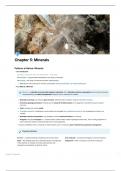
Chapter 5: Minerals
Patterns in Nature: Minerals
5.1 Introduction
Amethyst comes from the Greek amethustos = intoxicated
Mineralogist = a geoscientist specialising in the study of minerals.
Mineralogy = the study of minerals and their characteristics.
Minerals are very practical for humans, think about: industrial minerals, ore minerals and gems.
5.2 What Is a Mineral?
💎 Mineral = a naturally occurring solid inorganic substance with a definable chemical composition and an internal structure
characterised by an orderly arrangement of atoms, ions or molecules in a lattice.
Naturally occurring: true minerals grow in nature. Minerals that are made in a lab are synthetic minerals.
Formed by geologic processes: minerals are the result of the Earth system. If an organism is involved, they are biogenic
minerals.
Solid: minerals can only be solids.
Crystalline material: a substance in which atoms are arranged in a crystalline structure (= the arrangement of atoms in a
crystal).
Definable chemical composition: it is possible to write a chemical formula for a mineral.
Inorganic: they are not organic = 1. include carbon-carbon and/or carbon-hydrogen bonds and 2. form in living organisms or
have a structure similar to chemicals that form in living organisms.
→ A glass is different from in a mineral, in that the atoms, ions or molecules aren’t ordered into a geometric arrangement.
🧪 Chemistry refresher:
Element = a material entirely consisting of one kind of atom Ionic molecule = a molecule that gains or loses an electron.
Atom = the smallest piece of an element that has the properties Compound = when it consists of one kind of molecule.
of the element, it consists of nucleus (with protons and
neutrons) surrounded by an electron cloud.
Chapter 5: Minerals 1
, Electron cloud = the cloud consists of distinct orbitals or State of matter = a substance can be solid, liquid or gas or
electron shells, each of which contains a specific number of plasma.
electrons.
Change of state = when a material changes its state of matter;
Charge = the charge of a particle characterises the way the condensation, evaporation, freezing, sublimation.
particle responds to an electrical current or to a magnet. Chemical = a material consisting of a distinct element or
Atomic number = the number of protons in the nucleus of a compound.
given element.
Chemical formula = the “recipe” that specified the elements and
Atomic mass = the amount of matter in an atom; roughly, the their proportions in a compound.
sum of the number of protons plus the number of neutrons in
Chemical reaction = interactions among atoms and/or
the nucleus. molecules involving breaking or forming chemical bonds.
Isotope = atoms that have the same atomic number but a
Chemical equation = a representation of a chemical reaction in
different mass, they have different amounts of neutrons.
the form of an equation; on the left are the reactants and on the
Ion = a non-neutral atom; a negative ion is a anion and a positive right are the products.
ion is a cation. Mixture = a combination of two or more elements that can be
Chemical bond = the invisible link that holds together atoms in a separated without a chemical reaction.
molecule and/or in a crystal; there are: covalent bonds (= when
Solution =a type of material in which one chemical ( the solute)
atoms share electrons), ionic bonds and metallic bonds (= where
has dissolved in another (the solvent); a solute may separate
electrons from the outer shell can move freely).
into ions.
Molecule = two or more atoms held together by chemical Concentration = the proportion of one substance (the solute)
bonds. dissolved within another (the solvent).
Precipitate = the action of forming a solid substance from a
solution, when the solution gets over saturated.
5.3 Beauty in Patterns: Crystals and Their Structure
💠 Crystal = a single, continuous piece of a mineral bounded by flat surfaces, crystal faces, that formed naturally as the
mineral grew.
→ The word crystal comes from the Greek word krystallos = ice.
The angle between the crystal faces of any mineral is consistent for that mineral. For example,
the angle between the faces of a quartz crystal is always exactly 120°, this is the inter facial
angle.
Crystal structure = the repeating arrangement of atoms, molecules or ions, throughout a
crystal.
→ We know that atoms within a crystal must be evenly spaced and evenly arranged, because a
crystal causes diffraction (= the splitting of light into many tiny beams). An X-ray beam passing
through a crystal breaks up into many tiny beams that produce a pattern of dots on a screen.
If a crystal structure has the shape of a cube, then a crystal of the mineral will have faces that
intersect at 90° as well. The structure of a crystal is symmetric, the shape of one part represents Generally speaking anions are
the mirror image of a neighbouring part. bigger than cations.
Crystal lattice = a three-dimensional arrangement of points representing the regular spacing
of atoms in a crystal.
A variety of different geometries of packing can occur, for example: cubic or tetragonal.
Polymorphs are where two minerals have the same chemical composition but a different
crystal lattice structure, a different packing. An example is: diamond and graphite. Both are
fully made of carbon, but because their structure is different, they are different minerals.
Chapter 5: Minerals 2
Chapter 5: Minerals
Patterns in Nature: Minerals
5.1 Introduction
Amethyst comes from the Greek amethustos = intoxicated
Mineralogist = a geoscientist specialising in the study of minerals.
Mineralogy = the study of minerals and their characteristics.
Minerals are very practical for humans, think about: industrial minerals, ore minerals and gems.
5.2 What Is a Mineral?
💎 Mineral = a naturally occurring solid inorganic substance with a definable chemical composition and an internal structure
characterised by an orderly arrangement of atoms, ions or molecules in a lattice.
Naturally occurring: true minerals grow in nature. Minerals that are made in a lab are synthetic minerals.
Formed by geologic processes: minerals are the result of the Earth system. If an organism is involved, they are biogenic
minerals.
Solid: minerals can only be solids.
Crystalline material: a substance in which atoms are arranged in a crystalline structure (= the arrangement of atoms in a
crystal).
Definable chemical composition: it is possible to write a chemical formula for a mineral.
Inorganic: they are not organic = 1. include carbon-carbon and/or carbon-hydrogen bonds and 2. form in living organisms or
have a structure similar to chemicals that form in living organisms.
→ A glass is different from in a mineral, in that the atoms, ions or molecules aren’t ordered into a geometric arrangement.
🧪 Chemistry refresher:
Element = a material entirely consisting of one kind of atom Ionic molecule = a molecule that gains or loses an electron.
Atom = the smallest piece of an element that has the properties Compound = when it consists of one kind of molecule.
of the element, it consists of nucleus (with protons and
neutrons) surrounded by an electron cloud.
Chapter 5: Minerals 1
, Electron cloud = the cloud consists of distinct orbitals or State of matter = a substance can be solid, liquid or gas or
electron shells, each of which contains a specific number of plasma.
electrons.
Change of state = when a material changes its state of matter;
Charge = the charge of a particle characterises the way the condensation, evaporation, freezing, sublimation.
particle responds to an electrical current or to a magnet. Chemical = a material consisting of a distinct element or
Atomic number = the number of protons in the nucleus of a compound.
given element.
Chemical formula = the “recipe” that specified the elements and
Atomic mass = the amount of matter in an atom; roughly, the their proportions in a compound.
sum of the number of protons plus the number of neutrons in
Chemical reaction = interactions among atoms and/or
the nucleus. molecules involving breaking or forming chemical bonds.
Isotope = atoms that have the same atomic number but a
Chemical equation = a representation of a chemical reaction in
different mass, they have different amounts of neutrons.
the form of an equation; on the left are the reactants and on the
Ion = a non-neutral atom; a negative ion is a anion and a positive right are the products.
ion is a cation. Mixture = a combination of two or more elements that can be
Chemical bond = the invisible link that holds together atoms in a separated without a chemical reaction.
molecule and/or in a crystal; there are: covalent bonds (= when
Solution =a type of material in which one chemical ( the solute)
atoms share electrons), ionic bonds and metallic bonds (= where
has dissolved in another (the solvent); a solute may separate
electrons from the outer shell can move freely).
into ions.
Molecule = two or more atoms held together by chemical Concentration = the proportion of one substance (the solute)
bonds. dissolved within another (the solvent).
Precipitate = the action of forming a solid substance from a
solution, when the solution gets over saturated.
5.3 Beauty in Patterns: Crystals and Their Structure
💠 Crystal = a single, continuous piece of a mineral bounded by flat surfaces, crystal faces, that formed naturally as the
mineral grew.
→ The word crystal comes from the Greek word krystallos = ice.
The angle between the crystal faces of any mineral is consistent for that mineral. For example,
the angle between the faces of a quartz crystal is always exactly 120°, this is the inter facial
angle.
Crystal structure = the repeating arrangement of atoms, molecules or ions, throughout a
crystal.
→ We know that atoms within a crystal must be evenly spaced and evenly arranged, because a
crystal causes diffraction (= the splitting of light into many tiny beams). An X-ray beam passing
through a crystal breaks up into many tiny beams that produce a pattern of dots on a screen.
If a crystal structure has the shape of a cube, then a crystal of the mineral will have faces that
intersect at 90° as well. The structure of a crystal is symmetric, the shape of one part represents Generally speaking anions are
the mirror image of a neighbouring part. bigger than cations.
Crystal lattice = a three-dimensional arrangement of points representing the regular spacing
of atoms in a crystal.
A variety of different geometries of packing can occur, for example: cubic or tetragonal.
Polymorphs are where two minerals have the same chemical composition but a different
crystal lattice structure, a different packing. An example is: diamond and graphite. Both are
fully made of carbon, but because their structure is different, they are different minerals.
Chapter 5: Minerals 2