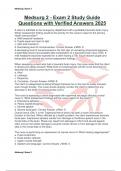
Medsurg 2 Exam 2
Medsurg 2 - Exam 2 Study Guide
Questions with Verified Answers 2025
A client is admitted to the emergency department with a probable traumatic brain injury.
Which assessment finding would be the priority for the nurse to report to the primary
health care provider?
a. Mild temporal headache
b. Pupils equal and react to light
c. Alert and oriented 3
d. Decreasing level of consciousness -Correct Answer ✔ANS: D
A decreasing level of consciousness is the first sign of increasing intracranial pressure,
a potentially severe and possibly fatal complication of a traumatic brain injury (TBI). A
mild headache would be expected for a client having a TBI. Equal reactive pupils and
being alert and oriented are normal assessment findings.
When assessing a client who had a traumatic brain injury, the nurse notes that the client
is drowsy but easily aroused. What level of consciousness will the nurse document to
describe this client's current level of consciousness?
a. Alert
b. Lethargic
c. Stuporous
d. Comatose -Correct Answer ✔ANS: B
The client is categorized as being lethargic because he or she can be easily aroused
even though drowsy. The nurse would carefully monitor the client to determine any
decrease in the level of consciousness (LOC).
The nurse is assessing a client diagnosed with trigeminal neuralgia affecting cranial
nerve V. What assessment findings will the nurse expect for this client?
a. Expressive aphasia
b. Ptosis (eyelid drooping)
c. Slurred speech
d. Severe facial pain -Correct Answer ✔ANS: D
Cranial nerve (CN) V is the Trigeminal Nerve which has both a motor and sensory
function in the face. When affected by a health problem, the client experiences severely
facial pain. Expressive aphasia results from damage to the Broca speech area in the
frontal lobe of the brain. Ptosis can result from damage to CN III and slurred speech
often occurs from either damage to several cranial nerves or from damage to the motor
strip in the frontal lobe of the brain.
The nurse is performing an assessment of cranial nerve III. Which testing isappropriate?
a. Pupil constriction
b. Deep tendon reflexes
c. Upper muscle strength
d. Speech and language -Correct Answer ✔ANS: A
Medsurg 2 Exam 2
,Medsurg 2 Exam 2
CN III is the oculomotor nerve which controls eye movement, pupil constriction, and
eyelid movement.
A nurse cares for a client who is experiencing deteriorating neurologic functions. The
client states, "I am worried I will not be able to care for my young children." How would
the nurse respond?
a. "Caring for your children is a priority. You may not want to ask for help, but you really
have to."
b. "Our community has resources that may help you with some household tasks so you
have energy to care for your children."
c. "You seem distressed. Would you like to talk to a psychologist about adjusting to your
changing status?"
d. "Can you tell me more about what worries you, so we can see if we can do something
to make adjustments?" -Correct Answer ✔ANS: D
Investigate specific concerns about situational or role changes before providing
additional information. The nurse would not tell the client what is or is not a priority for
him or her. Although community resources may be available, they may not be
appropriate for the patient. Consulting a psychologist would not be appropriate without
obtaining further information from the client related to current concerns.
After teaching a patient who is scheduled for magnetic resonance imaging (MRI), the
nurse assesses the client's understanding. Which statement indicates client
understanding of the teaching?
a. "I must increase my fluids because of the dye used for theMRI."
b. "My urine will be radioactive so I should not share a bathroom."
c. "My gag reflex will be tested before I can eat or drink anything."
d. "I can return to my usual activities immediately after the MRI." -Correct Answer
✔ANS: D
No post-procedure restrictions are imposed after MRI. The client can return to normal
activities after the test is complete. There are no dyes or radioactive materials used for
the MRI; therefore, increased fluids are not needed and the client's urine would not be
radioactive. The procedure does not impact the client's gag reflex
Which statement would the nurse include when teaching the assistive personnel (AP)
about how to care for a client with cranial nerve II impairment?
a. "Tell the client where food items are on the breakfast tray."
b. "Place the client in a high-Fowler position for all meals."
c. "Make sure the client's food is visually appetizing."
d. "Assist the client by placing the fork in the left hand." -Correct Answer ✔ANS: A
Cranial nerve II, the optic nerve, provides central and peripheral vision. A patient who
has cranial nerve II impairment will have decreased visual acuity, so the AP would tell
the client where different food items are on the meal tray. The other options are not
appropriate for client with cranial nerve II impairment.
Medsurg 2 Exam 2
, Medsurg 2 Exam 2
A nurse assesses a patient who is recovering from a lumbar puncture (LP). Which
complication of this procedure would alert the nurse to urgently contact the primary
health care provider?
a. Weak pedal pulses
b. Nausea and vomiting
c. Increased thirst
d. Hives on the chest -Correct Answer ✔ANS: B
The nurse would immediately contact the provider if the client experiences a severe
headache, nausea, vomiting, photophobia, or a change in level of consciousness after
an LP, which are all signs of increased intracranial pressure. Weak pedal pulses,
increased thirst, and hives are not complications of an LP.
A nurse assesses a client with a brain tumor. The client opens his eyes when the nurse
calls his name, mumbles in response to questions, and follows simple commands. How
would the nurse document this client's assessment using the Glasgow Coma Scale?
a. 8
b. 10
c. 12
d. 14 -Correct Answer ✔ANS: C
The client opens his eyes to speech (Eye Opening: To sound = 3), mumbles in
response to questions (Verbal Response: Inappropriate words = 3), and follows simple
commands (Motor Response: Obeys commands = 6). Therefore, the client's Glasgow
Coma Scale score is 3 + 3 + 6 = 12.
A nurse assesses a client with an injury to the medulla. Which clinical manifestations
would the nurse expect to find? (Select all that apply.)
a. Decreased respiratory rate
b. Impaired swallowing
c. Visual changes
d. Inability to shrug shoulders
e. Loss of gag reflex -Correct Answer ✔ANS: A, B, D, E
Cranial nerves IX (glossopharyngeal), X (vagus), XI (accessory), and XII (hypoglossal)
emerge from the medulla, as do portions of cranial nerves VII (facial) and VIII (acoustic).
Damage to these nerves causes decreased respirations, impaired swallowing, inability
to shrug shoulders, and loss of the gag reflex. The other manifestations are not
associated with damage to the medulla.
An 84-year-old client who is usually alert and oriented experiences an acute cognitive
decline. Which of the following factors would the nurse anticipate as contributing to this
neurologic change? (Select all that apply.)
a. Chronic hearing loss
b. Infection
c. Drug toxicity
d. Dementia
e. Hypoxia
f. Aging -Correct Answer ✔ANS: B, C, E
Medsurg 2 Exam 2
Medsurg 2 - Exam 2 Study Guide
Questions with Verified Answers 2025
A client is admitted to the emergency department with a probable traumatic brain injury.
Which assessment finding would be the priority for the nurse to report to the primary
health care provider?
a. Mild temporal headache
b. Pupils equal and react to light
c. Alert and oriented 3
d. Decreasing level of consciousness -Correct Answer ✔ANS: D
A decreasing level of consciousness is the first sign of increasing intracranial pressure,
a potentially severe and possibly fatal complication of a traumatic brain injury (TBI). A
mild headache would be expected for a client having a TBI. Equal reactive pupils and
being alert and oriented are normal assessment findings.
When assessing a client who had a traumatic brain injury, the nurse notes that the client
is drowsy but easily aroused. What level of consciousness will the nurse document to
describe this client's current level of consciousness?
a. Alert
b. Lethargic
c. Stuporous
d. Comatose -Correct Answer ✔ANS: B
The client is categorized as being lethargic because he or she can be easily aroused
even though drowsy. The nurse would carefully monitor the client to determine any
decrease in the level of consciousness (LOC).
The nurse is assessing a client diagnosed with trigeminal neuralgia affecting cranial
nerve V. What assessment findings will the nurse expect for this client?
a. Expressive aphasia
b. Ptosis (eyelid drooping)
c. Slurred speech
d. Severe facial pain -Correct Answer ✔ANS: D
Cranial nerve (CN) V is the Trigeminal Nerve which has both a motor and sensory
function in the face. When affected by a health problem, the client experiences severely
facial pain. Expressive aphasia results from damage to the Broca speech area in the
frontal lobe of the brain. Ptosis can result from damage to CN III and slurred speech
often occurs from either damage to several cranial nerves or from damage to the motor
strip in the frontal lobe of the brain.
The nurse is performing an assessment of cranial nerve III. Which testing isappropriate?
a. Pupil constriction
b. Deep tendon reflexes
c. Upper muscle strength
d. Speech and language -Correct Answer ✔ANS: A
Medsurg 2 Exam 2
,Medsurg 2 Exam 2
CN III is the oculomotor nerve which controls eye movement, pupil constriction, and
eyelid movement.
A nurse cares for a client who is experiencing deteriorating neurologic functions. The
client states, "I am worried I will not be able to care for my young children." How would
the nurse respond?
a. "Caring for your children is a priority. You may not want to ask for help, but you really
have to."
b. "Our community has resources that may help you with some household tasks so you
have energy to care for your children."
c. "You seem distressed. Would you like to talk to a psychologist about adjusting to your
changing status?"
d. "Can you tell me more about what worries you, so we can see if we can do something
to make adjustments?" -Correct Answer ✔ANS: D
Investigate specific concerns about situational or role changes before providing
additional information. The nurse would not tell the client what is or is not a priority for
him or her. Although community resources may be available, they may not be
appropriate for the patient. Consulting a psychologist would not be appropriate without
obtaining further information from the client related to current concerns.
After teaching a patient who is scheduled for magnetic resonance imaging (MRI), the
nurse assesses the client's understanding. Which statement indicates client
understanding of the teaching?
a. "I must increase my fluids because of the dye used for theMRI."
b. "My urine will be radioactive so I should not share a bathroom."
c. "My gag reflex will be tested before I can eat or drink anything."
d. "I can return to my usual activities immediately after the MRI." -Correct Answer
✔ANS: D
No post-procedure restrictions are imposed after MRI. The client can return to normal
activities after the test is complete. There are no dyes or radioactive materials used for
the MRI; therefore, increased fluids are not needed and the client's urine would not be
radioactive. The procedure does not impact the client's gag reflex
Which statement would the nurse include when teaching the assistive personnel (AP)
about how to care for a client with cranial nerve II impairment?
a. "Tell the client where food items are on the breakfast tray."
b. "Place the client in a high-Fowler position for all meals."
c. "Make sure the client's food is visually appetizing."
d. "Assist the client by placing the fork in the left hand." -Correct Answer ✔ANS: A
Cranial nerve II, the optic nerve, provides central and peripheral vision. A patient who
has cranial nerve II impairment will have decreased visual acuity, so the AP would tell
the client where different food items are on the meal tray. The other options are not
appropriate for client with cranial nerve II impairment.
Medsurg 2 Exam 2
, Medsurg 2 Exam 2
A nurse assesses a patient who is recovering from a lumbar puncture (LP). Which
complication of this procedure would alert the nurse to urgently contact the primary
health care provider?
a. Weak pedal pulses
b. Nausea and vomiting
c. Increased thirst
d. Hives on the chest -Correct Answer ✔ANS: B
The nurse would immediately contact the provider if the client experiences a severe
headache, nausea, vomiting, photophobia, or a change in level of consciousness after
an LP, which are all signs of increased intracranial pressure. Weak pedal pulses,
increased thirst, and hives are not complications of an LP.
A nurse assesses a client with a brain tumor. The client opens his eyes when the nurse
calls his name, mumbles in response to questions, and follows simple commands. How
would the nurse document this client's assessment using the Glasgow Coma Scale?
a. 8
b. 10
c. 12
d. 14 -Correct Answer ✔ANS: C
The client opens his eyes to speech (Eye Opening: To sound = 3), mumbles in
response to questions (Verbal Response: Inappropriate words = 3), and follows simple
commands (Motor Response: Obeys commands = 6). Therefore, the client's Glasgow
Coma Scale score is 3 + 3 + 6 = 12.
A nurse assesses a client with an injury to the medulla. Which clinical manifestations
would the nurse expect to find? (Select all that apply.)
a. Decreased respiratory rate
b. Impaired swallowing
c. Visual changes
d. Inability to shrug shoulders
e. Loss of gag reflex -Correct Answer ✔ANS: A, B, D, E
Cranial nerves IX (glossopharyngeal), X (vagus), XI (accessory), and XII (hypoglossal)
emerge from the medulla, as do portions of cranial nerves VII (facial) and VIII (acoustic).
Damage to these nerves causes decreased respirations, impaired swallowing, inability
to shrug shoulders, and loss of the gag reflex. The other manifestations are not
associated with damage to the medulla.
An 84-year-old client who is usually alert and oriented experiences an acute cognitive
decline. Which of the following factors would the nurse anticipate as contributing to this
neurologic change? (Select all that apply.)
a. Chronic hearing loss
b. Infection
c. Drug toxicity
d. Dementia
e. Hypoxia
f. Aging -Correct Answer ✔ANS: B, C, E
Medsurg 2 Exam 2