

Unit 15D: Electrical Circuits and their Applications
Issue date: 18/03/2022
Deadline: 26/04/2022
Introduction:
As I have been tasked with researching the common uses of measuring devices such as sensors and
transducers within this assignment, I will be relaying the different uses of these devices, the
construction, as well as the operation of these devices.
This assignment will detail the practicals that we had to undertake in order to prove our hypothesise
regarding different types of measuring devices, sensors & transducers, ranging from thermocouples
to pH meters to light dependent resistors to pressure sensors.
I'll be describing how these devices work as well as detailing their uses and their industrial
applications. This assignment will cover everything that you need to know about the different types
of measuring devices.
Measuring devices, sensors & transducers
What is a transducer?
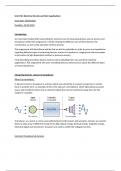
In layman's terms a transducer is a device which uses electricity to convert energy from a certain
form to another form, an example of this is the input of a microphone, which takes physical sound
waves and transforms them into an electrical signal that can be transferred using wires for the
output of a speaker.
Transducer, as a word, is a term used collectively for both sensors and actuators. Sensors are used to
detect a wide array of different energy forms like radiant energy, thermal energy, magnetic energy,
electrical signals and movement. Actuators are used to switch the voltages/currents
Common Transducers & Sensors
, What’s difference between a passive transducer & an active transducer?
The input variety of transducers/sensors produce a signal or voltage response that is proportionate
to the change in the stimulus(or quantity) that they are set to measure. Most types of transducers
can be categorized as two types, passive or active.
Passive transducers require an outside power source to be able to generate their signals. Unlike
active transducers, passive transducers lack the ability to convert physical signals to electrical signals
through themselves, passive transducers are not self-generating, they convert signals through the
means of outside energy sources. Passive transducers internal parameters, such as inductance,
resistance and capacitance change in response to the input signal. The external power source
changes the physical properties of the transducer.
Issue date: 18/03/2022
Deadline: 26/04/2022
Introduction:
As I have been tasked with researching the common uses of measuring devices such as sensors and
transducers within this assignment, I will be relaying the different uses of these devices, the
construction, as well as the operation of these devices.
This assignment will detail the practicals that we had to undertake in order to prove our hypothesise
regarding different types of measuring devices, sensors & transducers, ranging from thermocouples
to pH meters to light dependent resistors to pressure sensors.
I'll be describing how these devices work as well as detailing their uses and their industrial
applications. This assignment will cover everything that you need to know about the different types
of measuring devices.
Measuring devices, sensors & transducers
What is a transducer?
In layman's terms a transducer is a device which uses electricity to convert energy from a certain
form to another form, an example of this is the input of a microphone, which takes physical sound
waves and transforms them into an electrical signal that can be transferred using wires for the
output of a speaker.
Transducer, as a word, is a term used collectively for both sensors and actuators. Sensors are used to
detect a wide array of different energy forms like radiant energy, thermal energy, magnetic energy,
electrical signals and movement. Actuators are used to switch the voltages/currents
Common Transducers & Sensors
, What’s difference between a passive transducer & an active transducer?
The input variety of transducers/sensors produce a signal or voltage response that is proportionate
to the change in the stimulus(or quantity) that they are set to measure. Most types of transducers
can be categorized as two types, passive or active.
Passive transducers require an outside power source to be able to generate their signals. Unlike
active transducers, passive transducers lack the ability to convert physical signals to electrical signals
through themselves, passive transducers are not self-generating, they convert signals through the
means of outside energy sources. Passive transducers internal parameters, such as inductance,
resistance and capacitance change in response to the input signal. The external power source
changes the physical properties of the transducer.



