A 27-year-old man with no significant past medical history of note presents to the
Emergency Department with a one day history of dyspnoea and right-sided pleuritic chest
pain. A chest x-ray is taken which shows a right pneumothorax with a 2.5cm rim of air and
no mediastinal shift. Aspiration is performed by the admitting doctor.
He is reviewed four hours later. His dyspnoea has resolved but the chest x-ray shows that
whilst the pneumothorax has improved there is still a 1.5cm rim of air.
What is the most appropriate management?
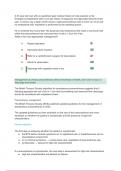
A. Repeat aspiration 3%
B. Intercostal drain insertion 23%
C. Refer to a cardiothoracic surgeon for pleurodesis 0%
D. Admit for observation 16%
E. Discharge with outpatient chest x-ray 57%
Management in primary pneumothorax without shortness of breath, and <2cm in size, is
discharge and review
The British Thoracic Society algorithm for spontaenous pneumothorax suggests that if
following aspiration the rim of air is < 2cm and the breathing has improved then discharge
should be considered with outpatient review.
Pneumothorax: management
The British Thoracic Society (BTS) published updated guidelines for the management of
spontaneous pneumothorax in 2023.
The updated guidelines put less emphasis on the size of the pneumothorax and more
emphasis on whether the patient is symptomatic and the presence of high-risk
characteristics.
Decision algorithm
The first step is assessing whether the patient is symptomatic
● the BTS define minimal symptoms as 'no significant pain or breathlessness and no
physiological compromise'
● no or minimal symptoms → conservative care, regardless of pneumothorax size
● symptomatic → assess for high-risk characteristics
If a pneumothorax is symptomatic, the next step is assessment for high-risk characteristics
● high-risk characteristics are defined as follows:
, ○ haemodynamic compromise (suggesting a tension pneumothorax)
○ significant hypoxia
○ bilateral pneumothorax
○ underlying lung disease
○ ≥ 50 years of age with significant smoking history
○ haemothorax
● if no high-risk characteristics are present, and it is safe to intervene, then there is a
choice of intervention:
○ conservative care
○ ambulatory device
○ needle aspiration
● if high-risk characteristics are present, and it is safe to intervene → chest drain
How is safety or intervention determined?
● before a needle aspiration/chest drain insertion, the safety of intervention should be
assessed
● this depends on the clinical context, but is usually:
○ 2cm laterally or apically on chest x-ray, or
○ any size on CT scan which can be safely accessed with radiological support
,Management options
Conservative care
● patients with a primary spontaneous pneumothorax that is managed conservatively
should be reviewed every 2-4 days as an outpatient
● patients with a secondary spontaneous pneumothorax that is managed
conservatively should be monitored as an inpatient
● if stable, follow-up in the outpatients department in 2-4 weeks
Ambulatory care
● an example of an ambulatory device is the Rocketµ Pleural Vent„
● it includes an 8FG catheter mounted on an 18G needle and a pigtail catheter to
minimize the risk of occlusion
● ambulatory devices typically have a one-way valve and vent to prevent air and fluid
return to the pleural space while allowing for controlled escape of air and drainage of
fluid
, ● many devices also have an indication diaphragm that signals when the catheter tip
enters the pleural space and continues to fluctuate with respiration, aiding in the
assessment of pneumothorax resolution
Needle aspiration
● a chest drain should be inserted if needle aspiration of a pneumothorax is
unsuccessful
● if resolved, discharge and follow-up in the outpatients department in 2-4 weeks
Chest drain insertion
● daily review as an inpatient
● remove drain when resolved
● discharge and follow-up in the outpatients department in 2-4 weeks
Persistentent / recurrent pneumothorax
If a patient has a persistent air leak or insufficient lung reexpansion despite chest drain
insertion, or the patient has recurrent pneumothoraces, then video-assisted thoracoscopic
surgery (VATS) should be considered to allow for mechanical/chemical pleurodesis +/-
bullectomy.
Discharge advice
Emergency Department with a one day history of dyspnoea and right-sided pleuritic chest
pain. A chest x-ray is taken which shows a right pneumothorax with a 2.5cm rim of air and
no mediastinal shift. Aspiration is performed by the admitting doctor.
He is reviewed four hours later. His dyspnoea has resolved but the chest x-ray shows that
whilst the pneumothorax has improved there is still a 1.5cm rim of air.
What is the most appropriate management?
A. Repeat aspiration 3%
B. Intercostal drain insertion 23%
C. Refer to a cardiothoracic surgeon for pleurodesis 0%
D. Admit for observation 16%
E. Discharge with outpatient chest x-ray 57%
Management in primary pneumothorax without shortness of breath, and <2cm in size, is
discharge and review
The British Thoracic Society algorithm for spontaenous pneumothorax suggests that if
following aspiration the rim of air is < 2cm and the breathing has improved then discharge
should be considered with outpatient review.
Pneumothorax: management
The British Thoracic Society (BTS) published updated guidelines for the management of
spontaneous pneumothorax in 2023.
The updated guidelines put less emphasis on the size of the pneumothorax and more
emphasis on whether the patient is symptomatic and the presence of high-risk
characteristics.
Decision algorithm
The first step is assessing whether the patient is symptomatic
● the BTS define minimal symptoms as 'no significant pain or breathlessness and no
physiological compromise'
● no or minimal symptoms → conservative care, regardless of pneumothorax size
● symptomatic → assess for high-risk characteristics
If a pneumothorax is symptomatic, the next step is assessment for high-risk characteristics
● high-risk characteristics are defined as follows:
, ○ haemodynamic compromise (suggesting a tension pneumothorax)
○ significant hypoxia
○ bilateral pneumothorax
○ underlying lung disease
○ ≥ 50 years of age with significant smoking history
○ haemothorax
● if no high-risk characteristics are present, and it is safe to intervene, then there is a
choice of intervention:
○ conservative care
○ ambulatory device
○ needle aspiration
● if high-risk characteristics are present, and it is safe to intervene → chest drain
How is safety or intervention determined?
● before a needle aspiration/chest drain insertion, the safety of intervention should be
assessed
● this depends on the clinical context, but is usually:
○ 2cm laterally or apically on chest x-ray, or
○ any size on CT scan which can be safely accessed with radiological support
,Management options
Conservative care
● patients with a primary spontaneous pneumothorax that is managed conservatively
should be reviewed every 2-4 days as an outpatient
● patients with a secondary spontaneous pneumothorax that is managed
conservatively should be monitored as an inpatient
● if stable, follow-up in the outpatients department in 2-4 weeks
Ambulatory care
● an example of an ambulatory device is the Rocketµ Pleural Vent„
● it includes an 8FG catheter mounted on an 18G needle and a pigtail catheter to
minimize the risk of occlusion
● ambulatory devices typically have a one-way valve and vent to prevent air and fluid
return to the pleural space while allowing for controlled escape of air and drainage of
fluid
, ● many devices also have an indication diaphragm that signals when the catheter tip
enters the pleural space and continues to fluctuate with respiration, aiding in the
assessment of pneumothorax resolution
Needle aspiration
● a chest drain should be inserted if needle aspiration of a pneumothorax is
unsuccessful
● if resolved, discharge and follow-up in the outpatients department in 2-4 weeks
Chest drain insertion
● daily review as an inpatient
● remove drain when resolved
● discharge and follow-up in the outpatients department in 2-4 weeks
Persistentent / recurrent pneumothorax
If a patient has a persistent air leak or insufficient lung reexpansion despite chest drain
insertion, or the patient has recurrent pneumothoraces, then video-assisted thoracoscopic
surgery (VATS) should be considered to allow for mechanical/chemical pleurodesis +/-
bullectomy.
Discharge advice