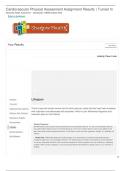
Cardiovascular Physical Assessment Assignment Results | Turned In
Advanced Health Assessment - Chamberlain, NR509-October-2024
Return to Assignment
Your Results Lab Pass
Activity Time: 9 min
Overview Lifespan
Transcript
Subjective Data Collection Tina’s 5-year-old cousin comes into the clinic and you notice that her heart rate increases
with inspiration and decreases with expiration. What is your differential diagnosis and
Objective Data Collection
treatment plan for this finding?
Education & Empathy
Documentation
Student Response:
Lifespan My differential would include intracranial pressure and myocardial ischemia. To rule out myocardial infarction,
we would need to keep an eye on her blood pressure. A CT scan could be done to rule out any bleed on the
Review Questions brain that could cause intracranial pressure. If she doesn't have any other symptoms, though, it is probably not
serious.
Self-Reflection
Model Note: Differential diagnosis includes benign sinus dysrhythmia, increased intracranial pressure,
increased vagal tone, and myocardial ischemia. Her blood pressure should be monitored to ensure perfusion
to rule out myocardial ischemia. She should be assessed for other symptoms that may indicate an underlying
problem. With no other symptoms, it can be assumed that the dysrhythmia is benign since it is so common in
children.
1/2
Advanced Health Assessment - Chamberlain, NR509-October-2024
Return to Assignment
Your Results Lab Pass
Activity Time: 9 min
Overview Lifespan
Transcript
Subjective Data Collection Tina’s 5-year-old cousin comes into the clinic and you notice that her heart rate increases
with inspiration and decreases with expiration. What is your differential diagnosis and
Objective Data Collection
treatment plan for this finding?
Education & Empathy
Documentation
Student Response:
Lifespan My differential would include intracranial pressure and myocardial ischemia. To rule out myocardial infarction,
we would need to keep an eye on her blood pressure. A CT scan could be done to rule out any bleed on the
Review Questions brain that could cause intracranial pressure. If she doesn't have any other symptoms, though, it is probably not
serious.
Self-Reflection
Model Note: Differential diagnosis includes benign sinus dysrhythmia, increased intracranial pressure,
increased vagal tone, and myocardial ischemia. Her blood pressure should be monitored to ensure perfusion
to rule out myocardial ischemia. She should be assessed for other symptoms that may indicate an underlying
problem. With no other symptoms, it can be assumed that the dysrhythmia is benign since it is so common in
children.
1/2