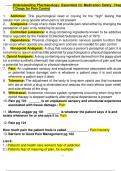
Understanding Pharmacology: Essentials for Medication Safety: Chap
7 Drugs for Pain Control
1. Addiction: THe psychological need or craving for the "high" feeling that
results from using opioids when pain is not present
2. Analgesics: Drugs of any class that provide pain relief either by changing the
perception of pain or by reducing its source
3. Controlled substance: A drug containing ingredients known to be addictive
that is regulated by the Federal COntrolled Substances Act of 1970
4. Dependance: Physical changes in autonomic nervous system function that
can occur when opioids are used long term and are not needed for pain control
5. Nonopioid Analgesic: A drug that reduces a person's perception of pain; it is
not similar to opium and has little potential for psychological or physical dependence
6. Opioid Analgesic: A drug containing any ingredient derived from the poppy plant
(or a similar synthetic chemical) that changes a person's perception of pain and has
a potential for psychological or physical dependence
7. Pain: An unpleasant sensory and emotional experience associated with acute
or potential tissue damage; pain is whatever a patient says it is and exists
whenever a patient says it does.
8. Tolerance: The adjustment of the body to long-term opioid use that increases
tehr ate at which a drug is eliminated and reduces the main effects (pain relief)
and side effects of the drug
9. Withdrawal: Autonomic nervous system symptoms occurring when long-term
opioid therapy is stopped suddenly after physical dependence is present
10. Pain pg 101 ______ is an unpleasant sensory and emotional experience
associated with tissue damage.: Pain
11. Memory Jogger pg 101 _______ is whatever the patient says it is and
exists whenever he or she says it is: Pain
12. Pain pg 101
How much pain the patient feels is called _____ ______: Pain Intensity
13. Barriers to Good Pain Management pg 102
List 6:
1.) Patient's and health care worker's fear of addiction
2.) Patient's fear of meaning of pain, for example:
, Understanding Pharmacology: Essentials for Medication Safety: Chap
7 Drugs for Pain Control
a.) Worsening of Condition
b.) Threats to independence
c.) Impending death
3.) Patient's and health care worker's belief that pain is an expected part of aging
4.) Patient's fear of testing
5.) Health care worker's fear of "Drugging the older adult"
6.) Heal care provider's fear of overdosing a patient
14. Pain Origin and Transmission pg 103
_______ are sensory nerve endings that, when activated, trigger the message
sent to the brain that allows the perception of pain.: Nociceptors
15. Pain Origin and Transmission pg 103
Nociceptors can be activated when body chemicals called ______ bind to
them.: Mediators
16. Pain Perception pg 103
The smallest amount of tissue damage that makes a person aware of having
pain is known as the _____ _______: Pain Threshold
17. Pain Perception pg 103
Related to pain threshold is _____ _______, which is a person;s ability to
endure or "stand" the pain intensity. Behavioral and emotional factors as well
as physical factors affects this.: Pain Tolerance
18. Types of Pain pg 104
Pain is divided into types on the basis of its cause, how long it lasts, and
whether it is present continuously or comes and goes (intermittent). The three
main types of pain are::
Acute
Chronic
Cancer
19. Types of Pain pg 104
, Understanding Pharmacology: Essentials for Medication Safety: Chap
7 Drugs for Pain Control
_______ _______ has a sudden onset, an identifiable cause, a limited duration,
and improves with time even when it is not treated. It is the most common
pain type; typically causes include trauma, surgery, heart attack,
inflammation, and burns. This type of pain usually triggers the physical
responses of elevated heart rate, respiratory rate, and blood pressure. Skin
becomes cool and clammy with increased sweating and the hands and feet.
The mouth becomes dry, and usually the pupils of the eyes dilate. A
concentrate, general distress, and a sense that something bad is happening
(a sense of impending doom): Acute Pain
20. Types of Pain pg 104
______ ______ is present daily for a month. It persists or increases with
time, may not have an identifiable cause, and does not trigger the
physiologic responses associated with acute pain. This means that a person
with chronic pain can have severe pain intensity without changes from the
normal ranges for heart rate, breathing rate, or blood pressure. Chronic pain
may hurt less on some days than others but is always present. Causes may
be difficult to find.: Chronic Pain 21. Types of Pain pg 104
_______ ________ has many causes and is complex. This means that more
than one pain strategy and often more than one type of drug for pain control
are needed. The patient with cancer often receives traditional pain-control
drugs but at much higher doses than those prescribed for other types of pain.
The drug therapy plan may include every type of pain-control drug given in
combination to ensure adequate pain relief. Drug therapy for cancer pain
must be tailored to each patient for the most effective pain control: Cancer
pain
22. General Issues Related to Analgesic Drug Therapy pg 104
_________ are drugs of any class that control pain either by changing
the perception or by reducing the source of pain.: Analgesics
23. General Issues Related to Analgesic Drug Therapy pg 104
7 Drugs for Pain Control
1. Addiction: THe psychological need or craving for the "high" feeling that
results from using opioids when pain is not present
2. Analgesics: Drugs of any class that provide pain relief either by changing the
perception of pain or by reducing its source
3. Controlled substance: A drug containing ingredients known to be addictive
that is regulated by the Federal COntrolled Substances Act of 1970
4. Dependance: Physical changes in autonomic nervous system function that
can occur when opioids are used long term and are not needed for pain control
5. Nonopioid Analgesic: A drug that reduces a person's perception of pain; it is
not similar to opium and has little potential for psychological or physical dependence
6. Opioid Analgesic: A drug containing any ingredient derived from the poppy plant
(or a similar synthetic chemical) that changes a person's perception of pain and has
a potential for psychological or physical dependence
7. Pain: An unpleasant sensory and emotional experience associated with acute
or potential tissue damage; pain is whatever a patient says it is and exists
whenever a patient says it does.
8. Tolerance: The adjustment of the body to long-term opioid use that increases
tehr ate at which a drug is eliminated and reduces the main effects (pain relief)
and side effects of the drug
9. Withdrawal: Autonomic nervous system symptoms occurring when long-term
opioid therapy is stopped suddenly after physical dependence is present
10. Pain pg 101 ______ is an unpleasant sensory and emotional experience
associated with tissue damage.: Pain
11. Memory Jogger pg 101 _______ is whatever the patient says it is and
exists whenever he or she says it is: Pain
12. Pain pg 101
How much pain the patient feels is called _____ ______: Pain Intensity
13. Barriers to Good Pain Management pg 102
List 6:
1.) Patient's and health care worker's fear of addiction
2.) Patient's fear of meaning of pain, for example:
, Understanding Pharmacology: Essentials for Medication Safety: Chap
7 Drugs for Pain Control
a.) Worsening of Condition
b.) Threats to independence
c.) Impending death
3.) Patient's and health care worker's belief that pain is an expected part of aging
4.) Patient's fear of testing
5.) Health care worker's fear of "Drugging the older adult"
6.) Heal care provider's fear of overdosing a patient
14. Pain Origin and Transmission pg 103
_______ are sensory nerve endings that, when activated, trigger the message
sent to the brain that allows the perception of pain.: Nociceptors
15. Pain Origin and Transmission pg 103
Nociceptors can be activated when body chemicals called ______ bind to
them.: Mediators
16. Pain Perception pg 103
The smallest amount of tissue damage that makes a person aware of having
pain is known as the _____ _______: Pain Threshold
17. Pain Perception pg 103
Related to pain threshold is _____ _______, which is a person;s ability to
endure or "stand" the pain intensity. Behavioral and emotional factors as well
as physical factors affects this.: Pain Tolerance
18. Types of Pain pg 104
Pain is divided into types on the basis of its cause, how long it lasts, and
whether it is present continuously or comes and goes (intermittent). The three
main types of pain are::
Acute
Chronic
Cancer
19. Types of Pain pg 104
, Understanding Pharmacology: Essentials for Medication Safety: Chap
7 Drugs for Pain Control
_______ _______ has a sudden onset, an identifiable cause, a limited duration,
and improves with time even when it is not treated. It is the most common
pain type; typically causes include trauma, surgery, heart attack,
inflammation, and burns. This type of pain usually triggers the physical
responses of elevated heart rate, respiratory rate, and blood pressure. Skin
becomes cool and clammy with increased sweating and the hands and feet.
The mouth becomes dry, and usually the pupils of the eyes dilate. A
concentrate, general distress, and a sense that something bad is happening
(a sense of impending doom): Acute Pain
20. Types of Pain pg 104
______ ______ is present daily for a month. It persists or increases with
time, may not have an identifiable cause, and does not trigger the
physiologic responses associated with acute pain. This means that a person
with chronic pain can have severe pain intensity without changes from the
normal ranges for heart rate, breathing rate, or blood pressure. Chronic pain
may hurt less on some days than others but is always present. Causes may
be difficult to find.: Chronic Pain 21. Types of Pain pg 104
_______ ________ has many causes and is complex. This means that more
than one pain strategy and often more than one type of drug for pain control
are needed. The patient with cancer often receives traditional pain-control
drugs but at much higher doses than those prescribed for other types of pain.
The drug therapy plan may include every type of pain-control drug given in
combination to ensure adequate pain relief. Drug therapy for cancer pain
must be tailored to each patient for the most effective pain control: Cancer
pain
22. General Issues Related to Analgesic Drug Therapy pg 104
_________ are drugs of any class that control pain either by changing
the perception or by reducing the source of pain.: Analgesics
23. General Issues Related to Analgesic Drug Therapy pg 104