Arrays, Vectors and Strings in C
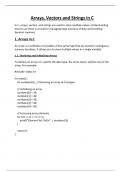
In C, arrays, vectors, and strings are used to store multiple values. Understanding
how to use them is crucial for managing large amounts of data and handling
dynamic memory.
1. Arrays in C
An array is a collection of variables of the same type that are stored in contiguous
memory locations. It allows you to store multiple values in a single variable.
1.1. Declaring and Initializing Arrays
To declare an array in C, specify the data type, the array name, and the size of the
array. For example:
#include <stdio.h>
int main() {
int numbers[5]; // Declaring an array of 5 integers
// Initializing an array
numbers[0] = 10;
numbers[1] = 20;
numbers[2] = 30;
numbers[3] = 40;
numbers[4] = 50;
// Accessing array elements
for (int i = 0; i < 5; i++) {
printf("Element %d: %d\n", i, numbers[i]);
}
return 0;
}
, 1.2. Array Initialization
You can initialize an array at the time of declaration:
#include <stdio.h>
int main() {
int numbers[] = {10, 20, 30, 40, 50}; // Size is automatically determined
// Accessing array elements
for (int i = 0; i < 5; i++) {
printf("Element %d: %d\n", i, numbers[i]);
}
return 0;
}
1.3. Multi-Dimensional Arrays
C supports multidimensional arrays, where each element is itself an array. A
common use case is a matrix.
#include <stdio.h>
int main() {
int matrix[2][3] = {{1, 2, 3}, {4, 5, 6}}; // 2x3 matrix
// Accessing elements of a 2D array
for (int i = 0; i < 2; i++) {
for (int j = 0; j < 3; j++) {
printf("Element at [%d][%d]: %d\n", i, j, matrix[i][j]);
}
}
return 0;
}
In C, arrays, vectors, and strings are used to store multiple values. Understanding
how to use them is crucial for managing large amounts of data and handling
dynamic memory.
1. Arrays in C
An array is a collection of variables of the same type that are stored in contiguous
memory locations. It allows you to store multiple values in a single variable.
1.1. Declaring and Initializing Arrays
To declare an array in C, specify the data type, the array name, and the size of the
array. For example:
#include <stdio.h>
int main() {
int numbers[5]; // Declaring an array of 5 integers
// Initializing an array
numbers[0] = 10;
numbers[1] = 20;
numbers[2] = 30;
numbers[3] = 40;
numbers[4] = 50;
// Accessing array elements
for (int i = 0; i < 5; i++) {
printf("Element %d: %d\n", i, numbers[i]);
}
return 0;
}
, 1.2. Array Initialization
You can initialize an array at the time of declaration:
#include <stdio.h>
int main() {
int numbers[] = {10, 20, 30, 40, 50}; // Size is automatically determined
// Accessing array elements
for (int i = 0; i < 5; i++) {
printf("Element %d: %d\n", i, numbers[i]);
}
return 0;
}
1.3. Multi-Dimensional Arrays
C supports multidimensional arrays, where each element is itself an array. A
common use case is a matrix.
#include <stdio.h>
int main() {
int matrix[2][3] = {{1, 2, 3}, {4, 5, 6}}; // 2x3 matrix
// Accessing elements of a 2D array
for (int i = 0; i < 2; i++) {
for (int j = 0; j < 3; j++) {
printf("Element at [%d][%d]: %d\n", i, j, matrix[i][j]);
}
}
return 0;
}