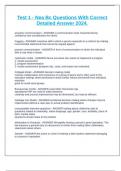
Test 1 - Nea Bc Questions With Correct
Detailed Answer 2024.
assertive communication - ANSWER-a communication style characterized by
confidence and consideration for others
Fogging - ANSWER-Assertive skill in which a person responds to a criticism by making
noncommittal statements that cannot be argued against
passive communication - ANSWER-A form of communication in which the individual
fails to say what is meant
cybernetic model - ANSWER-Nurse executive who wants to implement a program
1. needs assessment
2. program implementation
3. results assessment (program obj., costs, and impact are evaluated.
Collegial Model - ANSWER-Decision making model
involves collaboration and consensus of a group of peers and is often used in the
education settings where professions share similar values and benefit from individual
expertise
good for small sized groups
Bureaucratic model - ANSWER-used within hierarchal orgs
operational P&P are used to make decisions
creativity and process improvement may be diminished, but may be efficient
Garbage Can Model - ANSWER-accidental decision making where changes may be
implemented without a clear plan or actual problem identification
unacceptable interview questions - ANSWER-asking about children/or plan to
questions related to nationality, native language, age, gender, race, disability, place of
birth, marital status
Questions should relate to the position
defamation of character - ANSWER-Wrongfully hurting a person's good reputation. The
law imposes a general duty on all persons to refrain from making false, defamatory
statements about others.
Slander - ANSWER-the action or crime of making a false spoken statement damaging
to a person's reputation.
,Libel - ANSWER-A written defamation of a person's character, reputation, business, or
property rights.
Minor consent rules - ANSWER-all 50 states allow minors to consent for STD testing
and treatment
26 states allow for contraceptive services
state laws vary widely
very few states allow minors to consent to abortion
informed consent - ANSWER-cannot be provided by registered nurse
only the primary provider may provide the information required
Paternalistic - ANSWER-tending to supply the needs of or regulate the activities of
those under one's control
diminish autonomy
principles of autonomy and beneficence are in conflict
Total Patient Care Model - ANSWER-Model of care in which one nurse provides total
care to assigned patients.
functional nursing model - ANSWER-a method of providing patient care by which each
licensed and unlicensed staff member performs specific tasks for a large group of
patients (may be seen during a mass casualty event)
team nursing model - ANSWER-the RN is the leader who leads a team of other RN's,
practical nurses, and nursing assistive personnel who provide direct patient care.
Primary Nursing Model - ANSWER-A nurse is accountable for planning, evaluating, and
directing the care of a pt 24/7 throughout stay.
patient classification system - ANSWER-Method used to group or categorize patients
according to specific criteria and care requirements and thus help quantify the patient
acuity, or amount and level of nursing care needed.
Social Security Act - ANSWER-amended to include PPS for medicare beneficiaries
diagnosis related groups - ANSWER-medicare fixed fee structure for hospital billing of
inpatient services
based on international classification of disease diagnosis, procedures, age, comorbs.
Medical Waste - ANSWER-any solid waste that is generated in the diagnosis,
treatment, or immunization of human beings or animals, in research pertaining thereto,
or in the production or testing of biologicals
regulated by state environmental and health departments
, patient self determination act - ANSWER-A federal law that mandates that every
individual has the right to make decisions regarding medical care, including the right to
refuse treatment and the right-to-die
on admission patient must be asked about DPOA, living will and documented responses
SWOT analysis - ANSWER-a planning tool used to analyze an organization's strengths,
weaknesses, opportunities, and threats
Zero-based budgeting - ANSWER-a budgeting approach in which each department
starts from zero every year and must justify every item in the budget, rather than simply
adjusting the previous year's budget amounts
incremental budgeting - ANSWER-allocates increased or decreased funds to a
department by using the last budget period as a reference point; only incremental
changes in the budget request are reviewed
Priority Based Budgeting - ANSWER-development of a prioritization plan when
determining the allocation of resources
activity based budgeting - ANSWER-creating a budget based on costs of key activities
and their relationship to strategic goals
capital budget - ANSWER-budget for major capital, or investment, expenditures
operational budget - ANSWER-A type of budget that allocates and controls resources to
meet an organization's goals and objectives for the fiscal year
Labor budget - ANSWER-Hours of direct labor available for use
subset of operational budget
Benchmarking - ANSWER-a process by which a company compares its performance
with that of high-performing organizations
ANA Principles for Delegating Care - ANSWER-The nursing profession determines the
scope of nursing practice
The nursing profession defines and supervises UAPs involved in providing direct
nursing care
The RN is responsible and accountable for nursing practice
The RN supervises any assistant providing direct patient care
The purpose of UAP is to work in supportive role to the RN
specifically addressed by each state nurse practice act
OSHA blood-borne pathogens standard - ANSWER-designed to protect employees
against occupational exposure to blood-borne pathogens
new employees must be offered Hep B vaccination
Hep B Vaccination declination is mandatory
Detailed Answer 2024.
assertive communication - ANSWER-a communication style characterized by
confidence and consideration for others
Fogging - ANSWER-Assertive skill in which a person responds to a criticism by making
noncommittal statements that cannot be argued against
passive communication - ANSWER-A form of communication in which the individual
fails to say what is meant
cybernetic model - ANSWER-Nurse executive who wants to implement a program
1. needs assessment
2. program implementation
3. results assessment (program obj., costs, and impact are evaluated.
Collegial Model - ANSWER-Decision making model
involves collaboration and consensus of a group of peers and is often used in the
education settings where professions share similar values and benefit from individual
expertise
good for small sized groups
Bureaucratic model - ANSWER-used within hierarchal orgs
operational P&P are used to make decisions
creativity and process improvement may be diminished, but may be efficient
Garbage Can Model - ANSWER-accidental decision making where changes may be
implemented without a clear plan or actual problem identification
unacceptable interview questions - ANSWER-asking about children/or plan to
questions related to nationality, native language, age, gender, race, disability, place of
birth, marital status
Questions should relate to the position
defamation of character - ANSWER-Wrongfully hurting a person's good reputation. The
law imposes a general duty on all persons to refrain from making false, defamatory
statements about others.
Slander - ANSWER-the action or crime of making a false spoken statement damaging
to a person's reputation.
,Libel - ANSWER-A written defamation of a person's character, reputation, business, or
property rights.
Minor consent rules - ANSWER-all 50 states allow minors to consent for STD testing
and treatment
26 states allow for contraceptive services
state laws vary widely
very few states allow minors to consent to abortion
informed consent - ANSWER-cannot be provided by registered nurse
only the primary provider may provide the information required
Paternalistic - ANSWER-tending to supply the needs of or regulate the activities of
those under one's control
diminish autonomy
principles of autonomy and beneficence are in conflict
Total Patient Care Model - ANSWER-Model of care in which one nurse provides total
care to assigned patients.
functional nursing model - ANSWER-a method of providing patient care by which each
licensed and unlicensed staff member performs specific tasks for a large group of
patients (may be seen during a mass casualty event)
team nursing model - ANSWER-the RN is the leader who leads a team of other RN's,
practical nurses, and nursing assistive personnel who provide direct patient care.
Primary Nursing Model - ANSWER-A nurse is accountable for planning, evaluating, and
directing the care of a pt 24/7 throughout stay.
patient classification system - ANSWER-Method used to group or categorize patients
according to specific criteria and care requirements and thus help quantify the patient
acuity, or amount and level of nursing care needed.
Social Security Act - ANSWER-amended to include PPS for medicare beneficiaries
diagnosis related groups - ANSWER-medicare fixed fee structure for hospital billing of
inpatient services
based on international classification of disease diagnosis, procedures, age, comorbs.
Medical Waste - ANSWER-any solid waste that is generated in the diagnosis,
treatment, or immunization of human beings or animals, in research pertaining thereto,
or in the production or testing of biologicals
regulated by state environmental and health departments
, patient self determination act - ANSWER-A federal law that mandates that every
individual has the right to make decisions regarding medical care, including the right to
refuse treatment and the right-to-die
on admission patient must be asked about DPOA, living will and documented responses
SWOT analysis - ANSWER-a planning tool used to analyze an organization's strengths,
weaknesses, opportunities, and threats
Zero-based budgeting - ANSWER-a budgeting approach in which each department
starts from zero every year and must justify every item in the budget, rather than simply
adjusting the previous year's budget amounts
incremental budgeting - ANSWER-allocates increased or decreased funds to a
department by using the last budget period as a reference point; only incremental
changes in the budget request are reviewed
Priority Based Budgeting - ANSWER-development of a prioritization plan when
determining the allocation of resources
activity based budgeting - ANSWER-creating a budget based on costs of key activities
and their relationship to strategic goals
capital budget - ANSWER-budget for major capital, or investment, expenditures
operational budget - ANSWER-A type of budget that allocates and controls resources to
meet an organization's goals and objectives for the fiscal year
Labor budget - ANSWER-Hours of direct labor available for use
subset of operational budget
Benchmarking - ANSWER-a process by which a company compares its performance
with that of high-performing organizations
ANA Principles for Delegating Care - ANSWER-The nursing profession determines the
scope of nursing practice
The nursing profession defines and supervises UAPs involved in providing direct
nursing care
The RN is responsible and accountable for nursing practice
The RN supervises any assistant providing direct patient care
The purpose of UAP is to work in supportive role to the RN
specifically addressed by each state nurse practice act
OSHA blood-borne pathogens standard - ANSWER-designed to protect employees
against occupational exposure to blood-borne pathogens
new employees must be offered Hep B vaccination
Hep B Vaccination declination is mandatory