During the course, students will orally present an empirical research article in class (5 points), and complete 2
work projects (3 points each). At the end of the course, there
will be a written exam with 2 open questions (10 points each). Extra points (up to 2) will be given for class
participation.
Oct 1
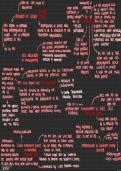
Pavlov - behaviourism - classical conditioning
Watson - behaviourism - supported nurture over nature; exp. little Albert’s experiment (reinforcement
and punishment)
Skinner - behaviourism - operant conditioning - positive and negative reinforcement
Piaget - constructivism - learning occurs thru active interaction with the env. Intelligence is not a
fixed trait
- Views on mathematical abilities: children in the early years of primary school need concrete
objects, pictures, actions, and symbols to develop mathematical meanings.
- Conservation theory -
Vygotsky - socio-cultural - child’s cog dev and learning ability can be guided and mediated by social
interactions. Basis for adaptive algorithms in modern video games (starts off easy and then builds up)
Summary
Behaviourism
- Groundbreaking idea: behav can be measurable
- Main limitation: didn’t care about cog process. Input - output, reductionist
Constructivism
- Groundbreaking idea: substantial modification of the mental structures. Qualitative
experiments. Stages instead of continues dev, active learning
- Main limitation: underestimation of children, did not consider many individual differences in
the same stage (ex: grouped them based on age)
- Prefers nature over nurture
Socio-cultural
- Groundbreaking: culture and language are important variables
- Limitation: not all social and cultural groups experience equal engagement in learning, as
individual learners may derive different meanings from their experiences based on their
unique backgrounds and contexts
- Prefers nurture over nature
Piaget - main criticism
- Piaget underestimated the role of social experience. In response - Vygotsky conferred a
crucial role to language and culture
- Piaget considered that cog dev was based on the evolution of the unitary structure. In response
- Cognitivists studied human cog in separate units and functions
- Piaget underestimated the
Oct 7
Nativism vs Neuroconstructivism
, - Nativism = cares about what makes us humans. Emphasis is on evolution… does comparative
studies across animals and cultures. Things are predisposed for ex, we are born without teeth
but we have the ability to grow teeth during development
- Neuroconstructivism = we are human but how do we become us… individual differences,
environment, genetics, experiences during critical periods
- Limitation: why do we do things similarly tho?
- Teeth ex: genetic and environment affects how the teeth grow
Oct 8
Nativism (most concepts are innate) - the env does not influence ontogenetic dev but phylogenetic dev
(evolution)
- Jerry Fodor: modularity of the mind - a binding principle that across mental domains, we still
see the same representation
- Ex: red bouncing ball. It is innate. Comparative views of lower-lvl processes like
behaviourists
- Steven Pinker: the mind works by domains
- Chomsky: the universal grammar, linguistic theory
- We all have the same ability to learn languages
- Gergely and Csibra: natural pedagogy, ostensive cues
- We have a human-specific capacity that allows us to acquire cultural info from
comms
- Ex: joint attention. On the basis of signals, ppl will react to stimulus. Ostensive cue =
same across humans and animals
- Leslie: theory of mind
- We are born with a set of knowledge related to the states of others’ mind which is part
of the genetic
- Spelke (the core knowledge article): children have innate knowledge sys and specific domains
- Modules: numbers, objects, persons (Faces), spatial relationships, actions
- Carey (coworker of Spelke): humans are born with cog modules however, the origin of
concepts perspective (bootstrapping) can be evolved
Neuroconstructivism: genes and env play a role in who we are - Johnson and Karmiloff-Smith
Oct 10
System of Subitizing - ability to quickly recognize the number of a set of objects that are presented
simultaneously
Is language and reading prerequisites for mathematical learning?
Proto-arithmetic abilities, study by Wynn in the 90s
- Babies look at either 1 or 2 objects and understand
Subitizing-object tracking system, study by Carey in 2005
- Crackers are hidden in buckets and babies (10 month olds) reach for the bucket that has the
most crackers
- Two separate mechanisms: OTS and ANS. limitation: only up to 3 crackers, 4 is too
confusing of a number for babies
ANS are also present in other species like rats and fish.
OTS need to be universal. Ex: Munduruku population in Brazil
- Language makes maths more precise
Numbers are located in the parietal lobe bc space influences numerical representations
work projects (3 points each). At the end of the course, there
will be a written exam with 2 open questions (10 points each). Extra points (up to 2) will be given for class
participation.
Oct 1
Pavlov - behaviourism - classical conditioning
Watson - behaviourism - supported nurture over nature; exp. little Albert’s experiment (reinforcement
and punishment)
Skinner - behaviourism - operant conditioning - positive and negative reinforcement
Piaget - constructivism - learning occurs thru active interaction with the env. Intelligence is not a
fixed trait
- Views on mathematical abilities: children in the early years of primary school need concrete
objects, pictures, actions, and symbols to develop mathematical meanings.
- Conservation theory -
Vygotsky - socio-cultural - child’s cog dev and learning ability can be guided and mediated by social
interactions. Basis for adaptive algorithms in modern video games (starts off easy and then builds up)
Summary
Behaviourism
- Groundbreaking idea: behav can be measurable
- Main limitation: didn’t care about cog process. Input - output, reductionist
Constructivism
- Groundbreaking idea: substantial modification of the mental structures. Qualitative
experiments. Stages instead of continues dev, active learning
- Main limitation: underestimation of children, did not consider many individual differences in
the same stage (ex: grouped them based on age)
- Prefers nature over nurture
Socio-cultural
- Groundbreaking: culture and language are important variables
- Limitation: not all social and cultural groups experience equal engagement in learning, as
individual learners may derive different meanings from their experiences based on their
unique backgrounds and contexts
- Prefers nurture over nature
Piaget - main criticism
- Piaget underestimated the role of social experience. In response - Vygotsky conferred a
crucial role to language and culture
- Piaget considered that cog dev was based on the evolution of the unitary structure. In response
- Cognitivists studied human cog in separate units and functions
- Piaget underestimated the
Oct 7
Nativism vs Neuroconstructivism
, - Nativism = cares about what makes us humans. Emphasis is on evolution… does comparative
studies across animals and cultures. Things are predisposed for ex, we are born without teeth
but we have the ability to grow teeth during development
- Neuroconstructivism = we are human but how do we become us… individual differences,
environment, genetics, experiences during critical periods
- Limitation: why do we do things similarly tho?
- Teeth ex: genetic and environment affects how the teeth grow
Oct 8
Nativism (most concepts are innate) - the env does not influence ontogenetic dev but phylogenetic dev
(evolution)
- Jerry Fodor: modularity of the mind - a binding principle that across mental domains, we still
see the same representation
- Ex: red bouncing ball. It is innate. Comparative views of lower-lvl processes like
behaviourists
- Steven Pinker: the mind works by domains
- Chomsky: the universal grammar, linguistic theory
- We all have the same ability to learn languages
- Gergely and Csibra: natural pedagogy, ostensive cues
- We have a human-specific capacity that allows us to acquire cultural info from
comms
- Ex: joint attention. On the basis of signals, ppl will react to stimulus. Ostensive cue =
same across humans and animals
- Leslie: theory of mind
- We are born with a set of knowledge related to the states of others’ mind which is part
of the genetic
- Spelke (the core knowledge article): children have innate knowledge sys and specific domains
- Modules: numbers, objects, persons (Faces), spatial relationships, actions
- Carey (coworker of Spelke): humans are born with cog modules however, the origin of
concepts perspective (bootstrapping) can be evolved
Neuroconstructivism: genes and env play a role in who we are - Johnson and Karmiloff-Smith
Oct 10
System of Subitizing - ability to quickly recognize the number of a set of objects that are presented
simultaneously
Is language and reading prerequisites for mathematical learning?
Proto-arithmetic abilities, study by Wynn in the 90s
- Babies look at either 1 or 2 objects and understand
Subitizing-object tracking system, study by Carey in 2005
- Crackers are hidden in buckets and babies (10 month olds) reach for the bucket that has the
most crackers
- Two separate mechanisms: OTS and ANS. limitation: only up to 3 crackers, 4 is too
confusing of a number for babies
ANS are also present in other species like rats and fish.
OTS need to be universal. Ex: Munduruku population in Brazil
- Language makes maths more precise
Numbers are located in the parietal lobe bc space influences numerical representations