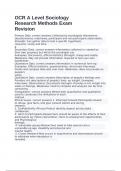
OCR A Level Sociology
Research Methods Exam
Revision
Primary Data correct answers Collected by sociologists themselves.
Examples:
Questionnaires, interviews, participant and non-participant observation,
experiments
Strength: Can gather data to test a specific hypothesis
Weakness:costly and time
consumin
g
Secondary Data correct answers Information collected or created by
someone
their own else for but which the sociologist can
purposes
then use. Documents, official statistics Strength: cheap and readily
Examples:
available
Weakness: May not provide information required to test your own
hypotheses
Quantative Data correct answers Information in numerical form eg
official statistics
Examples: Official statistics, questionnaires, structured interviews.
Strengths:
trends and Can spot data sets over time. Weakness: does not provide an
compare
insight into
people's
views.
Qualitative Data correct answers Description of people's feelings and
experiences.
Provides rich descriptions of people's lives- an insight. Examples:
Unstructured
Interviews, Observations, Documents Strength: Provides a rich insight into
a person's
views or feelings. Weakness: Hard to compare and analysis can be time
consuming
Triangulation correct answers Where both quantitative and qualitative
methods
used are
to counteract the limitations of each
method.
Ethical Issues correct answers 1. Informed Consent-Participants should
have
to the right
refuse, give facts, and give consent before and during
research.
2. Confidentiality /Privacy-Protect identity,respect privacy,data
confidential.
3. Harm to Participants-Researchers should be aware of the effects of their
research on eg. Police intervention, Harm to employment opportunities
participants
Social
and exclusion,
Psychological
damage.
4. Vulnerable groups-Researchers need to take special care o
participants
vulnerable egwho
age,are
disability,and physical and
mental health.
5. Covert Research-May occurs in experiments and observations-should
offer
to the right
withdraw when deception is
revealed.
, Practical correct answers 1. Time and Money-Some methods require
more timethan
complete to others. This can affect how much money is needed eg
RUTTER -
Questionnaire in 12 schools or VENKATESH- Observation lasting 7
years.
2. Funding body requirements-funding bodies eg ESRC may request
that data isin a certain format eg
presented
statistical.
3. Personal skills-Do you have the right characteristics or personal skills for
your chosen
method? Eg Interviews require more
rapport.
4. Subject matter-Method needs to be appropriate for the group being
studied eg
questionnaire should not be used for prisoners who may have
poor literacy.
5. Research opportunity-If an unexpected opportunity arises it is not
possible to methods.
structured use Eg Patrick -Glasgow Gang
Observed.
Theoretical correct answers 1. Positivists vs Interpretivists-Positivists-
preferreliable
more to use and representative quantitative methods. Interpretivism -
prefervalid
more to use
qualitative methods allowing
insight.
2. Reliability-A method that can be repeated and similar results are
obtained. EG.can
experiments Labbe repeated over time and obtain the
same results.
3.
Representativeness
whether the people we study are a typical cross-section of the group we are
interested
in. Large-scale surveys have representative
samples.
4. Validity-A valid method produces an accurate or genuine picture of what
something is
really
like.
Hypothesis correct answers Definition-This is a possible explanation that can
be tested
by collecting evidence to support it or prove
it false.
It helps to provide a link to the underlying theory and specific research
question. It helps
Aims correct answers Definition: Collects data on a certain topic.
in data analysis and measures the validity and reliability of the
Interpretivists
broad aim rather
research. favour
thanaa hypothesis concerned with actors'
meanings.
Advantage- More open-
ended.
Not tied to trying to prove a particular hypothesis. Useful at the start of
research
we know when
very
little.
Operationalisation correct answers Definition: Process of turning a
sociological
or theory intoconcept
something
measurable.
Advantage
s:
Research Methods Exam
Revision
Primary Data correct answers Collected by sociologists themselves.
Examples:
Questionnaires, interviews, participant and non-participant observation,
experiments
Strength: Can gather data to test a specific hypothesis
Weakness:costly and time
consumin
g
Secondary Data correct answers Information collected or created by
someone
their own else for but which the sociologist can
purposes
then use. Documents, official statistics Strength: cheap and readily
Examples:
available
Weakness: May not provide information required to test your own
hypotheses
Quantative Data correct answers Information in numerical form eg
official statistics
Examples: Official statistics, questionnaires, structured interviews.
Strengths:
trends and Can spot data sets over time. Weakness: does not provide an
compare
insight into
people's
views.
Qualitative Data correct answers Description of people's feelings and
experiences.
Provides rich descriptions of people's lives- an insight. Examples:
Unstructured
Interviews, Observations, Documents Strength: Provides a rich insight into
a person's
views or feelings. Weakness: Hard to compare and analysis can be time
consuming
Triangulation correct answers Where both quantitative and qualitative
methods
used are
to counteract the limitations of each
method.
Ethical Issues correct answers 1. Informed Consent-Participants should
have
to the right
refuse, give facts, and give consent before and during
research.
2. Confidentiality /Privacy-Protect identity,respect privacy,data
confidential.
3. Harm to Participants-Researchers should be aware of the effects of their
research on eg. Police intervention, Harm to employment opportunities
participants
Social
and exclusion,
Psychological
damage.
4. Vulnerable groups-Researchers need to take special care o
participants
vulnerable egwho
age,are
disability,and physical and
mental health.
5. Covert Research-May occurs in experiments and observations-should
offer
to the right
withdraw when deception is
revealed.
, Practical correct answers 1. Time and Money-Some methods require
more timethan
complete to others. This can affect how much money is needed eg
RUTTER -
Questionnaire in 12 schools or VENKATESH- Observation lasting 7
years.
2. Funding body requirements-funding bodies eg ESRC may request
that data isin a certain format eg
presented
statistical.
3. Personal skills-Do you have the right characteristics or personal skills for
your chosen
method? Eg Interviews require more
rapport.
4. Subject matter-Method needs to be appropriate for the group being
studied eg
questionnaire should not be used for prisoners who may have
poor literacy.
5. Research opportunity-If an unexpected opportunity arises it is not
possible to methods.
structured use Eg Patrick -Glasgow Gang
Observed.
Theoretical correct answers 1. Positivists vs Interpretivists-Positivists-
preferreliable
more to use and representative quantitative methods. Interpretivism -
prefervalid
more to use
qualitative methods allowing
insight.
2. Reliability-A method that can be repeated and similar results are
obtained. EG.can
experiments Labbe repeated over time and obtain the
same results.
3.
Representativeness
whether the people we study are a typical cross-section of the group we are
interested
in. Large-scale surveys have representative
samples.
4. Validity-A valid method produces an accurate or genuine picture of what
something is
really
like.
Hypothesis correct answers Definition-This is a possible explanation that can
be tested
by collecting evidence to support it or prove
it false.
It helps to provide a link to the underlying theory and specific research
question. It helps
Aims correct answers Definition: Collects data on a certain topic.
in data analysis and measures the validity and reliability of the
Interpretivists
broad aim rather
research. favour
thanaa hypothesis concerned with actors'
meanings.
Advantage- More open-
ended.
Not tied to trying to prove a particular hypothesis. Useful at the start of
research
we know when
very
little.
Operationalisation correct answers Definition: Process of turning a
sociological
or theory intoconcept
something
measurable.
Advantage
s: