QUESTION 1
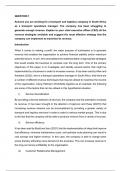
Assume you are working for a transport and logistics company in South Africa
as a transport operations manager. The company has been struggling to
generate enough revenue. Explain to your chief executive officer (CEO) all the
revenue strategies available and suggest the most effective strategy that the
company can implement to maximise its revenue.
Introduction
When it comes to making a profit, the major purpose of businesses is to generate
revenue that enables the organisation to achieve financial stability and/or maximum
potential returns. In turn, this necessitates the implementation of appropriate strategies
that would enable the business to compete over the long term. One of the primary
objectives of this paper is to investigate and identify several tactics that might be
implemented by a business in order to increase revenue. It has been said by Allen and
Arkolakis (2022), who is a transport operations manager in South Africa, that there are
a number of different revenue techniques that may be utilised to maximise the income
of the organisation. Using Hellmann Worldwide logistics as an example, the following
are some of the tactics that can be utilised in this hypothetical situation.
i) Service diversification
By providing a diverse selection of services, the company has the potential to increase
its revenue. It has been brought to the attention of Ajanovic and Haas (20210) that
increasing revenue streams can be accomplished by providing a greater variety of
transport and logistics services in order to cater to various market groups. This is due
to the fact that the company will be able to produce revenue from a variety of sources.
ii) Service efficiency
It has been said by Budd and Ison (2021) that the implementation of steps that improve
fuel efficiency, minimise maintenance costs, and optimise route planning can result in
cost savings and higher revenue. In this case, the company is able to charge lower
prices thereby attracting more demand to the business. This can increase revenue in
the long-run hence profitability to the organisation.
iii) Customer Relationship Management
, Utilising positive relationships is another effective tactic that can be utilised (Künle &
Minke, 2022). The reason for this is that putting an emphasis on developing long-term
relationships with clients can result in repeat business and referrals, which ultimately
leads to an increase in revenue.
iv) Integrating technology in business
Within the context of the contemporary business climate, technology is the most
effective instrument that a company can employ. Because of this, making investments
in technology such as GPS monitoring, software that optimises routes, and warehouse
management systems can improve operational efficiency and customer happiness,
which ultimately leads to a gain in income.
v) Market Expansion through niche markets
Through the exploration of new markets or the expansion of operations to areas that
are currently underserved, the company may be able to open up new revenue
potential.
vi) Strategic Partnerships with players such as retail outlets
There is the potential for new business possibilities and an increase in revenue (Künle
& Minke, 2022) to be created through the formation of strategic partnerships or through
collaboration with other companies in the supply chain.
vii) Value-addition on services
According to Fair and Williams (2021), the company may be able to generate new
revenue streams by providing additional services such as warehousing, packaging, or
customs clearance to its customers. This will attract more customers as they assume
benefitting from extra services that the company offers.
viii) Cost minimisation
In order to have a direct influence on the bottom line of the organisation, it is possible
to analyse and reduce operating costs without compromising service quality (Prus &
Sikora, 2021).
Conclusion
Assume you are working for a transport and logistics company in South Africa
as a transport operations manager. The company has been struggling to
generate enough revenue. Explain to your chief executive officer (CEO) all the
revenue strategies available and suggest the most effective strategy that the
company can implement to maximise its revenue.
Introduction
When it comes to making a profit, the major purpose of businesses is to generate
revenue that enables the organisation to achieve financial stability and/or maximum
potential returns. In turn, this necessitates the implementation of appropriate strategies
that would enable the business to compete over the long term. One of the primary
objectives of this paper is to investigate and identify several tactics that might be
implemented by a business in order to increase revenue. It has been said by Allen and
Arkolakis (2022), who is a transport operations manager in South Africa, that there are
a number of different revenue techniques that may be utilised to maximise the income
of the organisation. Using Hellmann Worldwide logistics as an example, the following
are some of the tactics that can be utilised in this hypothetical situation.
i) Service diversification
By providing a diverse selection of services, the company has the potential to increase
its revenue. It has been brought to the attention of Ajanovic and Haas (20210) that
increasing revenue streams can be accomplished by providing a greater variety of
transport and logistics services in order to cater to various market groups. This is due
to the fact that the company will be able to produce revenue from a variety of sources.
ii) Service efficiency
It has been said by Budd and Ison (2021) that the implementation of steps that improve
fuel efficiency, minimise maintenance costs, and optimise route planning can result in
cost savings and higher revenue. In this case, the company is able to charge lower
prices thereby attracting more demand to the business. This can increase revenue in
the long-run hence profitability to the organisation.
iii) Customer Relationship Management
, Utilising positive relationships is another effective tactic that can be utilised (Künle &
Minke, 2022). The reason for this is that putting an emphasis on developing long-term
relationships with clients can result in repeat business and referrals, which ultimately
leads to an increase in revenue.
iv) Integrating technology in business
Within the context of the contemporary business climate, technology is the most
effective instrument that a company can employ. Because of this, making investments
in technology such as GPS monitoring, software that optimises routes, and warehouse
management systems can improve operational efficiency and customer happiness,
which ultimately leads to a gain in income.
v) Market Expansion through niche markets
Through the exploration of new markets or the expansion of operations to areas that
are currently underserved, the company may be able to open up new revenue
potential.
vi) Strategic Partnerships with players such as retail outlets
There is the potential for new business possibilities and an increase in revenue (Künle
& Minke, 2022) to be created through the formation of strategic partnerships or through
collaboration with other companies in the supply chain.
vii) Value-addition on services
According to Fair and Williams (2021), the company may be able to generate new
revenue streams by providing additional services such as warehousing, packaging, or
customs clearance to its customers. This will attract more customers as they assume
benefitting from extra services that the company offers.
viii) Cost minimisation
In order to have a direct influence on the bottom line of the organisation, it is possible
to analyse and reduce operating costs without compromising service quality (Prus &
Sikora, 2021).
Conclusion