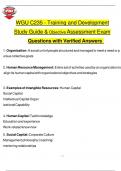
WGU C235 - Training and Development
Study Guide & Objective Assessment Exam
Questions with Verified Answers
1. Organization: A social unit of people structured and managed to meet a need or p
g g g g g g g g g g g g g g
ursue collective goals
g g
2. Human Resource Management: Entire set of activities used by an organization to
g g g g g g g g g g g
galign its human capital with organizational objectives and strategies
g g g g g g g g
3. Examples of Intangible Resources: Human Capital
g g g g g g
Social Capitalg
Intellectual Capital Organ g g
izational Capability g
4. Human Capital: Tacit knowledge
g g g g
Education and experience g g
Work-related know-how g
5. Social Capital: Corporate Culture
g g g g
Management philosophy Coaching/ g g
mentoring relationships g
1g/g 16
,Informal networking systems g g
6. Intellectual Capital: Patents and trade secrets g g g g g g
Copyrights
Intellectual property g
7. Organizational Capability: Bring new products to market quickly g g g g g g g g
Absorb and integrate other cultures in a merger
g g g g g g g
Identify customer needs and respond directly to them Continuously i
g g g g g g g g g
mprove production processes to drive down costs
g g g g g g
8. How is training and development strategically important in an organiza-
g g g g g g g g g
gtion?: By creating value for customers through training
g g g g g g g
Increase shareholder returns by investing in training and development Creating
g g g g g g g g g g
a competitive advantage through human capital
g g g g g
9. Differentiate between Training and Development: Training: Learning that is pla
g g g g g g g g g
nned by the organization and designed so as to further organizational objectives Deve
g g g g g g g g g g g g
lopment: Training that is longer- g g g g
term in focus, designed to help employees prepare for future jobs
g g g g g g g g g g
10. What is an intangible asset on which a company can build a sustainable co
g g g g g g g g g g g g g
mpetitive advantage by providing training regarding tacit knowledge in an effo
g g g g g g g g g g
rt to differentiate itself in a strategic way?: Human Capital
g g g g g g g g g
2g/g 16
,11. Orientation: The first common training that new hires go. New employees are
g g g g g g g g g g g
3g/g 16
, exposed to the expectations the organization has for them, key policies and pro-
g g g g g g g g g g g g
g cedures relevant to them, the basic business model under which the organization ope
g g g g g g g g g g g g
rates in order to be successful, the variety and types of co-
g g g g g g g g g g g
workers present on the job, and other aspects of organizational life.
g g g g g g g g g g
4g/g 16
Study Guide & Objective Assessment Exam
Questions with Verified Answers
1. Organization: A social unit of people structured and managed to meet a need or p
g g g g g g g g g g g g g g
ursue collective goals
g g
2. Human Resource Management: Entire set of activities used by an organization to
g g g g g g g g g g g
galign its human capital with organizational objectives and strategies
g g g g g g g g
3. Examples of Intangible Resources: Human Capital
g g g g g g
Social Capitalg
Intellectual Capital Organ g g
izational Capability g
4. Human Capital: Tacit knowledge
g g g g
Education and experience g g
Work-related know-how g
5. Social Capital: Corporate Culture
g g g g
Management philosophy Coaching/ g g
mentoring relationships g
1g/g 16
,Informal networking systems g g
6. Intellectual Capital: Patents and trade secrets g g g g g g
Copyrights
Intellectual property g
7. Organizational Capability: Bring new products to market quickly g g g g g g g g
Absorb and integrate other cultures in a merger
g g g g g g g
Identify customer needs and respond directly to them Continuously i
g g g g g g g g g
mprove production processes to drive down costs
g g g g g g
8. How is training and development strategically important in an organiza-
g g g g g g g g g
gtion?: By creating value for customers through training
g g g g g g g
Increase shareholder returns by investing in training and development Creating
g g g g g g g g g g
a competitive advantage through human capital
g g g g g
9. Differentiate between Training and Development: Training: Learning that is pla
g g g g g g g g g
nned by the organization and designed so as to further organizational objectives Deve
g g g g g g g g g g g g
lopment: Training that is longer- g g g g
term in focus, designed to help employees prepare for future jobs
g g g g g g g g g g
10. What is an intangible asset on which a company can build a sustainable co
g g g g g g g g g g g g g
mpetitive advantage by providing training regarding tacit knowledge in an effo
g g g g g g g g g g
rt to differentiate itself in a strategic way?: Human Capital
g g g g g g g g g
2g/g 16
,11. Orientation: The first common training that new hires go. New employees are
g g g g g g g g g g g
3g/g 16
, exposed to the expectations the organization has for them, key policies and pro-
g g g g g g g g g g g g
g cedures relevant to them, the basic business model under which the organization ope
g g g g g g g g g g g g
rates in order to be successful, the variety and types of co-
g g g g g g g g g g g
workers present on the job, and other aspects of organizational life.
g g g g g g g g g g
4g/g 16