

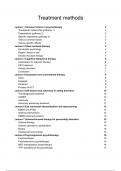
Treatment methods
Lecture 1 Common factors in psychotherapy 2
Therapeutic relationship (pathway 1) 2
Expectations (pathway 2) 2
Specific ingredients (pathway 3) 3
Various common factors 3
Various specific effects 3
Lecture 2 Client centered therapy 4
Humanistic psychology 4
Rogers’ theory of self 4
Emotion-focused therapy 4
Lecture 3 Cognitive behavioral therapy 6
Implications for behavior therapy 6
CBT treatment 6
Anxiety disorders 7
Conclusion 7
Lecture 4 Acceptance and commitment therapy 8
Open 8
Engaged 8
Centered 8
Process of ACT 9
Lecture 5 self-esteem and autonomy in eating disorders 10
Transdiagnostic treatment 10
COMET 10
Autonomy 11
Autonomy enhancing treatment 11
Lecture 6 Eye movement desensitization and reprocessing 12
EMDR and PTSD 12
Working mechanisms 12
EMDR treatment protocol 13
Lecture 7 Schema-focused therapy for personality disorders 14
Schema therapy 14
Schema operations: perpetuation 14
Modes 15
Assessment and change 15
Lecture 8 Psychodynamic psychotherapy 16
Psychoanalysis 16
Psychodynamic psychotherapy 16
MBT: mentalization based therapy 16
TFP: transference focused therapy 17
,Lecture 1 Common factors in psychotherapy
Do different types of psychotherapy matter or are the changes acquired through ‘common
factors’ which are present in all psychotherapy in general? All methods are effective, so what
are the common factors? There are measurable but not so perceivable mechanisms that
contribute towards changing people, it is part of our socio-biological heritage. Differences
helps us understand why different therapy models are more or less efficient.
Therapeutic relationship (pathway 1)
- Defining the relationship: different role each plays, trustworthiness, reliability,
verbal and non-verbal communication, level of cooperation towards forming a
working alliance, empathy, and holding (the capacity of the therapist to manage all
these factors and maintaining a secure therapeutic relationship).
- Social interaction can be healing through: understanding, mentalisation,
perspective taking, empathy, sense of togetherness and attachment.
- The role of attachment: attachment persists psychopatgology and can be a
predictor.
1. Secure attachment: easy forming of treatment alliance and straigh forward.
2. Anxious-preoccupied attachment: easy forming of treatment alliance but
difficulty in terminating treatment.
3. Fearful-avoidant attachment: forming alliance takes time, might seem less
motivated. At risk of rejection by therapist. More focused on problem-solving
and less on the relationship.
4. Disorganized attachment: therapist needs to have abundant patience.
Epistemic trust is to learn through a relationship and attachment: can go wrong
when they only trust themselves (vase, no water, flower dies).
- The relationship is unusual:
1. The interaction is confidential with statutory limits (child abuse report).
2. Disclosure of difficult material doesn’t disrupt the social bond (infidelity to a
spouse or something shameful).
Expectations (pathway 2)
Important factors of expectations are:
- Timing
- Previous experiences
- Beliefs about the complaints of the patient
- Beliefs about the solutions for the complaints problems which most of the time lead to
demoralization and motivational problems.
How do we alter expectations?
- Providing the patient a working model with a therapy method of the problem.
- Psycho-education about their problem and treatment (remoralising, establishing
hope).
- Promoting self-efficacy, sense of control, sense of mastery and autonomy. Improve
their sense of capacity to change their behavior and situation.
- Discussing and changing response expectancies.
Transference
Transference is the interaction between a patient and a therapist and is complicated.
Factors are: patient, past and present. A situation might make the patient or therapist feel
something or remind them of something which causes transference (she’s like my mother in
, law). Also the therapist might have a bad day, feelings towards a patient or have their own
trauma in the past, so the therapeutic relationship is always in danger.
Clear boundaries are necessary in every treatment, identifying what the relationship should
look like and when trouble arises.
Managing transference (common factor)
Leary’s Rose: a method used to manage transference.
Managing stress
Hyperarousal: excessive activation in the form of fight/flight responses
Hypoarousal: freeze response, emotionally flat, lack of energy and responses
Window of tolerance: optimal zone where you can deal with stress from
everyday life, which is smooth sailing.
Specific ingredients (pathway 3)
Common factors are insufficient on their own, the choice and fit of the treatment
is also important.
The contextual model says that specific ingredients (specific treatments) produce
expectations but also healthy actions, improving interpersonal relationships, being more
accepting os oneself etc.
Various common factors
1. Alliance: the bond, the agreement about the goal of therapy, and the agreement
about the tasks of therapy. Criticism on correlation between alliance and good
outcome: Either early symptom relief causes a strong alliance at the third session, or
due to the patients’ contribution to the alliance (come well prepared), or there may be
a halo effect if the patient rates both the alliance and the outcome.
2. Empathy: in a study on acupuncture, when barely interacting the outcome was
worse, but when the practitioner talked to the patient about their symptoms and
lifetsyle, the outcome was better.
3. Expectations: creating expectations through explanation of the patient’s disorder is
important.
4. Cultural adaptation: if there are cultural differences with the patient’s beliefs, they
will not believe that the treatment is right for them.
5. Therapist effects: if some therapists consistently achieve better outcomes with their
patients than other therapists regardless of the nature of the treatment. Some
therapists deliver the same ingredients but more skillfully. Therapist effects in
naturalistic settings are greater than in clinical trials.
Various specific effects
1. Treatment differences
2. Specific effects from dismantling studies: a specific ingredient is removed from a
treatment and minimal differences between the two is shown, recent studies show an
increased effect by a small amount.
3. Adherence and competence: adherence to the protocol and the competence of the
therapist. Rigid adherence can even increase resistance to the treatment and
flexibility in adherence is actually better.
Lecture 1 Common factors in psychotherapy 2
Therapeutic relationship (pathway 1) 2
Expectations (pathway 2) 2
Specific ingredients (pathway 3) 3
Various common factors 3
Various specific effects 3
Lecture 2 Client centered therapy 4
Humanistic psychology 4
Rogers’ theory of self 4
Emotion-focused therapy 4
Lecture 3 Cognitive behavioral therapy 6
Implications for behavior therapy 6
CBT treatment 6
Anxiety disorders 7
Conclusion 7
Lecture 4 Acceptance and commitment therapy 8
Open 8
Engaged 8
Centered 8
Process of ACT 9
Lecture 5 self-esteem and autonomy in eating disorders 10
Transdiagnostic treatment 10
COMET 10
Autonomy 11
Autonomy enhancing treatment 11
Lecture 6 Eye movement desensitization and reprocessing 12
EMDR and PTSD 12
Working mechanisms 12
EMDR treatment protocol 13
Lecture 7 Schema-focused therapy for personality disorders 14
Schema therapy 14
Schema operations: perpetuation 14
Modes 15
Assessment and change 15
Lecture 8 Psychodynamic psychotherapy 16
Psychoanalysis 16
Psychodynamic psychotherapy 16
MBT: mentalization based therapy 16
TFP: transference focused therapy 17
,Lecture 1 Common factors in psychotherapy
Do different types of psychotherapy matter or are the changes acquired through ‘common
factors’ which are present in all psychotherapy in general? All methods are effective, so what
are the common factors? There are measurable but not so perceivable mechanisms that
contribute towards changing people, it is part of our socio-biological heritage. Differences
helps us understand why different therapy models are more or less efficient.
Therapeutic relationship (pathway 1)
- Defining the relationship: different role each plays, trustworthiness, reliability,
verbal and non-verbal communication, level of cooperation towards forming a
working alliance, empathy, and holding (the capacity of the therapist to manage all
these factors and maintaining a secure therapeutic relationship).
- Social interaction can be healing through: understanding, mentalisation,
perspective taking, empathy, sense of togetherness and attachment.
- The role of attachment: attachment persists psychopatgology and can be a
predictor.
1. Secure attachment: easy forming of treatment alliance and straigh forward.
2. Anxious-preoccupied attachment: easy forming of treatment alliance but
difficulty in terminating treatment.
3. Fearful-avoidant attachment: forming alliance takes time, might seem less
motivated. At risk of rejection by therapist. More focused on problem-solving
and less on the relationship.
4. Disorganized attachment: therapist needs to have abundant patience.
Epistemic trust is to learn through a relationship and attachment: can go wrong
when they only trust themselves (vase, no water, flower dies).
- The relationship is unusual:
1. The interaction is confidential with statutory limits (child abuse report).
2. Disclosure of difficult material doesn’t disrupt the social bond (infidelity to a
spouse or something shameful).
Expectations (pathway 2)
Important factors of expectations are:
- Timing
- Previous experiences
- Beliefs about the complaints of the patient
- Beliefs about the solutions for the complaints problems which most of the time lead to
demoralization and motivational problems.
How do we alter expectations?
- Providing the patient a working model with a therapy method of the problem.
- Psycho-education about their problem and treatment (remoralising, establishing
hope).
- Promoting self-efficacy, sense of control, sense of mastery and autonomy. Improve
their sense of capacity to change their behavior and situation.
- Discussing and changing response expectancies.
Transference
Transference is the interaction between a patient and a therapist and is complicated.
Factors are: patient, past and present. A situation might make the patient or therapist feel
something or remind them of something which causes transference (she’s like my mother in
, law). Also the therapist might have a bad day, feelings towards a patient or have their own
trauma in the past, so the therapeutic relationship is always in danger.
Clear boundaries are necessary in every treatment, identifying what the relationship should
look like and when trouble arises.
Managing transference (common factor)
Leary’s Rose: a method used to manage transference.
Managing stress
Hyperarousal: excessive activation in the form of fight/flight responses
Hypoarousal: freeze response, emotionally flat, lack of energy and responses
Window of tolerance: optimal zone where you can deal with stress from
everyday life, which is smooth sailing.
Specific ingredients (pathway 3)
Common factors are insufficient on their own, the choice and fit of the treatment
is also important.
The contextual model says that specific ingredients (specific treatments) produce
expectations but also healthy actions, improving interpersonal relationships, being more
accepting os oneself etc.
Various common factors
1. Alliance: the bond, the agreement about the goal of therapy, and the agreement
about the tasks of therapy. Criticism on correlation between alliance and good
outcome: Either early symptom relief causes a strong alliance at the third session, or
due to the patients’ contribution to the alliance (come well prepared), or there may be
a halo effect if the patient rates both the alliance and the outcome.
2. Empathy: in a study on acupuncture, when barely interacting the outcome was
worse, but when the practitioner talked to the patient about their symptoms and
lifetsyle, the outcome was better.
3. Expectations: creating expectations through explanation of the patient’s disorder is
important.
4. Cultural adaptation: if there are cultural differences with the patient’s beliefs, they
will not believe that the treatment is right for them.
5. Therapist effects: if some therapists consistently achieve better outcomes with their
patients than other therapists regardless of the nature of the treatment. Some
therapists deliver the same ingredients but more skillfully. Therapist effects in
naturalistic settings are greater than in clinical trials.
Various specific effects
1. Treatment differences
2. Specific effects from dismantling studies: a specific ingredient is removed from a
treatment and minimal differences between the two is shown, recent studies show an
increased effect by a small amount.
3. Adherence and competence: adherence to the protocol and the competence of the
therapist. Rigid adherence can even increase resistance to the treatment and
flexibility in adherence is actually better.


