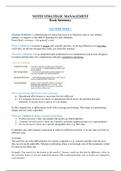
INTERNATIONAL MANAGEMENT
Summary of Book + Week 7 Materials
Table of Contents =
Book: International Business: competing in the global marketplace (12th edition) by Charles Hill
Week 1 (Chapter 16) Exporting, Importing, and Countertrade p. 02
Week 2 (Chapter 17) Global Production and Supply Chain Management p. 08
Week 3 (Chapter 18) Global Marketing and R&D p. 17
Break
Week 5 (Chapter 19) Global Human Resource Management p. 24
Week 6 (Chapter 20) Accounting and Finance in the International Business p. 30
Week 7 (HBR Ideacast) How Companies Like Google and Alibaba Respond p. 36
to Fast-Moving Markets – D. Ulrich
(Article) Strategy, not Technology, Drives Digital Transformation: p. 37
becoming a digitally mature enterprise – G. Kane et al.
(Podcast) Strategy, not Technology, Drives Digital Transformation p. 39
– G. Kane
,// CH16 // Exporting, Importing, and Countertrade //
The volume of export activity in the world economy has increased as exporting has become easier from
a large number of countries (less import tariffs, etc.). As the global marketplace becomes more viable
for many companies over time, companies must also adapt to this opportunity by strategically engaging
in exporting and operationally go about seeking opportunities globally.
Readiness to export or import: Readiness to export:
The international market is normally so much larger than the firm’s domestic market that exporting is
nearly always a way to increase the revenue and profit base of a company. Firms need to become more
proactive about seeking export opportunities.
Firms are not proactive when:
- They are unfamiliar with foreign market opportunities. Simple ignorance of the potential
opportunities is a huge barrier to exporting.
- Many would-be exporters, particularly smaller firms, are often intimidated by the complexities
and mechanics of exporting to countries where business practices, language, culture, legal
systems, and currency are very different from those in the home market.
Novice exporters tend to underestimate the time and expertise needed to cultivate business in foreign
countries. Exporters often face voluminous paperwork, complex formalities, and many potential delays
and errors. Common Exporting Pitfalls:
o Poor market analysis;
o Poor understanding of competitive conditions in the foreign market;
o Failure to customize the product offering to the needs of foreign customers;
o Lack of an effective distribution program;
o Poorly executed promotional campaign;
o Problems securing financing.
2
,Improving Export Performance:
International Comparisons → The way to overcome ignorance is to collect information.
- Japanese Ministry of International Trade and Industry (MITI): helps firms identify export
opportunities.
- Sogo shosha: Japan’s great trading houses that have offices all over the world, which
proactively, continuously seek export opportunities for their affiliated companies.
o Firms affiliated with one of Japan’s sogo shosha often have a competitive advantage in
countries where countertrade agreements are preferred.
Information Sources → The most comprehensive source of information with intelligence and assistance
for attacking foreign markets is the U.S. Department of Commerce. It has the Foreign Commercial
Service and International Trade Administration (ITA) departments, where the ITA regularly publishes A
Guide to Exporting.
- Additionally, the vast majority of U.S. states, country regions, and many large cities maintain
active trade commissions whose purpose is to promote exports.
Service Providers →
- Export Management Company (EMC) offers services to companies that have not previously
exported products. EMCs offer a full menu of services to handle all aspects of exporting, similar
to having an internal exporting department within your own firm.
- Freight forwarders are mainly in business to orchestrate transportation for companies that are
shipping internationally. Their primary task is to combine smaller shipments into a single large
shipment to minimize the shipping cost.
- Export trading companies export products for companies that contract with them. They provide
comprehensive exporting services, incl. export documentation and logistics.
- Export packaging companies provide services to companies that are unfamiliar with exporting.
- Customs brokers can help companies avoid the pitfalls involved in customs regulations.
- Confirming houses (buying agents) represent foreign companies that want to buy your
products. Typically, they try to get the products they want at the lowest prices and are paid a
commission by their foreign clients.
- Export agents, merchants, and remarketers buy products directly from the manufacturer and
package and label the products in accordance with their own wishes and specifications. They
then sell the products internationally through their own contacts and assume all risks.
- Piggyback marketing is an arrangement whereby one firm distributes another firm’s products.
For example, a firm may have a contract to provide an assortment of products to an overseas
client, but it does not have all the products requested.
Export Strategy → A few guidelines can help firms improve their odds of success.
1. Hire an EMC or at least an experienced export consultant to identify opportunities and navigate
the paperwork and regulations so often involved in exporting.
2. Initially focus on one market or a handful of markets. Learn what is required to succeed in those
markets before moving to other markets.
3. Enter a foreign market on a small scale to reduce the costs of any subsequent failure. It provides
the time and opportunity to learn about the foreign country before making significant capital
commitments to that market.
4. The exporter needs to recognize the time and managerial commitment involved in building
export sales and should hire additional personnel to oversee this activity.
3
, 5. Devote a lot of attention to building strong and enduring relationships with local distributors
and/or customers in countries.
6. Hire local personnel to help the firm establish itself in a foreign market
7. Be proactive about seeking export opportunities.
8. Retain the option of local production. Once exports
reach a sufficient volume to justify cost-efficient local
production, the exporting firm should consider
establishing production facilities in the foreign
market.
Company Readiness to Export (CORE) assists firms in self-
assessment of their exporting proficiency, evaluates both the
firm’s and the intended product’s readiness to be taken
internationally, and systematically identifies the firm’s
strengths and weaknesses within the context of exporting.
Export and Import Financing: mechanisms for financing
exports and imports have evolved over the centuries in response to a problem that can be particularly
acute in international trade: the lack of trust that exists when one must put faith in a stranger. This can
be overcome by using a neutral third party.
Financial devices that cope with lack-of-trust-problem in the context of international trade:
Letter of Credit: states that the bank will pay a specified sum of money to a beneficiary, normally the
exporter, on presentation of particular, specified documents.
- The letter is issued by a bank at the request of an importer.
Draft / Bill of Exchange: the instrument normally used in international commerce to effect payment. It’s
simply an order written by an exporter instructing an importer, or an importer’s agent, to pay a specified
amount of money at a specified time.
Time drafts are negotiable instruments; that is, once the draft is stamped with an acceptance, the maker
can sell the draft to an investor at a discount from its face value.
- Sight draft: is payable on presentation to the drawee.
- Time draft: allows for a delay in payment—normally 30, 60, 90, or 120 days. It is presented to
the drawee, who signifies acceptance of it by writing or stamping a notice of acceptance on its
face. Once accepted, the time draft becomes a promise to pay by the accepting party.
o Banker’s acceptance: when a time draft is drawn on and accepted by a bank.
o Trade acceptance: when it is drawn on and accepted by a business firm.
Bill of Lading: issued to the exporter by the common carrier transporting the merchandise. The bill of
lading can also function as collateral against which funds may be advanced to the exporter by its local
bank before or during shipment and before final payment by the importer. It serves three purposes:
- As a receipt: the bill of lading indicates that the carrier has received the merchandise described
on the face of the document.
- As a contract: it specifies that the carrier is obligated to provide a transportation service in
return for a certain charge.
- As a document of title: it can be used to obtain payment or a written promise of payment
before the merchandise is released to the importer.
4
Summary of Book + Week 7 Materials
Table of Contents =
Book: International Business: competing in the global marketplace (12th edition) by Charles Hill
Week 1 (Chapter 16) Exporting, Importing, and Countertrade p. 02
Week 2 (Chapter 17) Global Production and Supply Chain Management p. 08
Week 3 (Chapter 18) Global Marketing and R&D p. 17
Break
Week 5 (Chapter 19) Global Human Resource Management p. 24
Week 6 (Chapter 20) Accounting and Finance in the International Business p. 30
Week 7 (HBR Ideacast) How Companies Like Google and Alibaba Respond p. 36
to Fast-Moving Markets – D. Ulrich
(Article) Strategy, not Technology, Drives Digital Transformation: p. 37
becoming a digitally mature enterprise – G. Kane et al.
(Podcast) Strategy, not Technology, Drives Digital Transformation p. 39
– G. Kane
,// CH16 // Exporting, Importing, and Countertrade //
The volume of export activity in the world economy has increased as exporting has become easier from
a large number of countries (less import tariffs, etc.). As the global marketplace becomes more viable
for many companies over time, companies must also adapt to this opportunity by strategically engaging
in exporting and operationally go about seeking opportunities globally.
Readiness to export or import: Readiness to export:
The international market is normally so much larger than the firm’s domestic market that exporting is
nearly always a way to increase the revenue and profit base of a company. Firms need to become more
proactive about seeking export opportunities.
Firms are not proactive when:
- They are unfamiliar with foreign market opportunities. Simple ignorance of the potential
opportunities is a huge barrier to exporting.
- Many would-be exporters, particularly smaller firms, are often intimidated by the complexities
and mechanics of exporting to countries where business practices, language, culture, legal
systems, and currency are very different from those in the home market.
Novice exporters tend to underestimate the time and expertise needed to cultivate business in foreign
countries. Exporters often face voluminous paperwork, complex formalities, and many potential delays
and errors. Common Exporting Pitfalls:
o Poor market analysis;
o Poor understanding of competitive conditions in the foreign market;
o Failure to customize the product offering to the needs of foreign customers;
o Lack of an effective distribution program;
o Poorly executed promotional campaign;
o Problems securing financing.
2
,Improving Export Performance:
International Comparisons → The way to overcome ignorance is to collect information.
- Japanese Ministry of International Trade and Industry (MITI): helps firms identify export
opportunities.
- Sogo shosha: Japan’s great trading houses that have offices all over the world, which
proactively, continuously seek export opportunities for their affiliated companies.
o Firms affiliated with one of Japan’s sogo shosha often have a competitive advantage in
countries where countertrade agreements are preferred.
Information Sources → The most comprehensive source of information with intelligence and assistance
for attacking foreign markets is the U.S. Department of Commerce. It has the Foreign Commercial
Service and International Trade Administration (ITA) departments, where the ITA regularly publishes A
Guide to Exporting.
- Additionally, the vast majority of U.S. states, country regions, and many large cities maintain
active trade commissions whose purpose is to promote exports.
Service Providers →
- Export Management Company (EMC) offers services to companies that have not previously
exported products. EMCs offer a full menu of services to handle all aspects of exporting, similar
to having an internal exporting department within your own firm.
- Freight forwarders are mainly in business to orchestrate transportation for companies that are
shipping internationally. Their primary task is to combine smaller shipments into a single large
shipment to minimize the shipping cost.
- Export trading companies export products for companies that contract with them. They provide
comprehensive exporting services, incl. export documentation and logistics.
- Export packaging companies provide services to companies that are unfamiliar with exporting.
- Customs brokers can help companies avoid the pitfalls involved in customs regulations.
- Confirming houses (buying agents) represent foreign companies that want to buy your
products. Typically, they try to get the products they want at the lowest prices and are paid a
commission by their foreign clients.
- Export agents, merchants, and remarketers buy products directly from the manufacturer and
package and label the products in accordance with their own wishes and specifications. They
then sell the products internationally through their own contacts and assume all risks.
- Piggyback marketing is an arrangement whereby one firm distributes another firm’s products.
For example, a firm may have a contract to provide an assortment of products to an overseas
client, but it does not have all the products requested.
Export Strategy → A few guidelines can help firms improve their odds of success.
1. Hire an EMC or at least an experienced export consultant to identify opportunities and navigate
the paperwork and regulations so often involved in exporting.
2. Initially focus on one market or a handful of markets. Learn what is required to succeed in those
markets before moving to other markets.
3. Enter a foreign market on a small scale to reduce the costs of any subsequent failure. It provides
the time and opportunity to learn about the foreign country before making significant capital
commitments to that market.
4. The exporter needs to recognize the time and managerial commitment involved in building
export sales and should hire additional personnel to oversee this activity.
3
, 5. Devote a lot of attention to building strong and enduring relationships with local distributors
and/or customers in countries.
6. Hire local personnel to help the firm establish itself in a foreign market
7. Be proactive about seeking export opportunities.
8. Retain the option of local production. Once exports
reach a sufficient volume to justify cost-efficient local
production, the exporting firm should consider
establishing production facilities in the foreign
market.
Company Readiness to Export (CORE) assists firms in self-
assessment of their exporting proficiency, evaluates both the
firm’s and the intended product’s readiness to be taken
internationally, and systematically identifies the firm’s
strengths and weaknesses within the context of exporting.
Export and Import Financing: mechanisms for financing
exports and imports have evolved over the centuries in response to a problem that can be particularly
acute in international trade: the lack of trust that exists when one must put faith in a stranger. This can
be overcome by using a neutral third party.
Financial devices that cope with lack-of-trust-problem in the context of international trade:
Letter of Credit: states that the bank will pay a specified sum of money to a beneficiary, normally the
exporter, on presentation of particular, specified documents.
- The letter is issued by a bank at the request of an importer.
Draft / Bill of Exchange: the instrument normally used in international commerce to effect payment. It’s
simply an order written by an exporter instructing an importer, or an importer’s agent, to pay a specified
amount of money at a specified time.
Time drafts are negotiable instruments; that is, once the draft is stamped with an acceptance, the maker
can sell the draft to an investor at a discount from its face value.
- Sight draft: is payable on presentation to the drawee.
- Time draft: allows for a delay in payment—normally 30, 60, 90, or 120 days. It is presented to
the drawee, who signifies acceptance of it by writing or stamping a notice of acceptance on its
face. Once accepted, the time draft becomes a promise to pay by the accepting party.
o Banker’s acceptance: when a time draft is drawn on and accepted by a bank.
o Trade acceptance: when it is drawn on and accepted by a business firm.
Bill of Lading: issued to the exporter by the common carrier transporting the merchandise. The bill of
lading can also function as collateral against which funds may be advanced to the exporter by its local
bank before or during shipment and before final payment by the importer. It serves three purposes:
- As a receipt: the bill of lading indicates that the carrier has received the merchandise described
on the face of the document.
- As a contract: it specifies that the carrier is obligated to provide a transportation service in
return for a certain charge.
- As a document of title: it can be used to obtain payment or a written promise of payment
before the merchandise is released to the importer.
4