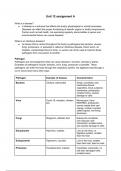
Unit 12 assignment A
What is a disease?
● A disease is a sickness that affects the body’s physiological or mental processes.
Diseases can affect the proper functioning of specific organs or bodily compoonents.
Factors such as bad health, not exercising regularly, abnormalities in genes and
environmental factors can cause diseases
What is an infectious disease?
● An illness that is carried throughout the body by pathogens like bacteria, viruses,
fungi, protozoans, or parasites is called an infectious disease. Direct touch, air
droplets, contaminated food or drink, or vectors can all be used to transmit these
pathogens from one person to another.
Pathogen
Pathogens are microorganisms that can cause disease in humans, animals or plants.
Examples of pathogens include, bacteria, virus, fungi, protozoan or parasite. These
pathogens can enter the body through the respiratory system, the digestive tract,through a
cut or wound and many other ways.
Pathogen Example of disease Characteristics
Bacteria Cholera, salmonella Small, unicellular, lack
membrane-bound
organelles, have a plasma
membrane, prokaryotic,
creates toxins, causes
damage to cells
Virus Covid-19, measles, chicken Microscopic, have
pox DNA/RNA, prokaryotic,
cannot create their own
energy, contain a protein
called capsid, non-living
structures
Fungi Ringworm, athletes foot Eukaryotic,unicellular,
non-vascular, lack
chlorophyll, creates toxins
and causes damage to cells
Ectoparasite Head lice, scabies Live on the host, no
digestive system, smaller
than the host
Endoparasite Tapeworm, coccidia Live in the host, smaller
than their host, feed on host
Protozoan Toxoplasmosis, malaria Unicellular, eukaryotic, no
cell wall, damages cells,
creates toxins
, Virus
● A virus is an infectious microbe that consists of a segment of nucleic acid which can
be either RNA or DNA surrounded by a protective coat. A virus can’t replicate by
itself so it needs to infect the host's cells and use its body components in order to
replicate.
Characteristics of a virus:
● Non-living
● Contain either DNA or RNA
● Need a host to multiply
● Microscopic
● Certain host range
● Range of shapes which
include, helical, spherical and
complex structures
● Mutate fast
● Unable to create their own
energy
Example of viral disease: HIV (human immunodeficiency virus)
HIV is a retrovirus that targets the immune system and can cause AIDS, a condition in which
the immune system is severely weakened and unable to fight off infections and other
diseases. Symptoms include fever, headache, aches, diarrhoea, weight loss and many
more.
Life cycle of HIV
HIV binds to receptors on the surface of a CD4 cell.
The HIV envelope and the CD4 cell membrane fuse,
which allows the HIV to enter the CD4 cell. Inside
the CD4 cell, HIV releases and uses reverse
transcriptase to convert its genetic material HIV RNA
into HIV DNA. The conversion of HIV RNA to HIV
DNA, allows HIV to enter the CD4 cell nucleus and
combine with the cell's genetic material (cell DNA).
Inside the CD4 cell nucleus, HIV releases integrase.
HIV uses integrase to convert its viral DNA into the
DNA of the CD4 cell. Once integrated into the CD4
cell DNA, HIV begins to use the machinery of the
CD4 cell to make long chains of HIV proteins. New
HIV proteins and HIV RNA move to the surface of
the cell and assemble into immature HIV. Newly
formed immature HIV pushes itself out of the host
CD4 cell. The new HIV releases protease. Protease
breaks up the long protein chains in the immature
virus, creating the mature virus
How does HIV make you ill?
What is a disease?
● A disease is a sickness that affects the body’s physiological or mental processes.
Diseases can affect the proper functioning of specific organs or bodily compoonents.
Factors such as bad health, not exercising regularly, abnormalities in genes and
environmental factors can cause diseases
What is an infectious disease?
● An illness that is carried throughout the body by pathogens like bacteria, viruses,
fungi, protozoans, or parasites is called an infectious disease. Direct touch, air
droplets, contaminated food or drink, or vectors can all be used to transmit these
pathogens from one person to another.
Pathogen
Pathogens are microorganisms that can cause disease in humans, animals or plants.
Examples of pathogens include, bacteria, virus, fungi, protozoan or parasite. These
pathogens can enter the body through the respiratory system, the digestive tract,through a
cut or wound and many other ways.
Pathogen Example of disease Characteristics
Bacteria Cholera, salmonella Small, unicellular, lack
membrane-bound
organelles, have a plasma
membrane, prokaryotic,
creates toxins, causes
damage to cells
Virus Covid-19, measles, chicken Microscopic, have
pox DNA/RNA, prokaryotic,
cannot create their own
energy, contain a protein
called capsid, non-living
structures
Fungi Ringworm, athletes foot Eukaryotic,unicellular,
non-vascular, lack
chlorophyll, creates toxins
and causes damage to cells
Ectoparasite Head lice, scabies Live on the host, no
digestive system, smaller
than the host
Endoparasite Tapeworm, coccidia Live in the host, smaller
than their host, feed on host
Protozoan Toxoplasmosis, malaria Unicellular, eukaryotic, no
cell wall, damages cells,
creates toxins
, Virus
● A virus is an infectious microbe that consists of a segment of nucleic acid which can
be either RNA or DNA surrounded by a protective coat. A virus can’t replicate by
itself so it needs to infect the host's cells and use its body components in order to
replicate.
Characteristics of a virus:
● Non-living
● Contain either DNA or RNA
● Need a host to multiply
● Microscopic
● Certain host range
● Range of shapes which
include, helical, spherical and
complex structures
● Mutate fast
● Unable to create their own
energy
Example of viral disease: HIV (human immunodeficiency virus)
HIV is a retrovirus that targets the immune system and can cause AIDS, a condition in which
the immune system is severely weakened and unable to fight off infections and other
diseases. Symptoms include fever, headache, aches, diarrhoea, weight loss and many
more.
Life cycle of HIV
HIV binds to receptors on the surface of a CD4 cell.
The HIV envelope and the CD4 cell membrane fuse,
which allows the HIV to enter the CD4 cell. Inside
the CD4 cell, HIV releases and uses reverse
transcriptase to convert its genetic material HIV RNA
into HIV DNA. The conversion of HIV RNA to HIV
DNA, allows HIV to enter the CD4 cell nucleus and
combine with the cell's genetic material (cell DNA).
Inside the CD4 cell nucleus, HIV releases integrase.
HIV uses integrase to convert its viral DNA into the
DNA of the CD4 cell. Once integrated into the CD4
cell DNA, HIV begins to use the machinery of the
CD4 cell to make long chains of HIV proteins. New
HIV proteins and HIV RNA move to the surface of
the cell and assemble into immature HIV. Newly
formed immature HIV pushes itself out of the host
CD4 cell. The new HIV releases protease. Protease
breaks up the long protein chains in the immature
virus, creating the mature virus
How does HIV make you ill?