

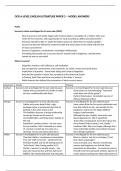
OCR A-LEVEL ENGLISH LITERATURE PAPER 2 – MODEL ANSWERS
PLAN:
Success is often worshipped for its own sake (2022)
- Idea of success is not stable: began with Truslow Adams’ conception of a “better, fuller and
richer life for everyone, with opportunity for each according to ability and achievement”.
Everyone should be able to “attain the fullest stature of which they’re innately capable”.
- Success has become defined by material wealth and social status in the 1920s with the rise
of mass consumerism
- Success is happiness, contentment, meaningful relationships
- Everything that people see as success doesn’t actually lead to happiness, and therefore
cannot be seen as successful
What is success?
- Originally: freedom, self-sufficiency, self-realisation
- But corrupted by consumerism, mass media etc. by 1920s, money and social status
- Implication of question – those latter things don’t lead to happiness
- Basically the question is about the corruption of the American Dream
- In Passing, both Clare and Irene are jealous of the other’s ‘success’
- White America has defined the parameters of what success means
Argument Gatsby Passing
Surface Success is not worshipped for its own sake because: Success is not worshipped for its own sake because:
- Gatsby only accumulates his wealth in order - Clare passes to seek belonging (“had never
to form a relationship with Daisy really been one of the group”)
- Harlem Renaissance: meaningful success of
African American writers
Deeper Success is worshipped for its own sake because: Success is worshipped for its own sake because:
- Gatsby only cares about Daisy’s sign- - Irene values Brian for his service profession and
exchange value; a permanent sign that he how this reflects on her, not actually for his
belongs in the same strata as her happiness. Interest in the Negro Welfare
- This backfires because a loving relationship League is performative
cannot be formed on the basis of - Although she has a family, Irene only cares
commodification, and Daisy leaves Gatsby at about appearances. She is superficial
the end - “Even after crossing back across the colour line,
- Superficial, careless society – no one cares Clare Kendry finds no peace, rest, loyalty” –
for one another. Nick’s haunted by a vision Jonathan Little. She is not happy although she’s
of a woman carried out of a party on a more materially wealthy (successful), because
stretcher, but no one knows who she is she is being inauthentic
Wider Success is worshipped for its own sake because: Success is worshipped for its own sake because:
- Thorstein Veblen, conspicuous consumption. - Brian is a doctor, but he is not happy (“Lord
Tom will “drift on forever”, admired for his how I hate sick people”)
inherited wealth, but his life having been an - If you are black, your chances of achieving
“anti-climax” after having peaked at 21 success and happiness are limited. Brian
- Myrtle’s ‘success’ is actually empty – she represents an alternative – he wants to remove
buys into consumerism and thus fails to be himself from this framework entirely. Spectre of
fulfilled. Her relationship with Tom only gets racism always looming over them (discussion of
, her “a moving pictures magazine… a copy of lynchings). Desire to move to Brazil is
Town Tattle… some cold cream… a small emblematic of the fact that these characters
flask of perfume” are doomed to have their dreams trampled on
ESSAY:
Success is often worshipped for its own sake (30/30 marks)
Each individual’s right to pursue, and achieve, success is a principle embedded both into the
American constitution and the American Dream. The Declaration of Independence (1776) states that
“all men are created equal” and thus afforded the right to “life, liberty and the pursuit of happiness”.
Indeed, Sarah Churchwell notes that initial understandings of the American Dream seemed to recall
these founding values, couching success in patriotic terms as “national self-government” and
“representative democracy”. Likewise, James Truslow Adams saw social equality as a measure of
success, defining the American Dream as “better, fuller and richer life for everyone, with opportunity
for each according to ability or achievement”. However, the definition of success is an unstable,
mutating one and, as such, Fitzgerald’s The Great Gatsby (1925) and Larsen’s Passing (1929) present
individualist societies, fixated on mass consumption and social status as indicators of success. Both
authors expose an America that is far-removed from the meritocratic aspirations of its founding
principles, instead emphasising the importance of class and hierarchy. They ultimately suggest that,
so long as we conflate success with money, true success – in the form of happiness, contentment and
meaningful relationships – will remain elusive. The worship of material success does not produce a
satisfied society, but a superficial one.
Nonetheless, on the surface, it appears that success – in terms of money and class – enables
characters in both The Great Gatsby and Passing to fulfil nobler dreams than simply raising their
social profile. It could be argued that Gatsby’s drive to accumulate wealth derives from his
“unwavering devotion” to Daisy, who will only accept him if he appears to belong to the “same social
strata as herself”. This suggests that his material possessions are ancillary to his love for Daisy, and so
Gatsby leverages his ostensible success to facilitate deeper human connection. Once the affair is
rekindled, Gatsby stops hosting the extravagant parties that had become symbols of his outward
success – “the whole caravansary had fallen in at the disapproval in her eyes” – supposedly because
they were merely a means to an end. Moreover, Gatsby’s father, at the end of the novel, shows Nick
his son’s “schedule” of “general resolves”, modelled on Benjamin Franklin’s 13 virtues. This reveals
that Gatsby had hoped to “study electricity” and “needed inventions”, suggesting that he did not
hope to merely successful, but to add value to society. In Passing, Larsen suggests that Clare passes
for white not for economic advantage, but in search of a sense of belonging and community. Irene
admits that “Clare had never really been one of the group” and her peers had delighted in spreading
“tantalising rumours” and “unkind words” about her. It would make sense, then, that she might try
and find acceptance elsewhere – namely, in white society. Although she marries a wealthy man, and
thus becomes a member of the materially successful white middle-class, Clare’s actions in the novel
are always motivated by a desire to alleviate how “lonely” she is. Larsen, as the mixed-race daughter
of a Danish mother and black father, and a writer of the Harlem Renaissance, would have understood
the struggle to find personal and artistic acceptance. The Harlem Renaissance marked the first
success for black creative communities hoping to be recognised by the white mainstream. As a group
still haunted by the collective memory of slavery in the Antebellum South, this commercial success
was not simply a matter of generating revenue, but was crucial in asserting their new-found civil
PLAN:
Success is often worshipped for its own sake (2022)
- Idea of success is not stable: began with Truslow Adams’ conception of a “better, fuller and
richer life for everyone, with opportunity for each according to ability and achievement”.
Everyone should be able to “attain the fullest stature of which they’re innately capable”.
- Success has become defined by material wealth and social status in the 1920s with the rise
of mass consumerism
- Success is happiness, contentment, meaningful relationships
- Everything that people see as success doesn’t actually lead to happiness, and therefore
cannot be seen as successful
What is success?
- Originally: freedom, self-sufficiency, self-realisation
- But corrupted by consumerism, mass media etc. by 1920s, money and social status
- Implication of question – those latter things don’t lead to happiness
- Basically the question is about the corruption of the American Dream
- In Passing, both Clare and Irene are jealous of the other’s ‘success’
- White America has defined the parameters of what success means
Argument Gatsby Passing
Surface Success is not worshipped for its own sake because: Success is not worshipped for its own sake because:
- Gatsby only accumulates his wealth in order - Clare passes to seek belonging (“had never
to form a relationship with Daisy really been one of the group”)
- Harlem Renaissance: meaningful success of
African American writers
Deeper Success is worshipped for its own sake because: Success is worshipped for its own sake because:
- Gatsby only cares about Daisy’s sign- - Irene values Brian for his service profession and
exchange value; a permanent sign that he how this reflects on her, not actually for his
belongs in the same strata as her happiness. Interest in the Negro Welfare
- This backfires because a loving relationship League is performative
cannot be formed on the basis of - Although she has a family, Irene only cares
commodification, and Daisy leaves Gatsby at about appearances. She is superficial
the end - “Even after crossing back across the colour line,
- Superficial, careless society – no one cares Clare Kendry finds no peace, rest, loyalty” –
for one another. Nick’s haunted by a vision Jonathan Little. She is not happy although she’s
of a woman carried out of a party on a more materially wealthy (successful), because
stretcher, but no one knows who she is she is being inauthentic
Wider Success is worshipped for its own sake because: Success is worshipped for its own sake because:
- Thorstein Veblen, conspicuous consumption. - Brian is a doctor, but he is not happy (“Lord
Tom will “drift on forever”, admired for his how I hate sick people”)
inherited wealth, but his life having been an - If you are black, your chances of achieving
“anti-climax” after having peaked at 21 success and happiness are limited. Brian
- Myrtle’s ‘success’ is actually empty – she represents an alternative – he wants to remove
buys into consumerism and thus fails to be himself from this framework entirely. Spectre of
fulfilled. Her relationship with Tom only gets racism always looming over them (discussion of
, her “a moving pictures magazine… a copy of lynchings). Desire to move to Brazil is
Town Tattle… some cold cream… a small emblematic of the fact that these characters
flask of perfume” are doomed to have their dreams trampled on
ESSAY:
Success is often worshipped for its own sake (30/30 marks)
Each individual’s right to pursue, and achieve, success is a principle embedded both into the
American constitution and the American Dream. The Declaration of Independence (1776) states that
“all men are created equal” and thus afforded the right to “life, liberty and the pursuit of happiness”.
Indeed, Sarah Churchwell notes that initial understandings of the American Dream seemed to recall
these founding values, couching success in patriotic terms as “national self-government” and
“representative democracy”. Likewise, James Truslow Adams saw social equality as a measure of
success, defining the American Dream as “better, fuller and richer life for everyone, with opportunity
for each according to ability or achievement”. However, the definition of success is an unstable,
mutating one and, as such, Fitzgerald’s The Great Gatsby (1925) and Larsen’s Passing (1929) present
individualist societies, fixated on mass consumption and social status as indicators of success. Both
authors expose an America that is far-removed from the meritocratic aspirations of its founding
principles, instead emphasising the importance of class and hierarchy. They ultimately suggest that,
so long as we conflate success with money, true success – in the form of happiness, contentment and
meaningful relationships – will remain elusive. The worship of material success does not produce a
satisfied society, but a superficial one.
Nonetheless, on the surface, it appears that success – in terms of money and class – enables
characters in both The Great Gatsby and Passing to fulfil nobler dreams than simply raising their
social profile. It could be argued that Gatsby’s drive to accumulate wealth derives from his
“unwavering devotion” to Daisy, who will only accept him if he appears to belong to the “same social
strata as herself”. This suggests that his material possessions are ancillary to his love for Daisy, and so
Gatsby leverages his ostensible success to facilitate deeper human connection. Once the affair is
rekindled, Gatsby stops hosting the extravagant parties that had become symbols of his outward
success – “the whole caravansary had fallen in at the disapproval in her eyes” – supposedly because
they were merely a means to an end. Moreover, Gatsby’s father, at the end of the novel, shows Nick
his son’s “schedule” of “general resolves”, modelled on Benjamin Franklin’s 13 virtues. This reveals
that Gatsby had hoped to “study electricity” and “needed inventions”, suggesting that he did not
hope to merely successful, but to add value to society. In Passing, Larsen suggests that Clare passes
for white not for economic advantage, but in search of a sense of belonging and community. Irene
admits that “Clare had never really been one of the group” and her peers had delighted in spreading
“tantalising rumours” and “unkind words” about her. It would make sense, then, that she might try
and find acceptance elsewhere – namely, in white society. Although she marries a wealthy man, and
thus becomes a member of the materially successful white middle-class, Clare’s actions in the novel
are always motivated by a desire to alleviate how “lonely” she is. Larsen, as the mixed-race daughter
of a Danish mother and black father, and a writer of the Harlem Renaissance, would have understood
the struggle to find personal and artistic acceptance. The Harlem Renaissance marked the first
success for black creative communities hoping to be recognised by the white mainstream. As a group
still haunted by the collective memory of slavery in the Antebellum South, this commercial success
was not simply a matter of generating revenue, but was crucial in asserting their new-found civil




