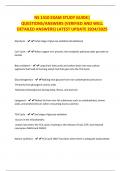
NS 1410 EXAM STUDY GUIDE|
QUESTIONS/ANSWERS (VERIFIED AND WELL
DETAILED ANSWERS) LATEST UPDATE 2024/2025
Glycolysis - ✔✔Initial stage of glucose oxidation (breakdown)
Cori Cycle - ✔✔When oxygen isn't present, the metabolic pathway takes pyruvate to
lactate
Beta-oxidation - ✔✔Long chain fatty acids are broken down into two-carbon
segments that lead to forming acetyl CoA that goes into the TCA Cycle
Gluconeogenesis - ✔✔Making new glucose from non-carbohydrate precursors
Primarily from glucogenic amino acids
Maintains blood glucose during sleep, illness, and exercise
Lipogensis - ✔✔Makes fat from non-fat substances such as carbohydrates, amino
acids, and alcohol (Occurs when consuming excess calories)
TCA Cycle - ✔✔2nd stage of glucose oxidation
Occurs in the mitachondria
Acetyl CoA enters the TCA cycle, resulting in the release of CO2, GTP, and reduced
coenzymes NADH and FADH2
Ketone synthesis - ✔✔TCS Cycle ONLY functions when there is adequate oxaloacetate
, Electron Transport Chain - ✔✔3rd and final stage of glucose oxidation
When oxygen accepts the low energy electrons, reacts with hydrogen, and forms water
O2 is essential for cellular energy production; without O2, cell metabolism stops
Protein deamination - ✔✔The process of removing an amino group from a molecule
pathway of Glycolysis - ✔✔Anaerobic
Pathway of Pyruvate - ✔✔Aerobic
What is generated as a result of metabolism of nutrients - ✔✔Acetyl CoA
**Anabolism** - ✔✔the process of making new molecules from smaller ones
(Critical for growth, repair, maintenance, and synthesis of body tissue, requires energy
from catabolism)
**Catabolism** - ✔✔the breakdown or degradation of larger, more complex
molecules to smaller, more basic molecules
(During digestion, chemical reactions break down proteins, lipids, and carbohydrates
Old tissues or cells are broken down for repair or replacement, releases energy)
**Fats** - ✔✔TCA Cycle, β-oxidation (fatty acid oxidation), and ketogenesis Beg.
Triglycerides End. ATP, CO2 and H2O
**Protein** - ✔✔Protein deamination, and Amino Acid synthesis Beg. Amino acids
End. ATP, CO2 and H2O
QUESTIONS/ANSWERS (VERIFIED AND WELL
DETAILED ANSWERS) LATEST UPDATE 2024/2025
Glycolysis - ✔✔Initial stage of glucose oxidation (breakdown)
Cori Cycle - ✔✔When oxygen isn't present, the metabolic pathway takes pyruvate to
lactate
Beta-oxidation - ✔✔Long chain fatty acids are broken down into two-carbon
segments that lead to forming acetyl CoA that goes into the TCA Cycle
Gluconeogenesis - ✔✔Making new glucose from non-carbohydrate precursors
Primarily from glucogenic amino acids
Maintains blood glucose during sleep, illness, and exercise
Lipogensis - ✔✔Makes fat from non-fat substances such as carbohydrates, amino
acids, and alcohol (Occurs when consuming excess calories)
TCA Cycle - ✔✔2nd stage of glucose oxidation
Occurs in the mitachondria
Acetyl CoA enters the TCA cycle, resulting in the release of CO2, GTP, and reduced
coenzymes NADH and FADH2
Ketone synthesis - ✔✔TCS Cycle ONLY functions when there is adequate oxaloacetate
, Electron Transport Chain - ✔✔3rd and final stage of glucose oxidation
When oxygen accepts the low energy electrons, reacts with hydrogen, and forms water
O2 is essential for cellular energy production; without O2, cell metabolism stops
Protein deamination - ✔✔The process of removing an amino group from a molecule
pathway of Glycolysis - ✔✔Anaerobic
Pathway of Pyruvate - ✔✔Aerobic
What is generated as a result of metabolism of nutrients - ✔✔Acetyl CoA
**Anabolism** - ✔✔the process of making new molecules from smaller ones
(Critical for growth, repair, maintenance, and synthesis of body tissue, requires energy
from catabolism)
**Catabolism** - ✔✔the breakdown or degradation of larger, more complex
molecules to smaller, more basic molecules
(During digestion, chemical reactions break down proteins, lipids, and carbohydrates
Old tissues or cells are broken down for repair or replacement, releases energy)
**Fats** - ✔✔TCA Cycle, β-oxidation (fatty acid oxidation), and ketogenesis Beg.
Triglycerides End. ATP, CO2 and H2O
**Protein** - ✔✔Protein deamination, and Amino Acid synthesis Beg. Amino acids
End. ATP, CO2 and H2O