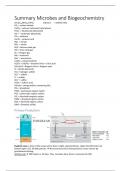
Summary Microbes and Biogeochemistry
CH2O)106(NH3)16H3PO4 106:16:1 = redfield ratio
CO2 = carbon dioxide
CaCO3 = calcium carbonate (solid phase)
HCO3- = bicarbonate (dissolved)
CO32- = carbonate (dissolved)
CH4 = methane
H2CO3 = carbonic acid
NO3- = nitrate
NO2- = nitrite
N2O = Nitrous oxide gas
NO = nitric oxide gas
N2 = nitrogen gas
NH3 = ammonia
NH4+ = ammonium
CaSiO3 = silicate bedrock
H4SiO4 = Si(OH)4 = dissolved silica = silicic acid
SiO2nH2O = Biogenic silica = biogenic opal
Si = silicate (element)
H2S = hydrogen sulfide
SO42- = sulfate
S2- = sulfide
SO32- = sulfite
H2SO4 = sulfuric acid
Silicate = compound/ion containing SiO4
PO4 = phosphate
POM = particulate organic matter
POC = particulate organic carbon
DIC = dissolved inorganic carbon
DOM = dissolved organic matter
DOC = dissolved organic carbon
DMS = Dimethyl sulfide
Primary Production
Euphotic zone = Zone of the ocean where there is light, photosynthesis. Upper 50-100 meters At
bottom light is 1%. 50 OM particles → 40 consumed and 10 transported to ocean interior by
gravitational settling.
Settling rate → 300 meters in 10 days. Thus, microbes have time to consume the OM.
,Ocean interior/deep ocean = dark part of the ocean, no photosynthesis. 3-5 km depth. Degradation
by bacteria and zooplankton, production of dissolved CO2 and nutrients. 10 OM particles → 8 are
degraded and 2 reach the ocean floor. 0.2 is buried by accumulation in sediments.
Phytoplankton
Three domains of life=
eukaryotes, bacteria (prokaryotes), archaea (prokaryotes)
Phytoplankton = PRIMARY PRODUCERS small to very small photosynthesizing organisms drifting an
floating in the water (mutual buoyancy as water). Very diverse. Classification by size → note that
names do not correspond with scientific size (bio
logical meaning different from physical meaning)
SIZE and SHAPE MATTER: determines how well they can harvest light and take up CO2
- Living:
- Sinking speed: larger → more settling, less recycling
- Eat: smaller → easier to eat
- Operational divide at 0.8μm
Photohosts = some algae live in other organisms. They occur in clusters/clums.
Picoplankton:
Cyanobacteria – Prochlorococcus and synechococcus
- Prokaryotes
- Main primary producers
o responsible for 2/3 CO2 fixation in oceans
o 1/3 total primary biomass production of earth
- Small cells: large surface area compared to volume → more diffusion → high affinity
- Mostly found at low latitudes: low nutrient concentrations, oligotrophic ocean.
- Date back to 3000 Mya
- Too small for consumption
, - Synechococcus
o Abundant in upper 25m of ocean where white or blue/green light is available
o Coastal regions and mesotrophic open ocean surface waters
- Prochlorococcus
o Much higher densities than synechococcus
o Predominant at depths greater than 25m where blue/violet light penetrates
o Warm, stratified, oligotrophic tropical and subtropical marine areas
o Ecotype 1: adapted to high light, occupying upper 100 m of water column
o Ecotype 2: adapted to low light (80-200m), nutrients more abundant
-
Cyanobacteria: N2 fixing
- E.g. Trichodesmium → Fix nitrogen
- Can become big and visible because they stick together → bloom very well
- Tropical waters
- Capture dust because of their structure and fertilize the ocean
Larger algae: nano and micro plankton
- Eukaryotes
- Relatively large → inefficient nutrient uptake
- Make skeletons and weird forms to protect themselves from consumption
- Mostly found at high latitudes and nutrient rich environments
- Have internal stores where they concentrate nitrate and phosphate → regulate their
buoyancy
Diatoms
- Silicate shield/skeletons: SiO2
o Frustules cause protection against predator + light penetration into cell
- Most dominant and most productive of photosynthetic plankton (apart from cyanobacteria)
- Large algae, settle by gravitation (can accumulate)
-
Dinoflagellates
- Have 2 flagella: 1 to drive organism forwards and 1 to rotate → to move towards nutrients
- Photosynthesize but also consume carbon
- Can produce fluorescence , Mostly in blooms (can be harmful, cause toxics)
-
, -
Coccolithophorid
- Fix carbon and make calcium carbonate skeletons: CaCO3
- Scatter light → can be sensed remotely
-
Phaeocystis
- Foam producers
Photosynthesis
Photosynthesis = Light harvesting + CO2 fixation
CO2 + H2O + light = CH2O + O2
Light harvesting (Z-scheme)
2H2O + light → O2 + ATP + NADPH
Electron donor waste product
A. PSII: 2H2O + light ➝ 4H+ + 4e + O2 (+ ATP)
B. PSI: NADP+ + H+ + e ➝ NADPH
PSI = photosystem. E=redox potential. RC=reaction centre
Oxygenic photosynthesis: water is electron donor → split into O2 and H+. Water has higher E → you
can get more energy out of it.
Anoxygenic photosynthesis: H2 and H2S are electron donor
CH2O)106(NH3)16H3PO4 106:16:1 = redfield ratio
CO2 = carbon dioxide
CaCO3 = calcium carbonate (solid phase)
HCO3- = bicarbonate (dissolved)
CO32- = carbonate (dissolved)
CH4 = methane
H2CO3 = carbonic acid
NO3- = nitrate
NO2- = nitrite
N2O = Nitrous oxide gas
NO = nitric oxide gas
N2 = nitrogen gas
NH3 = ammonia
NH4+ = ammonium
CaSiO3 = silicate bedrock
H4SiO4 = Si(OH)4 = dissolved silica = silicic acid
SiO2nH2O = Biogenic silica = biogenic opal
Si = silicate (element)
H2S = hydrogen sulfide
SO42- = sulfate
S2- = sulfide
SO32- = sulfite
H2SO4 = sulfuric acid
Silicate = compound/ion containing SiO4
PO4 = phosphate
POM = particulate organic matter
POC = particulate organic carbon
DIC = dissolved inorganic carbon
DOM = dissolved organic matter
DOC = dissolved organic carbon
DMS = Dimethyl sulfide
Primary Production
Euphotic zone = Zone of the ocean where there is light, photosynthesis. Upper 50-100 meters At
bottom light is 1%. 50 OM particles → 40 consumed and 10 transported to ocean interior by
gravitational settling.
Settling rate → 300 meters in 10 days. Thus, microbes have time to consume the OM.
,Ocean interior/deep ocean = dark part of the ocean, no photosynthesis. 3-5 km depth. Degradation
by bacteria and zooplankton, production of dissolved CO2 and nutrients. 10 OM particles → 8 are
degraded and 2 reach the ocean floor. 0.2 is buried by accumulation in sediments.
Phytoplankton
Three domains of life=
eukaryotes, bacteria (prokaryotes), archaea (prokaryotes)
Phytoplankton = PRIMARY PRODUCERS small to very small photosynthesizing organisms drifting an
floating in the water (mutual buoyancy as water). Very diverse. Classification by size → note that
names do not correspond with scientific size (bio
logical meaning different from physical meaning)
SIZE and SHAPE MATTER: determines how well they can harvest light and take up CO2
- Living:
- Sinking speed: larger → more settling, less recycling
- Eat: smaller → easier to eat
- Operational divide at 0.8μm
Photohosts = some algae live in other organisms. They occur in clusters/clums.
Picoplankton:
Cyanobacteria – Prochlorococcus and synechococcus
- Prokaryotes
- Main primary producers
o responsible for 2/3 CO2 fixation in oceans
o 1/3 total primary biomass production of earth
- Small cells: large surface area compared to volume → more diffusion → high affinity
- Mostly found at low latitudes: low nutrient concentrations, oligotrophic ocean.
- Date back to 3000 Mya
- Too small for consumption
, - Synechococcus
o Abundant in upper 25m of ocean where white or blue/green light is available
o Coastal regions and mesotrophic open ocean surface waters
- Prochlorococcus
o Much higher densities than synechococcus
o Predominant at depths greater than 25m where blue/violet light penetrates
o Warm, stratified, oligotrophic tropical and subtropical marine areas
o Ecotype 1: adapted to high light, occupying upper 100 m of water column
o Ecotype 2: adapted to low light (80-200m), nutrients more abundant
-
Cyanobacteria: N2 fixing
- E.g. Trichodesmium → Fix nitrogen
- Can become big and visible because they stick together → bloom very well
- Tropical waters
- Capture dust because of their structure and fertilize the ocean
Larger algae: nano and micro plankton
- Eukaryotes
- Relatively large → inefficient nutrient uptake
- Make skeletons and weird forms to protect themselves from consumption
- Mostly found at high latitudes and nutrient rich environments
- Have internal stores where they concentrate nitrate and phosphate → regulate their
buoyancy
Diatoms
- Silicate shield/skeletons: SiO2
o Frustules cause protection against predator + light penetration into cell
- Most dominant and most productive of photosynthetic plankton (apart from cyanobacteria)
- Large algae, settle by gravitation (can accumulate)
-
Dinoflagellates
- Have 2 flagella: 1 to drive organism forwards and 1 to rotate → to move towards nutrients
- Photosynthesize but also consume carbon
- Can produce fluorescence , Mostly in blooms (can be harmful, cause toxics)
-
, -
Coccolithophorid
- Fix carbon and make calcium carbonate skeletons: CaCO3
- Scatter light → can be sensed remotely
-
Phaeocystis
- Foam producers
Photosynthesis
Photosynthesis = Light harvesting + CO2 fixation
CO2 + H2O + light = CH2O + O2
Light harvesting (Z-scheme)
2H2O + light → O2 + ATP + NADPH
Electron donor waste product
A. PSII: 2H2O + light ➝ 4H+ + 4e + O2 (+ ATP)
B. PSI: NADP+ + H+ + e ➝ NADPH
PSI = photosystem. E=redox potential. RC=reaction centre
Oxygenic photosynthesis: water is electron donor → split into O2 and H+. Water has higher E → you
can get more energy out of it.
Anoxygenic photosynthesis: H2 and H2S are electron donor