lOMoARcPSD|44532475
https://www.stuvia.com/user/assistant https://www.stuvia.com/user/assistant https://www.stuvia.com/user/assistant
N 112 Exam 4 10/31/2022
Health promotion CH 42 - Hood 10/10
• Concept of health vs. wellness
• Health
• Absence of disease
• Physical focus
• Older term
• Wellness
• All aspects of health — mind, body, spirit
• 6 dimensions of health
• Emotional - Use of emotions, coping with problems, expression of emotions,
not being controlled by emotions (controlling appropriately)
• Emotions are energy!
• Intellectual - Open to new ideas, learning from life experiences, thinking clearly
and analytically, using brain power effectively
• Communicate effectively, time management, staying up to-date on issues,
learning from mistakes, considering options and consequences
• Spiritual - Ethics, values, morals, Love, joy, peace, fulfillment, Harmony/
balance Meaningful life, optimism, forgiveness
• Occupational - Enjoyment of work, contribution to society, ability to earn a
living, Work/home life balance, Choose a job you love!
• Social - Performance of social roles, skillful interactions with people, skillful interactions with society, respect for
others, willingness to compromise, Celebrate others!
• Physical - Eating right, exercise, avoiding harm, seeking medical care, responsible decisions, preventing illness
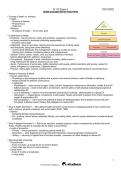
• Maslow’s Hierarchy of Needs
• Human needs theory
• Physiologic or psychological conditions that a person must meet to achieve a state of health or well being
• Needs motivate the behavior of the person
• 5 categories
• Physiological — basic survival (oxygen, fluids, nutrition, temperature maintenance, elimination, shelter & sex) EX
• Safety & security —need to feel safe in environment, need for safety in both physical & physiological aspects &
relationships EX
• Love & belonging — need for love encompasses both giving & receiving - attaining place in a group EX
• Self-esteem — independence, competence, & self-respect. Needs self esteem & esteem from others (recognition,
respect & appreciation) EX
• Self-actualization — one’s maximum potential & realize all abilities/qualities. Not all people become fully self-
actualized, & Maslow doesn’t believe that intelligence is required EX
• What is health promotion? — Who defined health promotion as the process of equipping people to have control over,
and to improve, physical, emotional. and social health (WHO, 1986)
• Barriers
• Unhealthy lifestyle choices/behaviors
• EX - smoking, alcohol abuse, sedentary lifestyle, poor eating habits, harmful coping mechanisms, substance abuse
& addiction
• What is disease Prevention? — Risk factor reduction, arrested progress, reduce consequences, activities that avoid
illness, Health protection is motivated by the desire to avoid illness
• Levels of prevention
• Primary — illness prevention, maintaining optimal health EX
• Secondary — early diagnosis & prompt intervention/treatment, slowed progression of disease EX
• Tertiary — returning to highest level of function possible - prevention of further disability or decline EX
• Recommended screenings
• Physical exam
• Every 3-5 years, up to age 40 (w/ no chronic illness)
• Yearly after age 40 (w/ no chronic illness)
• Dental exam
• Every 6 months w/ prophylaxis
• X-rays yearly
1
Downloaded by madiba South Africa stuvia https://www.stuvia.com/user/assistanthttps://www.stuvia.com/user/assistant
https://www.stuvia.com/user/assistanthttps://www.stuvia.com/user/assistant ()
https://www.stuvia.com/user/assistant
, lOMoARcPSD|44532475
https://www.stuvia.com/user/assistant https://www.stuvia.com/user/assistant https://www.stuvia.com/user/assistant
N 112 Exam 4 10/31/2022
• Eye exam
• Every 3-5 years, up to age 40
• Every 2 years after age 40
• ear exam
• Routine physical exam
• Testicular exam
• Monthly self exam beginning at age 15
• Routine health care visit beginning at 20
• Breast exam
• Monthly self exam beginning at age 20 (M & F)
• Clinical breast exam every 3 years until age 40 - annually exam &
mammogram after age 40
• Tuberculosis
• Mantoux TB skin test for those at high risk of exposure - health care workers, weak immune system, drug use
• Cardiovascular exam
• BP, HR, heart rhythm (part of routine physical exam unless risk factors present)
• Prevention — nutrition, exercise, stress management
• Diabetes exam
• Every 3 years if family HX
• Fasting blood glucose
• Colorectal exam
• Adults over 50
• Endoscopy, barium enema, fecal occult blood test, &/or digital rectum exam
• Depression screening
• Adolescents & older adults @ risk
• Use screen tool - Beck
• Reproductive exams
• Women
• Cervical cancer screen/HPV
• Annually once sexually active/beginning @ age 21
• Every 3 years after 30
• Men
• Prostate specific antigen (PSA) w/ or w/o DRE
• Annually starting @ age 50
• Testicular self exam
• Use both hands, grasp on testicle between dumb & index finger
• Roll testicle gently feeling for lumps or nodules — repeat w/ other
testicle
• If lump/nodule found - consult physician
NOTE: lump/nodule may not be result of disease but can only be
determined by physician
• Changes to assess during breast self exam
• Shape
• Size
• Contour
• Symmetry
• Skin discoloration
• Dimpling
• Bumps/lumps
• Sores/scaly skin
• Discharge/puckering nipple
• Hard, fixed, non tender
• Breast self exam techniques
• Patterns using circular motions
• Spiral
• Pie shaped wedges
• Up & down
2
Downloaded by madiba South Africa stuvia https://www.stuvia.com/user/assistanthttps://www.stuvia.com/user/assistant
https://www.stuvia.com/user/assistanthttps://www.stuvia.com/user/assistant ()
https://www.stuvia.com/user/assistant
, lOMoARcPSD|44532475
https://www.stuvia.com/user/assistant https://www.stuvia.com/user/assistant https://www.stuvia.com/user/assistant
N 112 Exam 4 10/31/2022
• Immunizations
• CDC guidelines
• Young children
• Older children
• Adults
Cardiac Assessment CH 13 & 15 - Standridge 10/10
• Arteries
• Carry freshly oxygenated blood
• High pressure — thick, elastic walls
• Pulse — all arteries have pressure wave - can only be felt where artery is close to skin & over
bone
• Temporal, carotid, brachial, radial, femoral, popliteal, posterior tibial, dorsalis pedis
• Grading
• 0
• 1+
• 2+
• 3+
• 4+
• Ischemia
• Deficient supply of oxygenated arterial blood to tissue (causing pain & dysfunction)
• Caused by obstruction of vessel
• Necrosis —death to tissue from lack of oxygen, irreversible
• Veins
• Parallel to arteries but closer to skin
• Drain deoxygenated blood & waste products from tissue & return it to RIGHT heart via VENA CAVA
• No pulse
• Blood moves by skeletal muscle contraction, inspiration, intraluminal valves (TCDB post op)
• Lymphatic system
• Protects & maintains internal fluid environment of the body
• Drain excess fluid & plasma proteins from tissue & returns it to blood stream
preventing edema
• Assists in immunity - lymphocytes produce antibodies
• Absorbs lipids from the intestinal tract into blood
• Aids to lymphatic system
• Spleen
• Tonsils
• Thymus gland
• Peyer’s patches
• Bone marrow
• Capillaries & fluid exchange
• Capillaries — connection between arterioles & venues
• Blood pressure (hyrdrostatic pressure) interstitial fluid/in capillaries —> tissues (releases O2, H2O & nutrients whole
picking up CO2)
• Osmotic pressure —> fluid reenters the capillaries maintaining fluid balance
• Review of systems
• Health Hx
• Past medical HX
• Family HX
• Psychosocial HX
• Medications
• Current health status
• Pain/tingling or numbness
• Edema or swelling
• Erectile dysfunction
3
Downloaded by madiba South Africa stuvia https://www.stuvia.com/user/assistanthttps://www.stuvia.com/user/assistant
https://www.stuvia.com/user/assistanthttps://www.stuvia.com/user/assistant ()
https://www.stuvia.com/user/assistant
, lOMoARcPSD|44532475
https://www.stuvia.com/user/assistant https://www.stuvia.com/user/assistant https://www.stuvia.com/user/assistant
N 112 Exam 4 10/31/2022
• Lymph node enlargement
• Skin change of extremities
• Inspection & palpation of CV system
• Overall view of skin color, hair distribution, edema, abnormal pulsations
• Gauge capillary filling time (w/in 3 sec)
• Palpate pulses for normal, bounding, thready or absent (0-3+)
• Thrill?
• Homan’s sign?
• Raynaud’s Syndrome
• Intermittent ischemic attacks of extremities (fingers, toes, ears & nose)
• Bilateral response to cold, vibration or stress (emotional stimuli)
• 1st white - arteriospasm
• 2nd blue - cyanosis as spasm response
• 3rd red - return of blood to capillaries
• May have numbness, tingling, pain, color & sensation restored w/ heat
• Leg inspection
• Both should be symmetrical w/o swelling or atrophy
• May need to measure calf muscle @ largest point for both legs
• Unilateral swelling = local problem - may be DVT
• Asymmetry of calves > 1 cm = abnormal
• Inspect & palpate
• Leg pain or cramps
• Claudication (limping) cramping w/ activity, distance- # of block/stairs that produces pain
• Edema — bilateral w/ CHF (systemic) unilateral w/ local obstruction or inflammation
• Skin color changes
• Brown discoloration occurs w/ chronic venous stasis due to hemosiderin deposits
• Venous stasis ulcers occur around medial malleous
• Arterial deficit triggers ulcers on tips of toes & may trigger unilateral cool feet or leg
• Palpate
• Homan’s sign — calf pain with dorsiflexion - may be due to DVT — don’t squeeze calf
• Palpate & grade the pulses
• Pitting edema — bilateral occurs w/ CHF, diabetic neuropathy, hepatic cirrhosis
• Deep vein thrombosis (DVT)
• Deep vein occluded by thrombus/clot
• Sudden onset, pain w/ dorsiflexion
• Positive Homan’s sign — accurate < ⅓ of time
• Risk for PE
• Lymphedema
• Damage or removal of lymph nodes impeded drainage of lymph
• Unilateral swelling, non pitting
• Aneurysm
• Usually caused by atherosclerosis which weakens lining the vessel
• Aorta — most common site
• Effects of BP causes ballooning of vessel
• More common in male & women over 70 & men over 55
• Landmarks to know
• Clavicle (MCL)
• Sternum (MSL)
• Axillary (AAL)
• Manubriosternal Angle (angle of Louis)
• Intercostal spaces (ICS)
4
Downloaded by madiba South Africa stuvia https://www.stuvia.com/user/assistanthttps://www.stuvia.com/user/assistant
https://www.stuvia.com/user/assistanthttps://www.stuvia.com/user/assistant ()
https://www.stuvia.com/user/assistant
https://www.stuvia.com/user/assistant https://www.stuvia.com/user/assistant https://www.stuvia.com/user/assistant
N 112 Exam 4 10/31/2022
Health promotion CH 42 - Hood 10/10
• Concept of health vs. wellness
• Health
• Absence of disease
• Physical focus
• Older term
• Wellness
• All aspects of health — mind, body, spirit
• 6 dimensions of health
• Emotional - Use of emotions, coping with problems, expression of emotions,
not being controlled by emotions (controlling appropriately)
• Emotions are energy!
• Intellectual - Open to new ideas, learning from life experiences, thinking clearly
and analytically, using brain power effectively
• Communicate effectively, time management, staying up to-date on issues,
learning from mistakes, considering options and consequences
• Spiritual - Ethics, values, morals, Love, joy, peace, fulfillment, Harmony/
balance Meaningful life, optimism, forgiveness
• Occupational - Enjoyment of work, contribution to society, ability to earn a
living, Work/home life balance, Choose a job you love!
• Social - Performance of social roles, skillful interactions with people, skillful interactions with society, respect for
others, willingness to compromise, Celebrate others!
• Physical - Eating right, exercise, avoiding harm, seeking medical care, responsible decisions, preventing illness
• Maslow’s Hierarchy of Needs
• Human needs theory
• Physiologic or psychological conditions that a person must meet to achieve a state of health or well being
• Needs motivate the behavior of the person
• 5 categories
• Physiological — basic survival (oxygen, fluids, nutrition, temperature maintenance, elimination, shelter & sex) EX
• Safety & security —need to feel safe in environment, need for safety in both physical & physiological aspects &
relationships EX
• Love & belonging — need for love encompasses both giving & receiving - attaining place in a group EX
• Self-esteem — independence, competence, & self-respect. Needs self esteem & esteem from others (recognition,
respect & appreciation) EX
• Self-actualization — one’s maximum potential & realize all abilities/qualities. Not all people become fully self-
actualized, & Maslow doesn’t believe that intelligence is required EX
• What is health promotion? — Who defined health promotion as the process of equipping people to have control over,
and to improve, physical, emotional. and social health (WHO, 1986)
• Barriers
• Unhealthy lifestyle choices/behaviors
• EX - smoking, alcohol abuse, sedentary lifestyle, poor eating habits, harmful coping mechanisms, substance abuse
& addiction
• What is disease Prevention? — Risk factor reduction, arrested progress, reduce consequences, activities that avoid
illness, Health protection is motivated by the desire to avoid illness
• Levels of prevention
• Primary — illness prevention, maintaining optimal health EX
• Secondary — early diagnosis & prompt intervention/treatment, slowed progression of disease EX
• Tertiary — returning to highest level of function possible - prevention of further disability or decline EX
• Recommended screenings
• Physical exam
• Every 3-5 years, up to age 40 (w/ no chronic illness)
• Yearly after age 40 (w/ no chronic illness)
• Dental exam
• Every 6 months w/ prophylaxis
• X-rays yearly
1
Downloaded by madiba South Africa stuvia https://www.stuvia.com/user/assistanthttps://www.stuvia.com/user/assistant
https://www.stuvia.com/user/assistanthttps://www.stuvia.com/user/assistant ()
https://www.stuvia.com/user/assistant
, lOMoARcPSD|44532475
https://www.stuvia.com/user/assistant https://www.stuvia.com/user/assistant https://www.stuvia.com/user/assistant
N 112 Exam 4 10/31/2022
• Eye exam
• Every 3-5 years, up to age 40
• Every 2 years after age 40
• ear exam
• Routine physical exam
• Testicular exam
• Monthly self exam beginning at age 15
• Routine health care visit beginning at 20
• Breast exam
• Monthly self exam beginning at age 20 (M & F)
• Clinical breast exam every 3 years until age 40 - annually exam &
mammogram after age 40
• Tuberculosis
• Mantoux TB skin test for those at high risk of exposure - health care workers, weak immune system, drug use
• Cardiovascular exam
• BP, HR, heart rhythm (part of routine physical exam unless risk factors present)
• Prevention — nutrition, exercise, stress management
• Diabetes exam
• Every 3 years if family HX
• Fasting blood glucose
• Colorectal exam
• Adults over 50
• Endoscopy, barium enema, fecal occult blood test, &/or digital rectum exam
• Depression screening
• Adolescents & older adults @ risk
• Use screen tool - Beck
• Reproductive exams
• Women
• Cervical cancer screen/HPV
• Annually once sexually active/beginning @ age 21
• Every 3 years after 30
• Men
• Prostate specific antigen (PSA) w/ or w/o DRE
• Annually starting @ age 50
• Testicular self exam
• Use both hands, grasp on testicle between dumb & index finger
• Roll testicle gently feeling for lumps or nodules — repeat w/ other
testicle
• If lump/nodule found - consult physician
NOTE: lump/nodule may not be result of disease but can only be
determined by physician
• Changes to assess during breast self exam
• Shape
• Size
• Contour
• Symmetry
• Skin discoloration
• Dimpling
• Bumps/lumps
• Sores/scaly skin
• Discharge/puckering nipple
• Hard, fixed, non tender
• Breast self exam techniques
• Patterns using circular motions
• Spiral
• Pie shaped wedges
• Up & down
2
Downloaded by madiba South Africa stuvia https://www.stuvia.com/user/assistanthttps://www.stuvia.com/user/assistant
https://www.stuvia.com/user/assistanthttps://www.stuvia.com/user/assistant ()
https://www.stuvia.com/user/assistant
, lOMoARcPSD|44532475
https://www.stuvia.com/user/assistant https://www.stuvia.com/user/assistant https://www.stuvia.com/user/assistant
N 112 Exam 4 10/31/2022
• Immunizations
• CDC guidelines
• Young children
• Older children
• Adults
Cardiac Assessment CH 13 & 15 - Standridge 10/10
• Arteries
• Carry freshly oxygenated blood
• High pressure — thick, elastic walls
• Pulse — all arteries have pressure wave - can only be felt where artery is close to skin & over
bone
• Temporal, carotid, brachial, radial, femoral, popliteal, posterior tibial, dorsalis pedis
• Grading
• 0
• 1+
• 2+
• 3+
• 4+
• Ischemia
• Deficient supply of oxygenated arterial blood to tissue (causing pain & dysfunction)
• Caused by obstruction of vessel
• Necrosis —death to tissue from lack of oxygen, irreversible
• Veins
• Parallel to arteries but closer to skin
• Drain deoxygenated blood & waste products from tissue & return it to RIGHT heart via VENA CAVA
• No pulse
• Blood moves by skeletal muscle contraction, inspiration, intraluminal valves (TCDB post op)
• Lymphatic system
• Protects & maintains internal fluid environment of the body
• Drain excess fluid & plasma proteins from tissue & returns it to blood stream
preventing edema
• Assists in immunity - lymphocytes produce antibodies
• Absorbs lipids from the intestinal tract into blood
• Aids to lymphatic system
• Spleen
• Tonsils
• Thymus gland
• Peyer’s patches
• Bone marrow
• Capillaries & fluid exchange
• Capillaries — connection between arterioles & venues
• Blood pressure (hyrdrostatic pressure) interstitial fluid/in capillaries —> tissues (releases O2, H2O & nutrients whole
picking up CO2)
• Osmotic pressure —> fluid reenters the capillaries maintaining fluid balance
• Review of systems
• Health Hx
• Past medical HX
• Family HX
• Psychosocial HX
• Medications
• Current health status
• Pain/tingling or numbness
• Edema or swelling
• Erectile dysfunction
3
Downloaded by madiba South Africa stuvia https://www.stuvia.com/user/assistanthttps://www.stuvia.com/user/assistant
https://www.stuvia.com/user/assistanthttps://www.stuvia.com/user/assistant ()
https://www.stuvia.com/user/assistant
, lOMoARcPSD|44532475
https://www.stuvia.com/user/assistant https://www.stuvia.com/user/assistant https://www.stuvia.com/user/assistant
N 112 Exam 4 10/31/2022
• Lymph node enlargement
• Skin change of extremities
• Inspection & palpation of CV system
• Overall view of skin color, hair distribution, edema, abnormal pulsations
• Gauge capillary filling time (w/in 3 sec)
• Palpate pulses for normal, bounding, thready or absent (0-3+)
• Thrill?
• Homan’s sign?
• Raynaud’s Syndrome
• Intermittent ischemic attacks of extremities (fingers, toes, ears & nose)
• Bilateral response to cold, vibration or stress (emotional stimuli)
• 1st white - arteriospasm
• 2nd blue - cyanosis as spasm response
• 3rd red - return of blood to capillaries
• May have numbness, tingling, pain, color & sensation restored w/ heat
• Leg inspection
• Both should be symmetrical w/o swelling or atrophy
• May need to measure calf muscle @ largest point for both legs
• Unilateral swelling = local problem - may be DVT
• Asymmetry of calves > 1 cm = abnormal
• Inspect & palpate
• Leg pain or cramps
• Claudication (limping) cramping w/ activity, distance- # of block/stairs that produces pain
• Edema — bilateral w/ CHF (systemic) unilateral w/ local obstruction or inflammation
• Skin color changes
• Brown discoloration occurs w/ chronic venous stasis due to hemosiderin deposits
• Venous stasis ulcers occur around medial malleous
• Arterial deficit triggers ulcers on tips of toes & may trigger unilateral cool feet or leg
• Palpate
• Homan’s sign — calf pain with dorsiflexion - may be due to DVT — don’t squeeze calf
• Palpate & grade the pulses
• Pitting edema — bilateral occurs w/ CHF, diabetic neuropathy, hepatic cirrhosis
• Deep vein thrombosis (DVT)
• Deep vein occluded by thrombus/clot
• Sudden onset, pain w/ dorsiflexion
• Positive Homan’s sign — accurate < ⅓ of time
• Risk for PE
• Lymphedema
• Damage or removal of lymph nodes impeded drainage of lymph
• Unilateral swelling, non pitting
• Aneurysm
• Usually caused by atherosclerosis which weakens lining the vessel
• Aorta — most common site
• Effects of BP causes ballooning of vessel
• More common in male & women over 70 & men over 55
• Landmarks to know
• Clavicle (MCL)
• Sternum (MSL)
• Axillary (AAL)
• Manubriosternal Angle (angle of Louis)
• Intercostal spaces (ICS)
4
Downloaded by madiba South Africa stuvia https://www.stuvia.com/user/assistanthttps://www.stuvia.com/user/assistant
https://www.stuvia.com/user/assistanthttps://www.stuvia.com/user/assistant ()
https://www.stuvia.com/user/assistant