2024
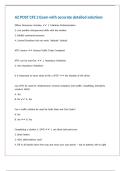
AANP Practice Exam Questions
& 100% Accurate Solutions
(Rated A+)
Conceptial Research ||
, AANP Practice Exam Questions & 100%
Accurate Solutions (Rated A+)
The medication of choice for the initial treatment of juvenile rheumatoid arthritis is:
1. acetaminophen.
2. prednisone.
3. aspirin.
4. ibuprofen. - ANSWER - ibuprofen
A 12-year-old with sickle cell anemia has recently experienced a sickle cell crisis and
presents for a follow-up examination after a recent hospitalization. It is most important to
continue monitoring growth, development, and:
1. white blood cell levels.
2. fecal occult blood test.
3. hemoglobin levels.
4. urine dipsticks. - ANSWER - hemoglobin levels
A 90-year-old female is brought to the clinic by her neighbor. She states that everything
is fine, but the nurse practitioner notes that she has poor hygiene and bruises on her
trunk. The neighbor is concerned that the patient often has no money to buy food,
despite income from social security and a coal miner's pension. The nurse practitioner
suspects abuse. Which of the following is the nurse practitioner obligated to do next?
1. Report the case to the proper authorities.
2. Tell the neighbor to check on the woman daily and report back.
3. Document the data and report the information to risk management.
4. Call the patient's family and inquire about the concerns. - ANSWER - report the case
to proper authorities
In most cases, the first manifestation of Alzheimer's disease is:
1. impaired judgment.
2. decrease in short-term memory.
3. disorientation in time and place.
4. decrease in long-term memory. - ANSWER - decrease in short-term memory
The optimal treatment for latent tuberculosis is:
1. rifampin (Rifadin) for 5 months.
2. isoniazid (Nydrazid) for 9 months.
3. pyrazinamide for 6 months.
4. ethambutol for 6 months. - ANSWER - osioniazid (nydrazid) for 9 months
, Unilateral spontaneous serous or serosanguineous discharge from a single duct of a
breast is most often caused by:
1. intraductal papilloma.
2. mucinous breast lesions.
3. Paget's disease.
4. ductal carcinoma in situ. - ANSWER - intraductal papilloma
A young child with asthma presents for follow-up evaluation. After numerous changes in
medications and doses, the parents report that the child continues to have difficulty with
coughing, especially during the night. Which of the following conditions would be the
most likely cause of the continued asthma symptoms?
1. Vocal cord dysfunction
2. Cystic fibrosis
3. Gastroesophageal reflux
4. Allergic rhinitis - ANSWER - gastroesophageal reflux
A pregnant woman with known HIV infection can reduce the risk of perinatal
transmission through zidovudine (Retrovir) therapy. Based on current research, optimal
therapy is to start daily dosing:
1. post amniocentesis.
2. after 14 weeks of gestation.
3. if premature rupture of membranes occurs.
4. if maternal viral loads are greater than 10,000. - ANSWER - after 14 weeks gestation
T-wave inversion with a normal ST segment on a 12-lead EKG may represent:
1. acute coronary ischemia.
2. right ventricular hypertrophy.
3. atrial hypertrophy.
4. hyperkalemia. - ANSWER - acute coronary ischemia
A 65-year-old woman presents for a follow-up examination after a new patient visit. She
has not seen a healthcare provider for several years. She is a smoker and her
hypertension is now adequately controlled with medication. Her mother died at age 40
from a heart attack. The fasting lipid profile shows cholesterol = 240 mg/dL, HDL = 30,
and LDL = 200. In addition to starting Therapeutic Lifestyle Changes, the nurse
practitioner should start the patient on:
1.bile acid sequestrant.
2. a statin drug.
3. a cholesterol absorption inhibitor.
4. low-dose aspirin. - ANSWER - A statin drug
AANP Practice Exam Questions
& 100% Accurate Solutions
(Rated A+)
Conceptial Research ||
, AANP Practice Exam Questions & 100%
Accurate Solutions (Rated A+)
The medication of choice for the initial treatment of juvenile rheumatoid arthritis is:
1. acetaminophen.
2. prednisone.
3. aspirin.
4. ibuprofen. - ANSWER - ibuprofen
A 12-year-old with sickle cell anemia has recently experienced a sickle cell crisis and
presents for a follow-up examination after a recent hospitalization. It is most important to
continue monitoring growth, development, and:
1. white blood cell levels.
2. fecal occult blood test.
3. hemoglobin levels.
4. urine dipsticks. - ANSWER - hemoglobin levels
A 90-year-old female is brought to the clinic by her neighbor. She states that everything
is fine, but the nurse practitioner notes that she has poor hygiene and bruises on her
trunk. The neighbor is concerned that the patient often has no money to buy food,
despite income from social security and a coal miner's pension. The nurse practitioner
suspects abuse. Which of the following is the nurse practitioner obligated to do next?
1. Report the case to the proper authorities.
2. Tell the neighbor to check on the woman daily and report back.
3. Document the data and report the information to risk management.
4. Call the patient's family and inquire about the concerns. - ANSWER - report the case
to proper authorities
In most cases, the first manifestation of Alzheimer's disease is:
1. impaired judgment.
2. decrease in short-term memory.
3. disorientation in time and place.
4. decrease in long-term memory. - ANSWER - decrease in short-term memory
The optimal treatment for latent tuberculosis is:
1. rifampin (Rifadin) for 5 months.
2. isoniazid (Nydrazid) for 9 months.
3. pyrazinamide for 6 months.
4. ethambutol for 6 months. - ANSWER - osioniazid (nydrazid) for 9 months
, Unilateral spontaneous serous or serosanguineous discharge from a single duct of a
breast is most often caused by:
1. intraductal papilloma.
2. mucinous breast lesions.
3. Paget's disease.
4. ductal carcinoma in situ. - ANSWER - intraductal papilloma
A young child with asthma presents for follow-up evaluation. After numerous changes in
medications and doses, the parents report that the child continues to have difficulty with
coughing, especially during the night. Which of the following conditions would be the
most likely cause of the continued asthma symptoms?
1. Vocal cord dysfunction
2. Cystic fibrosis
3. Gastroesophageal reflux
4. Allergic rhinitis - ANSWER - gastroesophageal reflux
A pregnant woman with known HIV infection can reduce the risk of perinatal
transmission through zidovudine (Retrovir) therapy. Based on current research, optimal
therapy is to start daily dosing:
1. post amniocentesis.
2. after 14 weeks of gestation.
3. if premature rupture of membranes occurs.
4. if maternal viral loads are greater than 10,000. - ANSWER - after 14 weeks gestation
T-wave inversion with a normal ST segment on a 12-lead EKG may represent:
1. acute coronary ischemia.
2. right ventricular hypertrophy.
3. atrial hypertrophy.
4. hyperkalemia. - ANSWER - acute coronary ischemia
A 65-year-old woman presents for a follow-up examination after a new patient visit. She
has not seen a healthcare provider for several years. She is a smoker and her
hypertension is now adequately controlled with medication. Her mother died at age 40
from a heart attack. The fasting lipid profile shows cholesterol = 240 mg/dL, HDL = 30,
and LDL = 200. In addition to starting Therapeutic Lifestyle Changes, the nurse
practitioner should start the patient on:
1.bile acid sequestrant.
2. a statin drug.
3. a cholesterol absorption inhibitor.
4. low-dose aspirin. - ANSWER - A statin drug