1
Representing Tangent Spaces of Manifolds
Let 𝑀 ⊆ ℝ𝑛 be a 𝑘-dimensional manifold and ⃗Φ
⃗⃗ a parametrization where
⃗Φ
⃗⃗ : 𝑈 ⊆ ℝ𝑘 → 𝑀 ⊆ ℝ𝑛 and ⃗Φ
⃗⃗ (𝑎 ) = 𝑥 ∈ 𝑀. We know that:
⃗⃗⃗ (𝑎 ): ℝ𝑘𝑎 → ℝ𝑛𝑥 .
𝐷Φ
⃗⃗ (ℝ𝑘𝑎 ) = 𝑇𝑥 (𝑀) the tangent space of 𝑴 at 𝒙. In fact this definition does
We call 𝐷Φ
⃗⃗ .
not depends on the parametrization of Φ
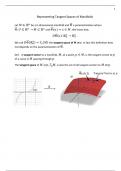
Def. A tangent vector to a manifold, 𝑀, at a point, 𝑝 ∈ 𝑀, is the tangent vector at 𝑝
of a curve in 𝑀 passing through 𝑝.
The tangent space of 𝑀 at 𝑝, 𝑇𝑝 𝑀, is also the set of all tangent vectors to 𝑀 at 𝑝.
⃗Φ
⃗ (𝛾(𝑡)) Tangent Vector at 𝑝
𝑀
, 2
Ex. Find an equation of the tangent space (i.e. plane) to the unit sphere
1 1 √2
𝑥 2 + 𝑦 2 + 𝑧 2 = 1 at the point (2 , 2 , ).
2
We first need to find a parametrization of the unit sphere, it doesn’t matter which one
1 1 √2
we use, and the point that gets mapped to ( , , ).
2 2 2
Let’s use the parametrization ⃗Φ
⃗ (𝑢, 𝑣 ) = (𝑢, 𝑣, √1 − 𝑢2 − 𝑣 2 ).
1 1 1 1 √2
Clearly 𝑢 = , 𝑣 = gets mapped to ( , , ).
2 2 2 2 2
1 1
By the definition of the tangent space, it is the image of ℝ 21 1 under 𝐷Φ
⃗⃗ ( , ). So
( , ) 2 2
22
1 1
⃗⃗ ( , ) of the basis vectors (1, 0) and
we just need to find the image under 𝐷Φ
2 2
(0, 1) for ℝ 21 1 .
(2,2)
𝜕𝑥 𝜕𝑥
𝜕𝑢 𝜕𝑣 1 0
𝜕𝑦 𝜕𝑦 0 1
⃗⃗ (𝑢, 𝑣 ) =
𝐷Φ = (⃗Φ
⃗⃗ 𝑢 ⃗Φ
⃗⃗ 𝑣 ) = ( )
𝜕𝑢 𝜕𝑣 −𝑢 −𝑣
𝜕𝑧 𝜕𝑧 √1−𝑢2−𝑣 2 √1−𝑢2−𝑣 2
(𝜕𝑢 𝜕𝑣 )
1 0
⃗⃗⃗ (1 , 1) = ( 0
𝐷Φ 1 ).
2 2 −√2 −√2
2 2
Representing Tangent Spaces of Manifolds
Let 𝑀 ⊆ ℝ𝑛 be a 𝑘-dimensional manifold and ⃗Φ
⃗⃗ a parametrization where
⃗Φ
⃗⃗ : 𝑈 ⊆ ℝ𝑘 → 𝑀 ⊆ ℝ𝑛 and ⃗Φ
⃗⃗ (𝑎 ) = 𝑥 ∈ 𝑀. We know that:
⃗⃗⃗ (𝑎 ): ℝ𝑘𝑎 → ℝ𝑛𝑥 .
𝐷Φ
⃗⃗ (ℝ𝑘𝑎 ) = 𝑇𝑥 (𝑀) the tangent space of 𝑴 at 𝒙. In fact this definition does
We call 𝐷Φ
⃗⃗ .
not depends on the parametrization of Φ
Def. A tangent vector to a manifold, 𝑀, at a point, 𝑝 ∈ 𝑀, is the tangent vector at 𝑝
of a curve in 𝑀 passing through 𝑝.
The tangent space of 𝑀 at 𝑝, 𝑇𝑝 𝑀, is also the set of all tangent vectors to 𝑀 at 𝑝.
⃗Φ
⃗ (𝛾(𝑡)) Tangent Vector at 𝑝
𝑀
, 2
Ex. Find an equation of the tangent space (i.e. plane) to the unit sphere
1 1 √2
𝑥 2 + 𝑦 2 + 𝑧 2 = 1 at the point (2 , 2 , ).
2
We first need to find a parametrization of the unit sphere, it doesn’t matter which one
1 1 √2
we use, and the point that gets mapped to ( , , ).
2 2 2
Let’s use the parametrization ⃗Φ
⃗ (𝑢, 𝑣 ) = (𝑢, 𝑣, √1 − 𝑢2 − 𝑣 2 ).
1 1 1 1 √2
Clearly 𝑢 = , 𝑣 = gets mapped to ( , , ).
2 2 2 2 2
1 1
By the definition of the tangent space, it is the image of ℝ 21 1 under 𝐷Φ
⃗⃗ ( , ). So
( , ) 2 2
22
1 1
⃗⃗ ( , ) of the basis vectors (1, 0) and
we just need to find the image under 𝐷Φ
2 2
(0, 1) for ℝ 21 1 .
(2,2)
𝜕𝑥 𝜕𝑥
𝜕𝑢 𝜕𝑣 1 0
𝜕𝑦 𝜕𝑦 0 1
⃗⃗ (𝑢, 𝑣 ) =
𝐷Φ = (⃗Φ
⃗⃗ 𝑢 ⃗Φ
⃗⃗ 𝑣 ) = ( )
𝜕𝑢 𝜕𝑣 −𝑢 −𝑣
𝜕𝑧 𝜕𝑧 √1−𝑢2−𝑣 2 √1−𝑢2−𝑣 2
(𝜕𝑢 𝜕𝑣 )
1 0
⃗⃗⃗ (1 , 1) = ( 0
𝐷Φ 1 ).
2 2 −√2 −√2
2 2