ACS ANALYTICAL CHEMISTRY GUIDE
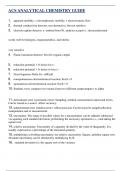
1. apparent mobility: = electrophoretic mobility + electroosmotic flow
2. thermal conductivity detector: non destructive, but not sensitive
3. electron capture detector: e- emitted from Ni, analyter accepts e-, decreasedcurrent
works well for halogens, organometallics, and nitriles
very sensitive
4. Flame ionization detector: best for organic cmpds
5. reduction potential > 0: desire for e-
6. reduction potential < 0: desire to lose e-
7. Nerst Equation: Delta G= -nFEcell
8. nonspontaneous electrochemical reaction: Ecell < 0
9. spontaneous electrochemical reaction: Ecell > 0
10. Students t test: compares two means from two different sampcompare t to alpha
11. determinate error (systematic error): Sampling, method, measurement orpersonal errors.
Can be traced to a source. Affect accuracy.
12. indeterminate error (random error): Affect precision. Can be traced to samplecollection,
manipulation and or measurement.
13. uncertainty: The range of possible values for a measurement. can be addedor subtracted
via squaring each standard deviation, performing the necessary operations (+,-) and taking the
square root.
14. relative uncertainty: Uncertainty of a quantity divided by the value of thequantity. It is
usually expressed as a percentage of the measured quantity.
15. multiplying or dividing uncertainty: use relative uncertainty. Square, add,then square root.
Absolute uncertainty can be obtained by multiplying by R.
16. standard deviation (s): the square root of the variance
1. apparent mobility: = electrophoretic mobility + electroosmotic flow
2. thermal conductivity detector: non destructive, but not sensitive
3. electron capture detector: e- emitted from Ni, analyter accepts e-, decreasedcurrent
works well for halogens, organometallics, and nitriles
very sensitive
4. Flame ionization detector: best for organic cmpds
5. reduction potential > 0: desire for e-
6. reduction potential < 0: desire to lose e-
7. Nerst Equation: Delta G= -nFEcell
8. nonspontaneous electrochemical reaction: Ecell < 0
9. spontaneous electrochemical reaction: Ecell > 0
10. Students t test: compares two means from two different sampcompare t to alpha
11. determinate error (systematic error): Sampling, method, measurement orpersonal errors.
Can be traced to a source. Affect accuracy.
12. indeterminate error (random error): Affect precision. Can be traced to samplecollection,
manipulation and or measurement.
13. uncertainty: The range of possible values for a measurement. can be addedor subtracted
via squaring each standard deviation, performing the necessary operations (+,-) and taking the
square root.
14. relative uncertainty: Uncertainty of a quantity divided by the value of thequantity. It is
usually expressed as a percentage of the measured quantity.
15. multiplying or dividing uncertainty: use relative uncertainty. Square, add,then square root.
Absolute uncertainty can be obtained by multiplying by R.
16. standard deviation (s): the square root of the variance